Emil Vorgens
WatchmenEmil Vorgens is the young Star Watch officer at the center of the opening military crisis on Oran VI, where his first official assignment grows into a decisive examination of loyalty, authority, and responsibility. He begins as a small, uncertain junior officer rereading his orders, but the campaign forces him to interpret commands rather than merely receive them, reject both rebellion and empty militarism, assume command in an emergency, and finally recognize that effective leadership may require relinquishing power.
Identity and Introduction
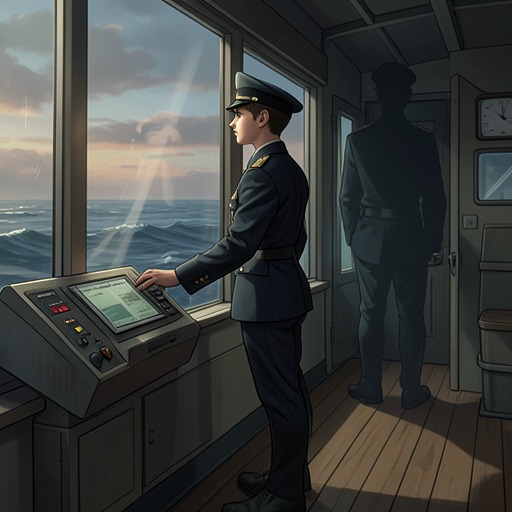
Emil Vorgens sits alone in a tiny compartment aboard a starship, rereading his orders for the tenth time. He has only just become a full-fledged officer of the Star Watch: school is finished, his commission is safely stored in his travel kit, and his first official mission exists on a strip of plastic film. The order sends him to Oran VI to assist the Imperial Governor in dealing with dissident elements of the native population. His first appearance therefore combines professional pride with apprehension. He is not yet an established commander, but a young officer confronting the distance between institutional language and the disorder awaiting him in the field.
Vorgens’ appearance immediately marks him as culturally distinct from the Terrans around him. He is small and wiry, with golden-brown skin, coppery hair, a thin fine-boned face, and a high forehead that gives him a notably babyish look. Brigadier Aikens, by contrast, is a towering Terran who outweighs Vorgens by half again and cultivates the image of a flamboyant, daring leader. Their visual contrast also signals a difference in authority: Aikens wears the Imperial Marines’ green, red, and gold semi-dress uniform, while Vorgens wears the standard black-and-silver uniform of the Star Watch. The young officer enters the story looking physically unimposing, but the narrative repeatedly places him in situations where judgment matters more than display.
Duty, Allegiance, and Moral Position
Vorgens’ loyalty is complicated by his ancestry. When Merdon urges him to join the Shinarian rebels, he acknowledges that he is not a native Terran and that his own people once fought against the Terrans. He nevertheless insists that they have become so thoroughly part of the Empire that they could not establish an independent nation even if they wished to. More importantly, he identifies himself as a sworn Star Watch officer who cannot turn his back on his word or fight against men with whom he has served.
This refusal is not presented as simple submission to imperial power. When Merdon accuses him of hiding behind duty, Vorgens concedes that the accusation may contain some truth, then argues that destroying the Empire would plunge the peoples under Terran rule into chaos and starvation. His position is pragmatic and ethically uneasy: he recognizes that the Empire may appear evil and arbitrary to the Shinarians, yet fears that revolutionary destruction would inflict immediate suffering on the same populations seeking freedom. Vorgens therefore stands between formal legality and anti-imperial resistance, unable to accept either the rebels’ absolute indictment or the Empire’s authority as morally self-justifying.
His judgment is tested again when he becomes a prisoner of the Komani. Okatar Kang identifies him as the Terran prisoner who attempted to escape and invokes the Komani custom that prisoners who reject their hospitality are traditionally executed. The threat reduces a complicated political conflict to a stark question of imposed rules and survival. Vorgens’ earlier commitment to duty is thus not an abstract creed: he has to maintain his sense of identity while being classified as an enemy by one power and distrusted by another.
From Junior Officer to Commander
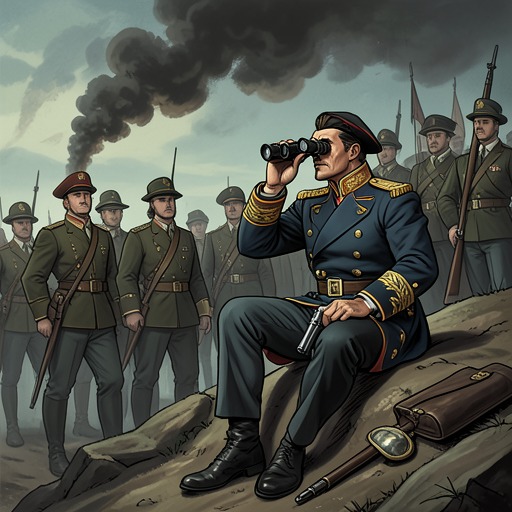
Vorgens’ most consequential institutional action occurs aboard the Mobile Force ship when he enters Aikens’ compartment with the executive officer while Sergeant McIntyre waits in the passageway. Aikens is in full-dress uniform and buckling ornate pistols across his middle; he reacts angrily, having already ordered Vorgens to stay out of his sight. Vorgens answers quietly that Brigadier Aikens is relieved of duty and that he is assuming command of the Mobile Force. The contrast is exact: Aikens prepares himself for command as theatrical presence, while Vorgens exercises command through a precise declaration of responsibility. Aikens is left speechless, unable even to answer the transfer of authority.
The transition has been prepared by Vorgens’ insistence that orders must be interpreted in circumstances the issuing headquarters cannot fully know. Aikens calls him in specifically to hear how he understands his orders, pointing out that he has been with the Mobile Force for only two days. Vorgens initially sees little to interpret, but the exchange exposes the central problem of his mission: an order written at Star Watch Headquarters cannot automatically resolve a local military and political emergency. His development begins when he learns that obedience includes judgment about purpose, timing, and consequence.
As acting commander, Vorgens recognizes that the Mobile Force alone cannot defeat the Komani on Shinar. It can defend itself, but Okatar Kang may ravage the planet before reinforcements arrive. He therefore proposes cooperation to the Shinarian leadership, represented in the cited exchange by Clanthas. Vorgens argues that Okatar has a single strategic weakness: he must win on Shinar quickly and decisively. If the Shinarians hold him at bay, frustrate him, and keep him off balance, the other Komani clans may refuse to join him, and even his own people may tire of a fruitless war. The plan turns military weakness into political leverage and makes time itself a weapon.
Vorgens frames the choice without disguising its stakes. The Shinarians can fight for their world alongside the Terrans against the Komani, or allow the Komani to seize the planet as a springboard for a galactic war. His appeal does not erase the Empire’s record or convert the Shinarians into passive imperial subjects. Instead, it asks former enemies to cooperate against a more immediate threat while preserving their own agency. This is the first clear sign that Vorgens’ leadership exceeds the narrow role assigned by his original orders.
Relationships and Conflicts
Vorgens’ relationship with Aikens is shaped by a clash between inherited rank and demonstrated competence. Aikens is older, physically imposing, publicly flamboyant, and accustomed to projecting daring authority. Vorgens is younger, smaller, and initially subordinate, yet he is the one who reads the strategic situation without reducing it to bravado. Their confrontation exposes the difference between looking like a commander and accepting the consequences of command. Vorgens does not defeat Aikens through physical force or spectacle; he displaces him by taking responsibility when the existing commander can no longer provide it.
His encounter with Merdon and Sittas reveals a different conflict. Merdon sees Vorgens’ non-Terran origin as a possible bridge between the Empire and its opponents and asks him to help free Shinar, even imagining the destruction of the Empire and the liberation of Vorgens’ own people. Vorgens refuses because his identity is no longer organized around ancestral separation. He regards citizenship, service, and a sworn word as binding realities. Yet his explanation also shows that he hears the rebels’ indictment. He does not deny the Empire’s wrongdoing; he disputes the claim that its destruction would necessarily produce freedom rather than catastrophe.
Okatar Kang functions as the opposing model of command. Whereas Vorgens seeks to contain war through patience, alliance, and a calculated defense, Okatar needs rapid and decisive victory. The Komani leader’s strategy makes him dangerous precisely because his political legitimacy depends on momentum. Vorgens’ answer is not to imitate that drive but to interrupt it. By identifying the enemy’s dependence on speed and glory, he treats military command as an analysis of political psychology as well as battlefield strength.
Change, Departure, and Narrative Significance
Vorgens’ arc does not culminate in permanent possession of authority. After the crisis on Shinar, he decides to leave. He reasons that Star Watch officers are aboard the ships carrying reinforcements and that any one of them would be better qualified to command the Imperial forces there. Others object that those officers will not understand the local situation as he does and that the people of Shinar will not trust a total stranger. Vorgens can answer only by asking what else he can do. The decision is an inversion of the conventional heroic return: the officer who has earned command refuses to mistake temporary necessity for personal entitlement.
His departure gives his leadership an ethical limit. He has assumed authority when Aikens failed, built a strategy around Shinarian cooperation, and helped create the conditions under which a larger force can continue the struggle. But he does not convert that achievement into a claim to rule. The same sense of duty that once kept him from joining the rebellion now prevents him from treating local trust and battlefield success as a license to remain indefinitely. His willingness to step aside suggests that command, for Vorgens, is a burden to be discharged rather than a prize to be retained.
Vorgens’ importance lies in the tension he embodies between imperial order and the lived realities that order cannot fully control. He is an outsider by ancestry, an insider by citizenship, a subordinate who becomes a commander, and a commander who ultimately withdraws. The plot uses his small physical presence and youthful appearance against the spectacle of military authority: his decisive strength is interpretive. He reads defective orders, conflicting loyalties, enemy customs, strategic time, and the political needs of a people who do not naturally trust him. His story gives the opening conflict its central question—whether loyalty can remain ethical when institutions are unjust—and answers it not with rebellion or unquestioning obedience, but with accountable action, restraint, and the readiness to surrender power once its immediate purpose has been served.