Kor
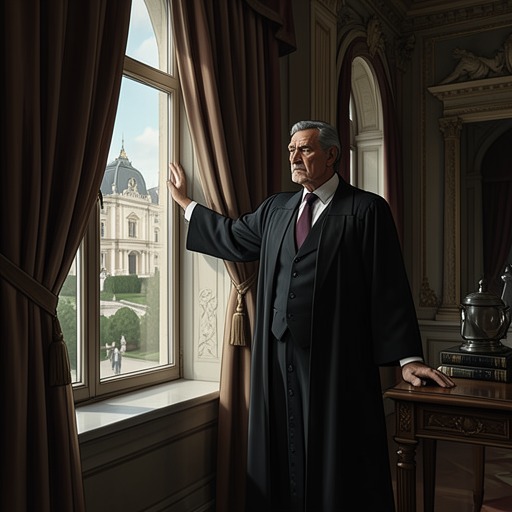
WatchmenKor is the head of Intelligence in the Kerak regime and, technically, Emil Vorgens’s superior. He is the quiet man among the officials surrounding Odal, but his silence is not passivity: his few words are feared, his capacity for cruelty is described as unfathomed, and his power comes from knowing more than anyone else is allowed to know. Through Kor, political authority becomes a system of observation, secrecy, and controlled violence rather than merely a matter of rank.
Identity and Political Position
Kor appears in the ruling circle as a withdrawn and formidable official. While other men expose themselves through appetite, ambition, or military grievance, he sits apart, silent and watchful. His position as head of Intelligence gives him institutional power, while his technical superiority over Odal places the trained telepath inside a chain of command that Kor controls. The contrast is important: Odal possesses unusual abilities, but Kor decides when those abilities will be used and what political purpose they will serve.
Kor’s authority is also psychological. The narrative associates his speech with terror for those whom he opposes, suggesting that intimidation is not an accidental by-product of his office but one of its operating methods. He does not need to display anger constantly. His restraint makes each intervention more ominous, because his decisions seem to emerge from an inaccessible design rather than from an impulse that others can anticipate.
The Hidden Plan and the Use of Odal
Kor treats Odal’s duel with the Watchman as a strategic matter, not a personal contest. After speaking with the Leader, he tells Odal that the plan has been adjusted: following Odal’s next duel, Dr. Leoh will be his opponent, and Leoh is to be the next man killed. The announcement turns the dueling system into an instrument of political assassination. What appears publicly as a regulated contest is, under Kor’s direction, a sequence of targets selected by the regime.
When Kanus expresses a personal desire to meet the Watchman again, Kor rejects that motive as irrelevant. He identifies the Watchman as an inept opponent who nevertheless destroyed the primary plan for defeating Acquatainia, then assigns the decisive blame to Leoh, whom he calls the meddler who must be removed. Kor’s reasoning reveals his characteristic logic: individuals matter only as obstacles or assets within a larger operation. The Watchman’s insult to Kanus is insignificant beside the strategic damage caused by Leoh’s intervention.
Kor refuses to disclose the nature of his larger plan. He tells Odal that even Odal cannot understand it because Kor has revealed it to no one except the Leader, and that he will continue to tell no one until disclosure becomes necessary. This secrecy gives Kor a distinctive form of power. Information is not merely something he possesses; it is something he rations, using uncertainty to keep subordinates dependent and to prevent resistance from forming around a shared understanding.
Surveillance, Secrecy, and the Dueling Machine
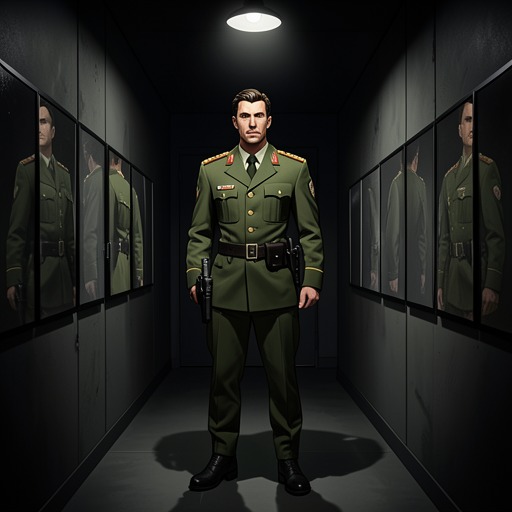
Kor’s influence extends into the technological spaces surrounding the dueling machine. When an enterprising newsman seeks an interview with Leoh at the machine, Hector accompanies the Professor. Later, Hector follows an unmistakable Odal through a corridor and enters a dark room filled with rows of life-sized tri-di viewscreens, each beside control and monitoring equipment. The room may be a tape-viewing or editing room, but its immediate function is surveillance: screens, desks, and controls transform observation into an organized institutional practice.
Kor’s presence is felt even where he is not physically visible. The monitored rooms, the dueling machine, Odal’s role as a trained telepath, and the Intelligence apparatus form a single environment in which people can be watched, tested, targeted, and interpreted. The technology does not replace Kor’s judgment; it enlarges it. The room’s darkness and its rows of screens create a visual counterpart to his hidden plan, keeping the machinery of knowledge present while concealing who controls the information it produces.
The same system becomes overtly coercive when Hector is discovered. White-helmeted guards rush into the chamber with guns, while a high viewscreen displays a furious bald man ordering them to seize him. After Hector is struck by a stun bolt, Kor orders the arrest of everyone who helped him and commands that they be killed if they resist. This episode defines Kor’s intelligence work through its endpoint: surveillance leads to identification, identification leads to capture, and capture can become execution without a public process.
Relationship with Kanus and the Inner Cabinet
Kor operates close to Kanus, yet he is not simply a subordinate who carries out the Leader’s wishes. In the Inner Cabinet, Kanus sits behind an immense desk, brooding while the assembled officials either look up toward him or avoid his displeased stare. Kor’s access to him is unusually direct. Kor has spoken privately with the Leader, knows the concealed plan, and acts as the channel through which its operational adjustments are made.
Their relationship nevertheless contains distrust. When Kanus celebrates the prospect of overwhelming the Terran Commonwealth and claims that the galaxy will tremble at his name, he abruptly turns to Kor and asks whether the secret is genuine or whether someone else is pursuing the same breakthrough. Kor answers that Leoh may be working along similar lines because the Professor invented the dueling machine, but adds that Leoh lacks a trained telepath such as Odal. His answer both reassures and alarms Kanus: it identifies a rival possibility while emphasizing the regime’s supposed advantage.
Kanus then complains that he dislikes depending on Odal, whom he calls a failure. Kor’s position is exposed in that exchange. He relies on Odal’s abilities while refusing to treat Odal as a partner, and he allows Kanus’s contempt to coexist with the operational necessity of the telepath. Odal is valuable precisely as an instrument, but the regime’s leaders remain anxious about the reliability of any instrument they do not completely control.
Narrative Function and Significance
Kor is a comparatively fixed character, defined by secrecy, cruelty, and strategic calculation rather than by a visible moral transformation. His consistency is narratively productive. Other characters move through duels, discoveries, loyalties, and reversals; Kor makes the surrounding world feel governed by a colder continuity. He connects the political cabinet to the dueling machine, the intelligence office to the monitored room, and the hidden plan to the immediate violence inflicted on Hector and those who aided him.
His power is therefore both personal and architectural. Kor’s emotionless eyes, concealed knowledge, and command over guards belong to the same system as the dark room of viewscreens and control desks. The regime watches because it can, but it also watches because Kor has made observation the precondition of action. His terror lies not only in the order to kill. It lies in the possibility that every movement has already been recorded, interpreted, and incorporated into a plan whose purpose remains hidden until the moment it becomes irreversible.