Chancellor Kanus
WatchmenChancellor Kanus is the Supreme Leader of the Kerak Worlds and one of the book’s clearest embodiments of authoritarian power converted into military ambition. He stands behind political crisis rather than at its visible center: the assassination carried out by Major Par Odal cripples Acquatainia’s government, and Kanus immediately reads that disorder as an opening for conquest. His authority rests on hierarchy, fear, spectacle, and the ability to turn other people’s violence into evidence of his own command.
Identity and Political Position
Kanus is introduced as the ruler of the Kerak Worlds, speaking to a small circle of officials and advisers from a balcony above a wild gorge. The setting gives his political language a monumental frame. He points to the howling winds, the mountains, the open sky, and the dark clouds as forces that mold human action, presenting harsh landscape and elemental power as a natural justification for human domination. His ministers respond with agreement, and one declares that they will destroy the past. Kanus adds that they will avenge the memory of defeat, making historical grievance the emotional language of his expansionist program.
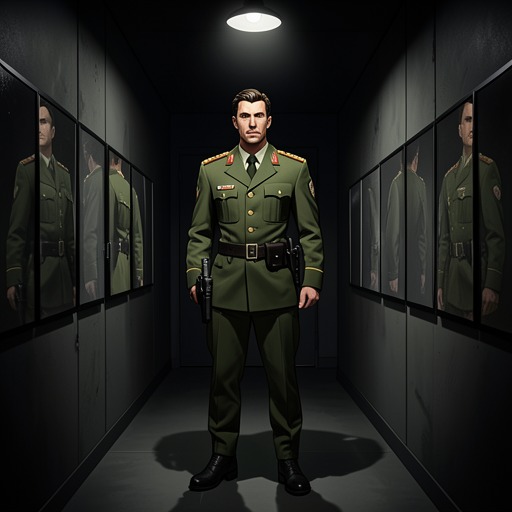
His physical appearance sharply contrasts with the scale of the power he exercises. He is the smallest man on the balcony, short, spare, and sallow-faced, while his gaudy military uniform is too large and too heavily burdened with braid and medals. Yet the mismatch does not diminish him in the political scene. His piercing dark eyes and strong voice command attention, showing how authority can be staged through speech and insignia even when the body itself appears unimpressive. The oversized uniform becomes an image of a regime that wants to look larger, stronger, and more historically inevitable than the man who embodies it.
The Assassination and the Turn toward Conquest
Kanus identifies Major Par Odal as a primary instrument in the first steps of conquest. Odal answers that he hopes only to serve his Leader and his Worlds, and Kanus confirms that the major has already served them by killing Emile Dulaq. Kanus describes the Acquatainians as thrashing about like a snake whose head has been cut off: without Dulaq, he says, they have no brain to direct them. The image reveals his method of thinking. A government is not, for him, a community of citizens or a system of competing institutions; it is a head that can be severed, leaving the body vulnerable to capture.
Kanus rewards Odal with a small ebony box presented as a token of the esteem of the Kerak Worlds and of his personal regard. The gift transforms murder into ceremony. Violence is not treated as a crime requiring concealment or remorse but as a service deserving a commemorative object and official praise. The scene also establishes the relationship between Kanus and Odal: Kanus supplies the political purpose and public meaning, while Odal supplies the direct action. Their arrangement fuses personal loyalty with state policy, allowing the Leader to distance himself from the act while claiming its strategic benefits.
The consequences of the assassination are not confined to the victim. Dr. Leoh later hears that the hired assassin has killed four men and nearly wrecked a government before returning under guard to his native worlds. Kanus’s strategy therefore produces a wider chain of destruction: an individual operative becomes the means by which a foreign government is destabilized, and the resulting crisis becomes pretext for Kerak expansion. The apparent success of the operation also shows why Kanus treats political murder as a rational weapon rather than an exceptional act.
Rule, Militarization, and the Inner Cabinet
Kanus is associated with the transformation of the Kerak Worlds into an arsenal. Dr. Leoh explicitly wonders who Kanus is and why he is trying to turn the Kerak Worlds into one, linking the ruler’s identity directly to systematic rearmament. Kanus’s ambition is therefore broader than a single campaign or revenge against a particular enemy. He is building a political order in which military preparation becomes the state’s defining activity and conquest appears as the natural continuation of defense, memory, and national honor.
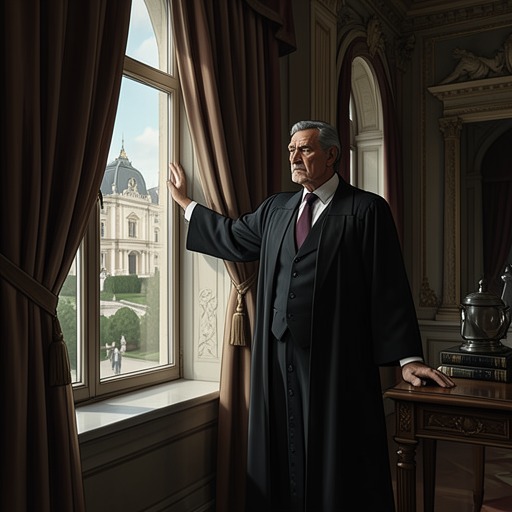
Later, Kanus sits in brooding silence behind an immense desk while most of his Inner Cabinet occupies the oversized office. Some members look up toward his cunningly elevated desk; others avoid his sullen stare. The arrangement makes power spatial and theatrical. Kanus is physically raised above the officials who depend on him, and the cabinet’s gestures reveal the discipline imposed by his presence. Yet the scene also carries a note of strain. The ministers’ avoidance and Kanus’s displeasure suggest a government held together less by shared conviction than by apprehension before the ruler’s judgment.
The contrast between the balcony scene and the office scene is revealing. On the balcony, Kanus speaks with historical confidence, invoking landscape, defeat, and conquest before attentive followers. In the office, he is silent and brooding, surrounded by men who cannot comfortably meet his eyes. His power remains intact, but its emotional foundation is narrower: public agreement has become private caution. The dictatorship’s grandeur depends on the constant performance of command, even as its inner circle registers the pressure beneath that performance.
Relations with Servants and Instruments
Kanus’s title as “the Leader” defines the vertical structure of his relationships. Major Par Odal is praised as an instrument, and the ministers function as an audience that confirms the ruler’s interpretation of history. Kanus does not present political actors as equals who deliberate together. He assigns functions, receives obedience, and converts their actions into proof of his own strategic vision.
The same hierarchy appears in the domestic space of his residence. When a terrified servant abruptly awakens him, Kanus grumbles and slowly sits up in an immense circular bed. The room’s floor-to-ceiling windows reveal distant snow-capped peaks just as the sun begins to touch them, repeating the mountain imagery associated with his public ideology. In the balcony speech, the mountains help Kanus explain power; in the bedroom scene, they surround the ruler while a servant brings him alarming news. The natural grandeur remains, but the immediate relation is one of dependence: the Leader must be awakened and informed by those beneath him.
The servants’ fear also shows the cost of Kanus’s system at its most intimate level. Even before the nature of the warning is disclosed, the servant’s terror establishes an atmosphere in which bad news is dangerous to deliver and authority is dangerous to approach. Kanus’s rule reaches beyond official policy into posture, timing, speech, and bodily caution. The regime’s discipline is therefore not only military; it is reproduced through the everyday behavior of people who must anticipate the ruler’s reaction.
Narrative Role and Significance
Kanus functions as the political antagonist behind a larger structure of violence. He is not merely a commander ordering an isolated attack. He is the figure who interprets assassination as strategy, transforms defeat into a mandate for vengeance, rewards the assassin, and connects the collapse of Acquatainia to Kerak’s expansion. Through him, the novel presents dictatorship as a system that converts memory into grievance, grievance into rearmament, and rearmament into conquest.
His characterization is built on deliberate contradictions. He is physically small but institutionally immense; his uniform is too large, yet his voice commands the room; he speaks of elemental forces as if they authorize human action, yet his power depends on carefully managed subordinates; he celebrates triumph in public, yet later sits in brooding silence while his cabinet avoids his gaze. These contrasts make him more than a simple emblem of evil. They show a ruler whose authority is real but theatrically maintained, whose political reach is vast but whose immediate world is organized around fear.
Kanus’s decisive significance lies in the way he turns people into instruments and events into political materials. The death of Emile Dulaq becomes an occasion for conquest, Major Par Odal becomes a weapon and then a decorated servant, and the Kerak Worlds become an arsenal under the pressure of an imagined historical reckoning. His rule makes violence appear orderly, purposeful, and even ceremonial. At the same time, the unease of his cabinet and the terror of his servants reveal the fragility concealed by that order: a regime that must constantly invoke conquest and obedience is also a regime haunted by the possibility that its instruments may cease to serve it.