Sittas
WatchmenSittas is an elderly priest from Oran VI whose quiet authority gives a moral and humane dimension to the war on Shinar. First encountered among the bodies left around a damaged cruiser, he is blessing the dead while Komani warriors move through the wreckage. He later becomes Emil Vorgens’s interlocutor and ally, tending the wounded of opposing sides and helping preserve the lives of the Mobile Force. His importance lies not in military power but in the way he places compassion, mortality, and responsibility alongside strategy and violence.
Identity and Introduction
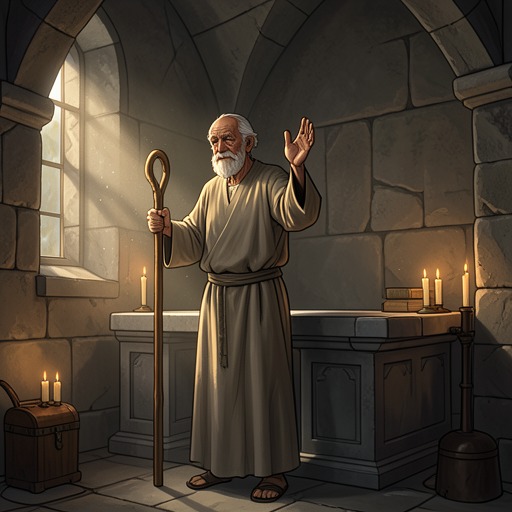
Sittas first appears on a small hillock roughly a hundred yards from the wrecked cruiser, moving slowly among the sprawled bodies with two Komani warriors. He is a native of Oran VI and wears the flowing white robes of a priest. The image immediately distinguishes him from the armed men around him: while the warriors carry rifles, Sittas performs a rite for the dead. His presence turns the battlefield from a purely military scene into a place of mourning and obligation.
His age is as striking as his priesthood. Vorgens observes that Sittas has deeply brown skin, jet-black eyes, silver remnants of wispy hair, and a face marked by a web of wrinkles. He is evidently very old, yet carries himself with a dignity that compels respect. The sight unsettles Vorgens because he has never seen a truly old person face to face. On Plione IX, on Mars, during his training with the Star Watch, and elsewhere throughout the Terran Empire, Terran science has eliminated the visible physical signs of age centuries earlier. Sittas therefore embodies a form of human experience that advanced imperial society has largely removed from ordinary view: the undeniable body of time and the proximity of natural mortality.
Dialogue with Emil Vorgens
After the battlefield encounter, Sittas travels with Vorgens through cool woods, and the two begin talking. Their conversation concerns general and noncommittal matters rather than war or the inevitability of death. That restraint is important. Sittas does not immediately turn his religious position into a sermon, nor does he treat Vorgens merely as an enemy officer. The exchange creates a temporary space in which two people from distant worlds can meet outside the categories imposed by the conflict.
Sittas asks Vorgens about his homeworld, prompting an account of Plione IX, the ninth planet circling the star the Terrans call Plione. Vorgens describes Plione as a giant blue star, larger and hotter than Oran, while noting that his planet lies considerably farther from it than Oran VI lies from its sun. The question establishes Sittas as curious and attentive, while the answer gives their relationship a concrete interstellar dimension: their companionship begins through an exchange of places, distances, and lived worlds rather than through political agreement.
The conversation eventually turns toward responsibility. Sittas acknowledges that war leaves no one entirely without blame, but Vorgens insists that the immediate issue is no longer assigning blame; the survivors must decide where to go from there. Back at Vorgens’s tent, protected by a quadruple guard, Sittas thanks him for answering questions frankly and offers to answer questions in return. Vorgens then asks how many Komani warriors are on Shinar. The scene shows Sittas occupying an unusual position between spiritual witness and practical source of information. His moral authority does not make him detached from events; it enables a serious exchange about the conditions that will determine what happens next.
Priest, Caregiver, and Witness
Sittas’s religious work is inseparable from physical labor. During the fighting around Carmeer, he stands in the upper floor of the town hall at Matara, a tiny farming village a few miles from the valley of Carmeer. Rain begins to fall steadily after a night in which clouds have gathered over the countryside. The old priest hears the first drops strike the roof while watching the wounded being brought through the muddy, rain-spattered morning.
He has converted Matara’s only two-story building into an emergency hospital. Terrans, Komani, and the few wounded Shinarians are all brought there, and Sittas has spent the entire night dressing wounds and blessing the dead. He has gathered every doctor available, along with boys and women from miles around, to keep the improvised infirmary functioning. The mixed population of the hospital matters: his care crosses the lines of the battle rather than reinforcing them. The wounded are first bodies in need, not representatives of an army deserving or denied assistance.
The scene also emphasizes the scale and repetition of suffering. Sittas watches a continuing procession of maimed and shattered men enter the makeshift hospital and wonders when the pitiful parade will end. His priestly role is therefore not limited to ceremonial blessing after death. He remains amid the prolonged consequences of combat, confronting injury, exhaustion, and the practical demands of keeping strangers alive. The rain, the mud, and the improvised building give his compassion a material setting; mercy is shown through medical work performed under wartime conditions.
Relationship with Vorgens and the Mobile Force
Sittas later receives Vorgens in the town hall after Vorgens has taken command in a crisis. Vorgens explains that Brigadier Aikens would not listen to reason, that there was no one else to whom he could turn, and that he assumed responsibility because he believed he possessed more information about the situation than anyone else. He also admits that whether he had the right to seize that authority will eventually be decided by a Star Watch court. Sittas does not erase the legal or institutional question, but his presence provides a setting in which Vorgens can account for the decision without reducing it to either simple heroism or simple insubordination.
Vorgens’s visit has a further purpose. Through a lieutenant sent to Matara with medical supplies, he has asked to see Sittas in person. He thanks the priest for his part in saving his life and the lives of all the men in the Mobile Force, declaring that nothing they can do could repay the debt owed to him. This acknowledgment confirms that Sittas’s assistance has had military as well as humanitarian consequences. By treating wounded people and organizing medical help, he has contributed directly to the survival of the force whose fate is tied to Vorgens’s command.
Their relationship is consequently founded on reciprocal recognition. Vorgens provides Sittas with frank answers and seeks information from him, while Sittas offers counsel, courage, medical aid, and practical support. Neither man occupies the other’s role. Vorgens remains responsible for decisions involving command and military danger; Sittas remains a priest and caregiver. Yet the narrative places them in dialogue because the war cannot be understood through command structures alone.
Courage and Narrative Significance
Sittas’s influence is most intimate when Vorgens is left in stunned silence inside a tent after being brought there under guard by Komani warriors. The young Star Watchman stares at a blank tent wall until the touch of a hand on his shoulder startles him. Sittas is standing beside him and quietly tells him to have courage. When Vorgens asks whether his fear is visible, the exchange reveals the priest’s function as more than a witness to violence: he recognizes fear without humiliating the frightened person and answers it with calm presence.
The gesture on the shoulder and the earlier blessing of the dead form a pattern. Sittas repeatedly responds to war by making contact with what military systems tend to conceal: the body, age, grief, fear, injury, and death. He does not deny the conflict or pretend that blame is irrelevant. Instead, he redirects attention from condemnation toward the question of what can still be done for the living. His conduct gives ethical weight to Vorgens’s later insistence that the survivors must decide where to go from there.
Sittas also complicates the imperial contrast between technological progress and human limitation. The Terran Empire has used science to remove the outward marks of age, but Sittas’s wrinkled face and silver hair are not presented as weakness. They signify accumulated experience and a dignity that commands respect. Against the cruiser’s scorched ground, the rifles of the Komani warriors, and the wreckage of battle, the old priest’s white robes and deliberate rites preserve another measure of value. He is not powerful because he can defeat an army; he is powerful because he refuses to let war determine the full meaning of the people caught within it.