Hector H. Hector
WatchmenHector H. Hector is a young Star Watch officer whose body, training, and personality become the testing ground for the dueling machine’s transformation from a simulated combat device into an instrument of psychonic teleportation. His decisive significance lies in the contrast between his initially comic, youthful appearance and the severe consequences of his experiments: he begins as an apparently ordinary junior lieutenant and ends by emerging from the machine beside Major Par Odal with an expression that suggests an irreversible fusion of knowledge, purpose, or identity.
Identity and Introduction
Hector first appears at a communications desk after Dr. Leoh returns from the Szamo Confederacy. He is described as a lanky, thin-faced youth with curly blond hair and crystal-blue eyes, dressed in ill-fitting clothes and nervously attempting to talk to the attractive dark-haired girl operating the booth. The scene gives him an awkward, almost boyish presence before military discipline abruptly replaces it. When Leoh questions whether he is really a Star Watch officer, Hector stiffens to attention, nearly salutes, and identifies himself as Junior Lieutenant Hector, on special detached duty from cruiser SW4-J188, whose home base is Perseus Alpha VI. His answer to Leoh’s question about his name is deliberately striking: Hector is both his first and last name.
This introduction establishes a double image that remains important throughout his arc. Hector is young, nervous, and socially unpolished, yet he belongs to an institutional military structure and responds instantly to its commands. The contrast allows the narrative to make his later achievements more surprising. He is not introduced as a legendary warrior or an established scientist; he is a seemingly ordinary officer whose value emerges when the Star Watch’s practical training meets Dr. Leoh’s scientific investigation.
Partnership with Dr. Leoh
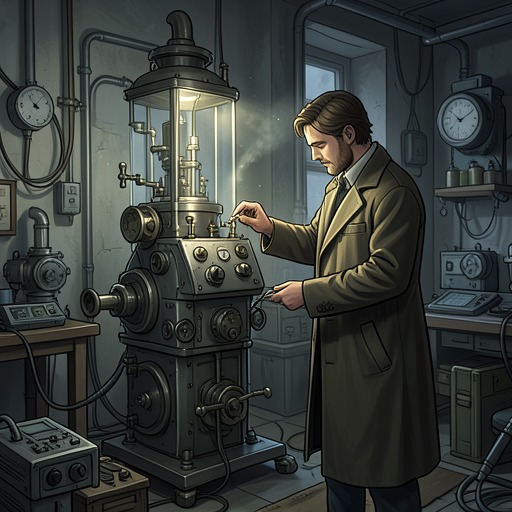
Hector joins Dr. Leoh in examining the dueling machine after its use has produced consequences that the machine was not supposed to permit. Their first experiments are cautious and exploratory. They play hide-and-seek inside the machine, taking turns choosing environments while the other tries to locate the hidden opponent. The simulated settings range from jungles and cities to glaciers and interplanetary voids, although neither man leaves the dueling-machine booths.
Once Leoh becomes confident that the machine reproduces and amplifies thought patterns with strict fidelity, the experiments become light duels. They fence with blunted foils, then test pistols, sonic beams, and grenades while imagining themselves protected by appropriate equipment. Hector’s training gives him faster reflexes and greater familiarity with the weapons, but those advantages do not guarantee victory. Leoh performs poorly at fencing and is neither faster nor more accurate during target shooting, yet he wins almost all of the bouts in which the two men directly face one another. The result leads Leoh to recognize that the machine projects more than thoughts: it projects personality.
The work becomes physically and emotionally punishing. Leoh and Hector spend twelve or more hours a day inside the booths, driving themselves and the machine’s regular staff toward exhaustion. They gulp meals between duels, become physically ragged and sharp-tempered, and often fall asleep in Leoh’s office while discussing the day’s results. Hector’s participation therefore is not a brief technical service. He submits himself repeatedly to an experiment whose implications are still unfolding, and his persistence makes possible the discovery that personality can influence the outcome of a simulated contest independently of simple physical skill.
The Teleportation Experiments
Hector’s military discipline also makes him the subject of increasingly dangerous tests. At one point, after hesitation and exhaustion, he accepts another trial. At dawn, Dr. Leoh enters the dueling machine determined to let him win and permits Hector to choose both the weapons and the environment. Hector selects one-man scout ships in planetary orbits, armed with conventional laser beams. The choice places him in a setting that reflects his training and gives the experiment a distinctly military scale, even though the encounter remains inside the machine.
The later experiments move beyond simulated combat. Hector begins by teleporting himself from one booth of the dueling machine to the other. He performs the jump twelve times on the first day while Leoh measures transit time and power consumption. The average transit takes four picoseconds, and the energy drain is approximately equal to that required by a starship’s drive engines to propel a mass equal to Hector’s weight. The figures turn a seemingly miraculous act into a measurable technological process, while also revealing its enormous cost.
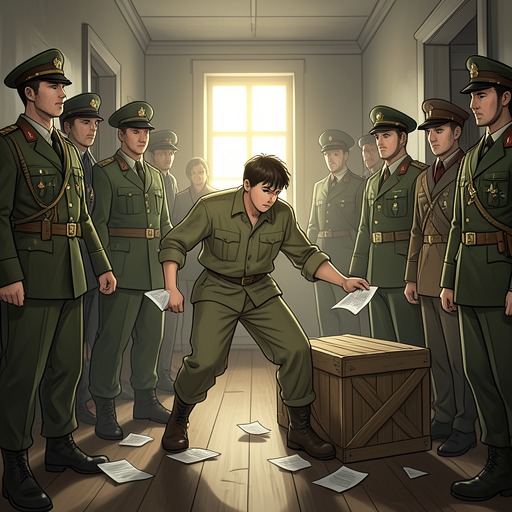
The next step is the first long-distance jump. Hector sits in the dueling machine in Acquatainia and concentrates on transporting a drawerful of papers, tapes, and holograms to a dueling machine elsewhere on the planet. His concentration is strained by the knowledge that Geri Dulaq is waiting outside and by the memory of Major Par Odal, whose possible progress in teleportation enters his thoughts. The attempt begins with a brief tingling sensation like a mild electric shock, marking the bodily threshold between ordinary experimental work and a new form of movement through space.
Transformation and Return
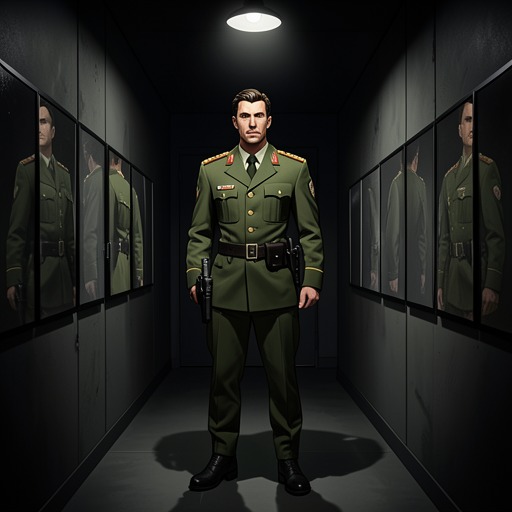
Hector’s final appearance gives his trajectory its disturbing resolution. While the meditech believes the Watchman is alone in the machine and fears that he may have recovered and escaped, both booth doors open simultaneously. Hector steps from one booth clear-eyed, straight-backed, tall, lean, and blond. His face is calm, almost smiling. In the other booth stands Major Par Odal, physically matching Hector in height, build, and coloring and wearing almost exactly the same expression: a knowing satisfaction that nothing can damage them.
The scene does not explain the full nature of what has occurred, but its visual symmetry makes the implication unavoidable. Hector has not merely learned to cross a short distance or transport objects. His association with Odal has culminated in a return that makes the two men appear uncannily paired. Kor’s shocked recognition that Hector has returned converts the experiment into a public rupture: the Star Watch officer who entered the machine as a single person emerges in a scene where his likeness and expression are mirrored by Odal.
Hector’s ending therefore resists a simple heroic return. His achievement is a technological breakthrough, but it is also an identity crisis. The calm, almost smiling face can signify mastery, survival, or the possession of knowledge beyond ordinary human limits; the evidence does not settle which interpretation is correct. What it does establish is that Hector’s experiments have brought him into a new relation with Odal and that the dueling machine has become a medium capable of joining or reproducing more than bodies in space.
Narrative Role and Significance
Hector functions as the bridge between military practice, scientific inquiry, and psychonic transformation. His Star Watch status supplies the training that shapes the machine’s combat tests, while his willingness to endure repeated experiments allows Dr. Leoh to distinguish physical ability from personality and then to investigate teleportation. The machine does not simply display Hector’s skills; through its measured trials, it exposes the unpredictable force of character and eventually expands that force into movement across space.
His arc also gives the novel a sharp contrast between the harmless theory of simulated combat and the dangerous reality of technological misuse. A dueling machine is initially valuable because it can settle aggressive feelings without mental or physical harm, but Hector’s experiments reveal that the same apparatus can alter the relation between thought, body, distance, and identity. His progress from nervous recruit to calm figure emerging beside Odal makes that change personal rather than merely mechanical. Hector is the human measure of the machine’s escalation: every new capability is recorded in his body, tested through his discipline, and finally written across his face.