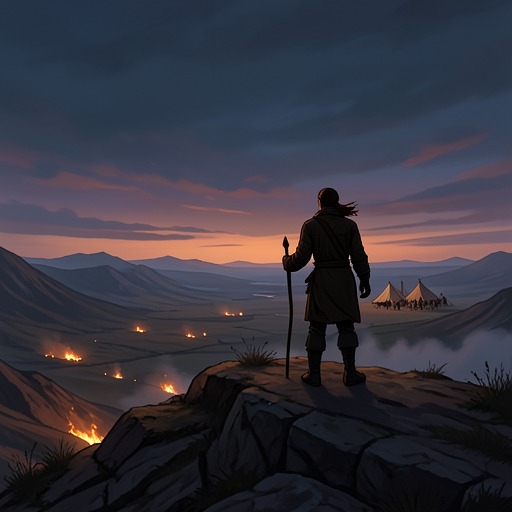
Altai
WatchmenAltai is a Shinarian rebel whose practical intelligence becomes one of the resistance’s most valuable forms of strength. She does not dominate the narrative through speeches or formal authority. Instead, she works through recruitment, secrecy, visual communication, and carefully timed intervention, helping Emil Vorgens survive the Komani campaign and helping convert Shinarian resistance from scattered defiance into organized cooperation.
Identity and Introduction
Altai first enters the story indirectly, among the young fighters gathered by Merdon. A girl approaches him to announce that new recruits are waiting beyond the gates, placing her at the threshold between the rebel compound and the growing movement outside it. Her introduction associates her with the movement’s expanding human base: the fighters include the sons and daughters of farmers, philosophers, and merchants, and recruitment is already becoming a political as well as military activity.
Altai’s importance becomes clearer when Merdon orders a covert division of captured weapons. After Romal has prepared an inventory of the weapons taken from the arsenal, Merdon instructs that half be kept in the rebel compound while the other half is sent with new recruits to the Komani camp. The order depends on secrecy and on the ability to move matériel without exposing the entire resistance. Although the scene does not explicitly identify the person carrying out every stage of the plan, Altai belongs to the operational world that makes such clandestine coordination possible.
Intelligence and Covert Action
Altai’s most distinctive contribution is her ability to communicate under surveillance. When Emil Vorgens is held in the Komani encampment, she arrives as the Shinarian girl he had previously glimpsed while only half-conscious after being shot. Her appearance resolves his uncertainty: she is not a dream but a real participant in the struggle. The delayed recognition also gives her entrance a quality of revelation, as though the resistance had been present before Vorgens was capable of understanding it.
She does not rely on spoken conversation. With Sittas chanting nearby as a distraction, Altai pulls a low bench to the table, sits beside Vorgens, and uses a thin strip of plastifilm and a stylus to draw a map. She sketches their tent and about a dozen surrounding tents, marks two of them with the word “ammunition,” and traces a pair of parallel wavy lines toward the edge of the film. Inside the lines she writes “safe lane”; outside them she marks “fire.” She then gestures toward the tent wall and touches the stylus to the word “fire.” The sequence gives Vorgens a precise tactical message while guards remain outside: the ammunition stores are identifiable, a route exists through the danger, and the surrounding area is covered by hostile fire.
This scene defines Altai’s method. Her intelligence is embodied in an improvised object, a map that turns silence into actionable knowledge. She reads the physical arrangement of the camp, understands the need for concealment, and trusts Vorgens to interpret signs rather than demand a conventional exchange. Her communication is therefore both military and relational: it transfers information while demonstrating that she recognizes Vorgens as someone capable of acting on it.
Alliance with the Terran Force
Altai’s actions help complicate the boundary between Shinarian rebels, Terran soldiers, and Komani forces. Emil Vorgens arrives on Oran VI under orders to negotiate with the chief of the Komani raiders, offering peaceful withdrawal if the raids stop and invoking the Komani clans’ earlier alliance with the Terran Empire. On Shinar, however, the crisis becomes more entangled. The Komani threaten the planet, the Terran Mobile Force is too weak to defeat them alone, and the Shinarians must decide whether to fight alongside the Terrans or permit a Komani takeover.
Vorgens later tells the Shinarians that their choice is stark: they can fight for their world with the Terrans against the Komani, or allow the Komani to take the planet and use it as a springboard for a galactic war. He cannot guarantee that cooperation will earn Shinar self-government, but he argues that resistance is the only practical route toward both survival and political leverage. Altai’s conduct anticipates this alliance before it is formally accepted. She assists Vorgens not because the imperial relationship is simple or free of coercion, but because the immediate defense of Shinar requires cooperation across political boundaries.
That cooperation eventually receives an explicit public confirmation. Clanthas tells Vorgens and Altai that the other leaders have decided to take him at his word and will help work against the Komani in whatever way possible. Altai’s presence beside Vorgens during the communication makes her part of the emerging coalition rather than a merely local helper. Her role helps show how the resistance becomes credible to its potential allies: not through abstract declarations alone, but through concrete intelligence, disciplined risk, and proof that Shinarian actors can coordinate with the Terran force.
Relationships, Risk, and Aftermath
Altai’s relationship with Vorgens is built on mutual recognition under dangerous conditions. She approaches him while he is confined among the Komani, communicates in a manner designed to evade their guards, and gives him information that can expose both her and the prisoners if discovered. Vorgens understands her signs immediately and responds by following the plan rather than forcing her into speech. Their partnership is consequently practical before it is intimate: trust is created through accurate interpretation and shared danger.
The story also places Altai in the orbit of Sittas, whose presence enables the covert exchange. While the priest chants and gestures toward his ear and the guards outside, Altai and Vorgens conduct their silent briefing. Religious performance and military intelligence overlap in the scene; Sittas supplies cover, while Altai supplies the map and the tactical knowledge. The division of labor allows the prisoners’ situation to be addressed without openly challenging Komani authority.
Later, after the Mobile Force has endured severe losses, Altai appears at the entrance wearing a raincape, her hair glistening wet, and asks whether the scene is “not a very pretty sight.” The remark places her in direct contact with the cost of the campaign. She is not represented only as a clever operative working behind the lines; she also witnesses the aftermath of violence and enters a space marked by exhaustion, casualties, and the physical consequences of war.
Altai’s political courage is equally visible when a Komani officer claims, in the name of Okatar Kang, that the Terrans sheltered there are Komani prisoners. Sittas rejects the claim with a vehement “Never!” The confrontation exposes competing jurisdictions: Komani custom and command authority on one side, local sanctuary and the protection offered by the resistance on the other. Altai’s earlier assistance to the prisoners gives that refusal material force. The shelter is not an empty assertion of principle; it has been actively maintained by people willing to risk retaliation.
Narrative Significance
Altai represents a form of resistance that is neither grandiloquent nor passive. Her power comes from noticing arrangements, preserving secrecy, conveying information, and acting at the narrow interval before violence closes the available choices. The girl who announces new recruits, the operative who helps divide and move weapons, the silent cartographer in the Komani camp, and the ally standing with Vorgens after the battle are facets of one political function: turning a population under pressure into a network capable of deliberate action.
Her significance also lies in the way she unsettles simple categories of allegiance. Vorgens is a sworn officer of the Star Watch and refuses Merdon’s invitation to turn against the Empire, even though his people once fought the Terrans. Altai, by contrast, works with him while remaining rooted in Shinar’s struggle. Their cooperation does not erase the conflict between imperial rule and self-government; it demonstrates how resistance can use an imperial officer’s skills without surrendering its own objective. When Clanthas and the other leaders agree to work against the Komani, the practical alliance that Altai helped make possible becomes a broader collective decision.
Altai is therefore important less as a conventional battlefield commander than as an agent of connection. She links recruits to the rebel organization, hidden weapons to operational plans, prisoners to escape routes, local resistance to Terran military survival, and immediate defense to the longer demand for Shinarian self-government. Her most memorable instrument is not a weapon but a strip of plastifilm on which a safe lane can be drawn through fire. That image captures her narrative role: she finds a passage through a hostile structure and makes it legible to those prepared to move.