Okatar Kang
WatchmenOkatar Kang is the Komani chief who commands the clan that lands on Shinar and overwhelms the local Terran defenses. He presents himself as the leader of a wider Komani awakening, but his campaign treats Shinar less as a homeland to be liberated than as the first position in an offensive against the Terran Empire. His confidence makes him formidable; his dependence on rapid victory creates the weakness that his opponents eventually identify.
Identity and Introduction
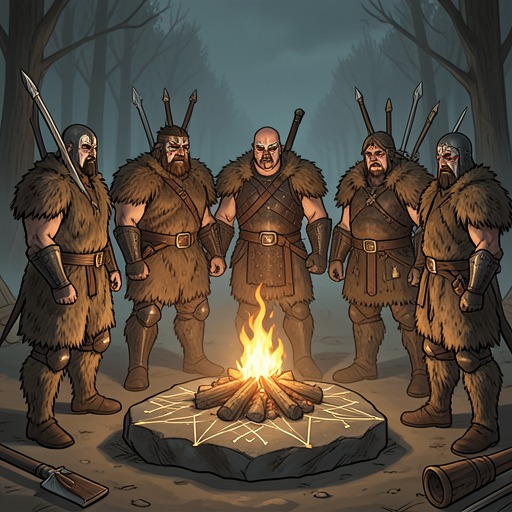
Okatar is introduced through the scale of the force gathered around him. An entire Komani clan has landed on Shinar, with an estimated fifteen thousand fighting men, and Emil Vorgens immediately seeks an audience with its chief. The title is not merely ceremonial. The Komani are organizing for a major attack on the Mobile Force, and Okatar stands at the center of that preparation.
When Vorgens enters the chief’s tent, Okatar is not physically larger or more imposing than the other Komani present. His authority is conveyed through small distinctions: his head is held slightly higher, his back is a shade stiffer, and his yellow, catlike eyes project unquestioned command. The impression is one of controlled fierceness rather than theatrical magnificence. He can allow others to wait while he finishes reviewing a long list with Merdon, making delay itself an instrument of hierarchy.
Political Vision and Military Strategy
Okatar understands that the Terran position on Shinar is vulnerable. He points out that the Mobile Force is trapped and living on borrowed time, while the Star Watch fleets are too far away to arrive for at least a month. From this situation he constructs a larger claim: the Empire has no military arm capable of withstanding the Komani, and one small clan has already humbled both the Mobile Force and the planetary garrison. His intended audience is not limited to Shinar. He expects news of the Komani advance to spread through the galaxy and believes that other clans will join once his success becomes visible.
His strategy depends on speed, spectacle, and the psychological force of an apparently unstoppable victory. Okatar plans to leave Shinar within days or, at most, a few weeks. By then, he expects the Terrans to have been wiped out, allowing the Komani to strike elsewhere, closer to the heart of the Empire, before additional troops can reach the planet. Shinar is therefore a stepping-stone: useful precisely because it can be conquered quickly and abandoned once it has served the larger offensive.
Okatar does not disguise this calculation when Merdon objects that the Komani are using Shinar for their own purposes. He accepts that characterization and dismisses the distinction between liberation and exploitation as irrelevant. In his view, the motives behind the campaign do not matter if the Terrans are driven from the planet. The statement exposes the gap between the Shinarian hope for self-government and the Komani program of conquest. A people may be freed from one ruler only to become the instrument of another power’s war.
Relations with Vorgens and the Shinarian Rebels
Okatar’s position also sharpens Vorgens’s divided loyalties. Merdon urges Emil Vorgens to recruit the Komani and other available forces for a broader struggle against the Empire, arguing that Vorgens is not originally Terran and that his people once fought the Terrans. Vorgens refuses. He identifies himself as an Imperial citizen and a sworn officer of the Star Watch, unwilling to betray the men with whom he has served. Okatar consequently becomes the force that tests whether opposition to imperial rule can be separated from loyalty, duty, and political responsibility.
The chief also exposes the precarious position of Merdon and the other Shinarians. At first, the prospect of Terran defeat encourages them to cooperate with the Komani. Once the fighting continues and the risks increase, however, their commitment becomes uncertain. Okatar interprets their hesitation as weakness, describing the native leaders as people who change direction with the wind. His contempt prevents him from recognizing that their uncertainty is a rational response to being caught between imperial rule and an invading power that openly intends to use their world.
Vorgens later argues that Okatar has one decisive vulnerability: he must win on Shinar quickly and conclusively. If the Komani can be held, frustrated, and kept off balance, the promise of glory may fade. Other clans may refuse to join a fruitless war, and even Okatar’s own people may tire of continued losses. The plan to resist him therefore attacks not only his army but the coalition-building logic on which his authority depends.
Confrontation with Shinar and the Empire
Okatar’s campaign forces the Shinarians into a stark political choice. They can fight beside the Terrans against the Komani or allow the invaders to take their planet and use it as the springboard for a galactic war. Vorgens cannot guarantee that Imperial cooperation will earn Shinar the right to govern itself, but he insists that inaction would hand Okatar the strategic position he seeks. The chief’s presence thus turns the question of self-government into a crisis of survival: resistance to the Empire cannot remain purely symbolic when another conquering army is advancing.
The Shinarian leaders eventually begin to reconsider their alignment. Clanthas, who depends on buying and selling the farmers’ produce, initially appeals to the Terran governor for the nutrient processors essential to his countrymen. Rather than quietly endure the situation, he recalls the historical maxim that freedom requires both independent courage and the strength to resist enslavement. Later, after consulting with the other leaders, Clanthas tells Vorgens that they will help work against the Komani in every possible way. Their decision demonstrates the collective shift Okatar’s conduct has produced: the invasion makes imperial rule appear less immediately dangerous than the supposedly liberating army that seeks to replace it.
The same political logic appears in the decision to move against Katan. When Merdon lacks enough groundcars to reach the threatened area quickly, Vorgens offers a squadron of vans and troop carriers within the hour. Merdon then admits that he has been wrong about Vorgens and agrees to fight alongside him. Their handshake marks a practical alliance formed under pressure from Okatar’s offensive. The chief’s attack has unintentionally brought together people who had distrusted one another, including a Shinarian rebel and an Imperial Watchman.
Weakness, Threat, and Narrative Role
Okatar is most dangerous when his confidence appears justified. He has already trapped the Mobile Force, commands a force measured in the thousands, and believes the remoteness of the Star Watch will prevent an effective response. He also understands the symbolic value of victory: if the galaxy hears that a single Komani clan defeated the Empire on Shinar, the result could attract reinforcements from other clans and transform a planetary battle into a general war.
Yet the same ambition that gives his campaign its reach supplies the means of resisting it. Okatar cannot settle for survival, negotiation, or a limited gain. He requires a decisive victory quickly enough to preserve his prestige and inspire the other Komani clans. His opponents therefore see a way to break the deadlock by killing him and decapitating the Komani clan. The proposal is presented as a military necessity rather than a personal vendetta: remove the chief, and the political structure holding the invasion together may collapse.
As a character, Okatar embodies the novel’s refusal to treat every enemy of empire as a liberator. The Terran order is oppressive enough to provoke rebellion, but Okatar’s answer is not self-determination; it is expansion under another banner. His physical restraint, calculated delays, sweeping military claims, and contempt for Shinarian autonomy make him the concentrated image of power that mistakes conquest for freedom. His decisive significance lies in that contradiction: by threatening to free Shinar from the Terrans only to use it against the rest of the Empire, he forces the planet’s inhabitants and Vorgens alike to define what freedom must mean beyond the mere replacement of one master by another.