Mount Ida
AeneidMount Ida is the mountain beside which the Trojan exiles begin the practical work of becoming a seafaring people. Near ancient Antandros, at the mountain’s foot, they cut timber from its sacred groves and build their fleet, even though they still do not know where the gods have assigned them a place of rest. Mount Ida therefore stands at the decisive threshold between the loss of Troy and the uncertain foundation of a new homeland.
Setting and Sacred Landscape
Mount Ida appears not as an empty wilderness but as a landscape marked by sanctity. Its groves provide the timber required for the fleet, yet the wood is described as sacred, making the act of cutting both a material necessity and an encounter with divine territory. The mountain thus joins natural resources to religious meaning: the exiles must draw the means of survival from a place whose holiness distinguishes it from ordinary terrain.
Its position near Antandros gives the mountain a concrete geographical role in the Trojan departure. The fleet is built at Ida’s foot, where the community can still work collectively on land before committing itself to the sea. Friends continue to arrive, and the group grows around the construction effort. The mountain functions as a temporary anchorage for a displaced people, a place where scattered survivors gather and acquire the physical means to continue their journey.
The Fleet and Trojan Exile
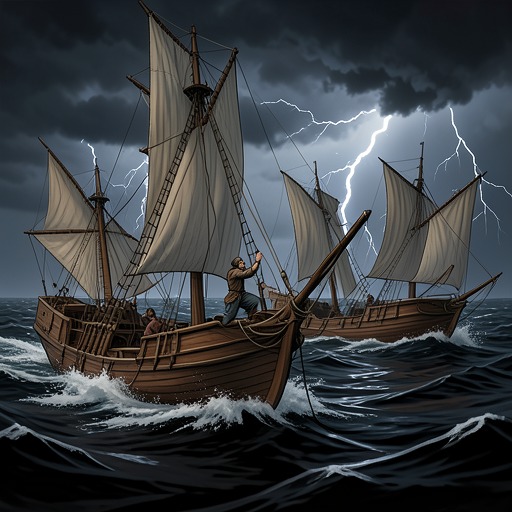
The felling of Ida’s timber transforms exile into organized movement. The Trojans do not simply flee with whatever remains from the destroyed city; they manufacture a new future from the mountain’s forests. Their ships are therefore products of both loss and adaptation. They carry Trojan identity away from its original city while embodying the labor by which that identity survives.
The purpose of the building remains uncertain. The exiles do not yet know what country the gods have chosen for their repose, so Mount Ida supplies means without supplying destination. This distinction gives the scene its characteristic tension: the fleet is carefully made, but its voyage is not yet politically or geographically resolved. Ida provides preparation rather than arrival, and its timber becomes the substance of a destiny that must still be discovered.
Recurrent Point of Departure
The mountain is recalled later when the chief prepares for flight and cuts timber from its heights. In this retrospective account, Ida becomes more than the site of one construction episode: it is the remembered source of the fleet itself. The return to the image of felling timber gives the mountain a recurring place in the epic’s account of Trojan movement, linking the first departure to the larger providential design of the voyage.
That recurrence also places human labor within a wider sacred order. The ships arise from axes, trees, and collective work, but the narrative frames their making through divine intervention and heavenly purpose. Mount Ida is consequently both a physical resource and a point at which the human project of escape is interpreted as part of a destiny beyond the exiles’ immediate knowledge.
Historical and Literary Significance
Mount Ida concentrates several of the epic’s central oppositions: sacred grove and practical industry, fixed ancestral land and mobile exile, uncertain wandering and promised settlement. Its forests are rooted in the old Trojan world, while the ships made from them carry that world into a future not yet visible. The mountain preserves continuity even as it enables departure.
As a location, Mount Ida belongs to the epic’s larger pattern of producing political community through space. The Trojans gather there, build together, and convert a sacred landscape into the first instrument of collective migration. The mountain does not itself become their final city; its importance lies in making later settlement possible. It is the terrestrial beginning of a voyage whose destination is governed by the gods, and the material foundation on which Trojan survival can become the origin of a new people.