Pergamus
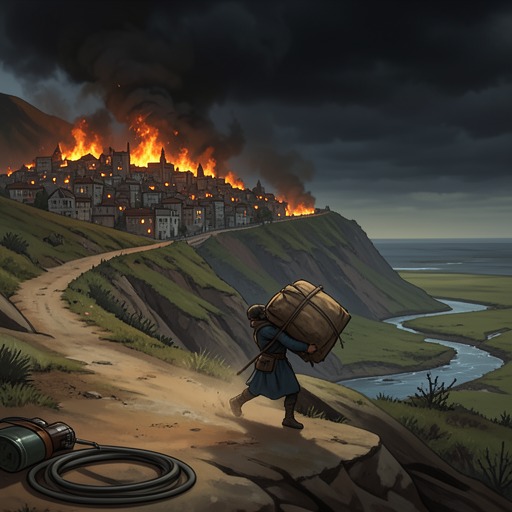
AeneidPergamus is the rising Trojan settlement that Aeneas establishes on the shore of Crete, naming it after Troy’s Pergamus. Its importance lies in the way it turns exile into an attempted act of foundation: the Trojans do not merely land, but begin to build houses, a fort, and a communal future. Yet the settlement also embodies a crucial error, since the Trojans later learn that their search for a homeland has been directed elsewhere by fate.
Foundation in Crete
The Trojans reach the promised Cretan land with joy and immediately move from arrival to construction. Aeneas frames a new town and gives it the name Pergamus, preserving a remembered Trojan identity within foreign territory. The name is described as pleasing because it carries the emotional authority of the lost homeland; it makes the new place legible as a continuation rather than an absolute beginning.
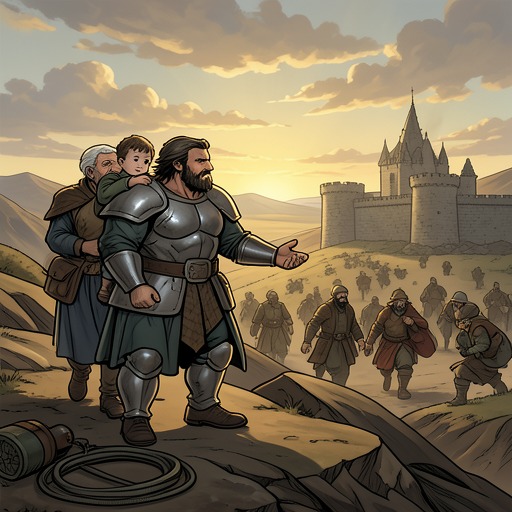
The settlement develops through practical acts of occupation. Aeneas urges the Trojans to found their houses and erect a fort, while the ships are hauled onto the yellow strand and the young men begin cultivating worked land. Pergamus therefore combines military defense, domestic settlement, and agriculture. Its boundaries are produced by both the fort and the fields: the community claims space as a place to live, protect, and labor.
A False Homeland
Pergamus appears to answer the central problem of Trojan exile, but its foundation is based on a mistaken interpretation of the gods’ direction. The Trojans treat Crete as the promised country and invest their energy in making Pergamus permanent. The later movement of the narrative exposes the fragility of that permanence: a settlement can be materially established and emotionally embraced while still lacking the divine and geographic legitimacy required by fate.
This error gives Pergamus a distinctive narrative function. It is neither simply a failure nor an empty stop. The building of houses, the fortification of the town, and the cultivation of the land show the Trojans acquiring the habits of a settled people. At the same time, the abandonment of the Cretan project demonstrates that foundation alone does not guarantee destiny. The town is a provisional homeland whose name preserves Troy even as its location proves wrong.
Community and Ritual Order
Pergamus belongs to a broader pattern in which Trojan movement is repeatedly accompanied by attempts to impose order on unfamiliar spaces. The settlement begins with Aeneas’s command and is sustained by collective labor, transforming a shore reached by ships into an organized community. Its creation joins the authority of the leader to the participation of the people: Aeneas determines the town’s identity and defensive needs, while the Trojans build and cultivate it together.
The epic later links Trojan settlement to public institutions and sacred observance elsewhere. A chosen senate is drawn from the people, judges and laws are appointed, and a temple is begun on the top of Eryx; sacrifices are likewise performed before the descent toward the Underworld. Against this larger pattern, Pergamus represents an early and incomplete stage of civic formation. It has a name, houses, a fort, and fields, but its political and sacred order remains subject to correction by the gods.
Place, Memory, and Destiny
The name Pergamus makes memory into a tool of territorial production. By naming the Cretan town after a Trojan place, Aeneas attempts to carry the defeated city forward through language and architecture. The settlement is thus a spatial expression of continuity: the Trojans’ past is not left behind but planted in a new soil. That act also reveals the tension between human remembrance and divine geography. The exiles can reproduce a name, but they cannot by naming alone determine where their future will occur.
The contrast becomes sharper when the poem’s prophetic horizon is considered. Aeneas is shown the Italian succession that fate will join to his people, and he is told that his race will spread the conquests of imperial Rome. Pergamus stands before that imperial future as a modest, mistaken beginning. Its fort and fields are the small-scale forms of a later political logic in which settlement, territorial claim, and collective identity expand into a much larger destiny.
Narrative Significance
Pergamus marks the moment when Trojan exile briefly seems to end in successful colonization. Its creation gives concrete form to hope, and its name allows a displaced people to imagine that Troy can be rebuilt. But because the settlement is founded in the wrong country, it also teaches that the Trojan mission cannot be secured by courage, labor, or nostalgia alone. The town’s lasting significance is therefore double: it is an achievement of communal reconstruction and a warning against mistaking an emotionally convincing refuge for the land ordained by fate.