Carthage
AeneidCarthage is the North African city that gives the Trojan exiles their most compelling temporary home and becomes the setting for the destructive union of Dido and Aeneas. It is a place of war, construction, royal authority, and illicit pleasure: surrounded by hostile powers, yet rising rapidly under Trojan labor. The city’s importance lies in the contrast between what it seems to promise—shelter, prosperity, and a settled future—and the destiny that draws Aeneas away from it.
Setting and Political Condition
The city stands in a dangerous landscape. Its territory is hemmed in on every side by warlike foes, while Gaetulian cities are spread around it. Carthage is therefore not presented as an untouched refuge but as a defended political project whose survival depends upon vigilance, strength, and the authority of its rulers. The surrounding pressure of enemies gives the city an atmosphere of permanent insecurity even when its internal life appears prosperous.
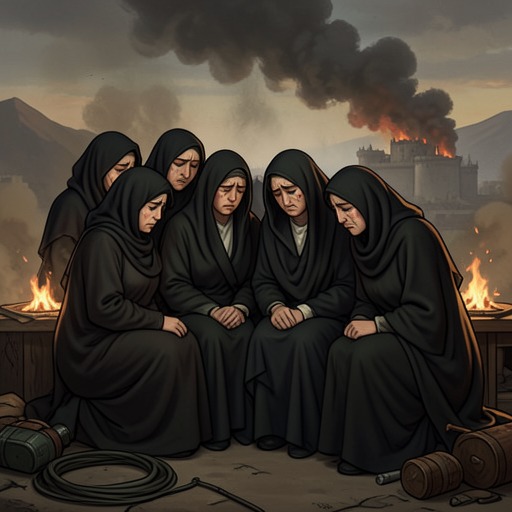
That insecurity is answered by vigorous building. When the gods look upon Carthage, the city is described as a place where towers now rise into the clouds on ground once occupied by shepherds in humble sheds. The transformation from pastoral huts to elevated fortifications marks the speed and ambition of its development. Carthage is not merely a backdrop for the lovers’ story: it is an urban foundation in progress, a visible expression of collective labor and political will.
A City Observed by the Gods
Carthage’s central crisis is watched from above. Jupiter looks toward the city and sees the royal pair submerged in unlawful pleasure, absorbed in their love and insensible to shame. The city thus becomes the site where private desire acquires public and cosmic consequences. What appears to the inhabitants as intimacy is interpreted by the divine order as a dangerous interruption of Aeneas’s appointed course.
The contrast is sharp. Carthage is expanding outward through walls and towers, while Aeneas and Dido turn inward toward a secluded attachment. Its political future requires construction, defense, and continuity; their union suspends those demands in favor of immediate passion. The city’s grandeur therefore intensifies the tragedy, because the more convincingly Carthage appears capable of becoming a lasting home, the more decisive Aeneas’s departure becomes.
Trojan Arrival and Construction
Aeneas’s presence is linked directly to the city’s defensive growth. On arriving, he finds the Trojan prince raising new ramparts for the town’s defense. His work places him within Carthage’s civic and military development, even though his ultimate allegiance lies elsewhere. The walls symbolize an available future: Aeneas could help transform the city into a secure community rather than continue the unsettled life of the Trojan exile.
This association also joins two acts of foundation. Carthage is being built by Dido’s people, while Aeneas is destined to carry the Trojan line toward another land and another political order. His labor on Carthage’s defenses consequently has an unstable meaning. It contributes to the city’s immediate safety, yet it cannot become the final foundation of his own people. The city receives his strength without possessing his future.
Conflict Between Settlement and Destiny
Carthage embodies the conflict between emotional settlement and the demands of destiny. It offers Aeneas a city already rising, a queen with authority, and a setting protected by walls; nevertheless, the divine command requires him to abandon the life taking shape there. The city’s danger is not only the enemies outside its borders but the possibility that Aeneas may mistake temporary shelter for his ordained destination.
The surrounding warlike foes make Dido’s attachment understandable as a political as well as personal matter. A city under pressure needs alliance and continuity, and Aeneas’s presence appears to strengthen both. Yet the same presence becomes a source of catastrophe when he leaves. Carthage’s political vulnerability and Dido’s emotional exposure converge: the city that is still building its walls cannot prevent the withdrawal of the man who has become central to its queen.
Narrative Significance and Afterlife
Carthage is shaped by oppositions that organize the wider poem: wandering against settlement, future against present desire, public foundation against private pleasure, and mortal plans against divine purpose. Its towers rising from shepherds’ sheds suggest the constructive energy of a new civilization, while the gods’ judgment upon the lovers reveals how quickly such achievement can be subordinated to a larger historical design.
The city also gathers several layers of the poem’s cultural memory. Trojan warriors, Greek heroic traditions, divine observation, and the early forms of Mediterranean kingdoms intersect around it. The remembered world of Troy lies behind Aeneas, while the future political order associated with his mission lies beyond Carthage. For that reason, Carthage is neither a simple stopping place nor merely the scene of a love tragedy. It is the most powerful alternative to the destiny the poem finally preserves: a city strong enough to receive the exile, but not strong enough to keep him.