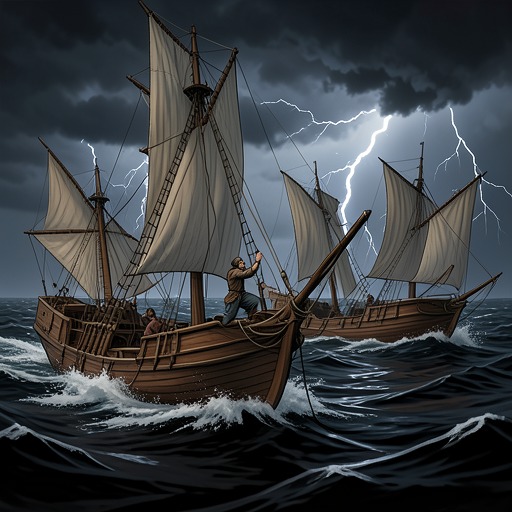
Strait of Messina
AeneidThe Strait of Messina is presented as a dangerous passage between Italy and Sicily, a maritime threshold whose geography turns movement into a calculated risk. Aeneas is warned that, after the winds carry his fleet toward Sicily, he must make for the straits and then alter course carefully: he is to tack to the larboard, stand out to sea, and afterward veer starboard between sea and land. The passage is therefore not merely a point on the route but a narrow space in which the future of the Trojan voyage depends on exact judgment.
Definition and Setting
The strait is marked by two contrary perils. On the right, Scylla lies hidden with her dogs; on the left, Charybdis rules with a roaring whirlpool that draws in the tides. The paired dangers make the channel a spatial trap: steering too close to one side exposes the fleet to the monster, while drifting toward the other risks being swallowed by the sea. Its threat is thus produced by opposition, with safety occupying the precarious middle between two forms of destruction.
The surrounding coastline is also described as vulnerable to time. Natural beauty and fertile fields can be diminished by decay, so that the passage joins violent maritime danger to the broader instability of the landscape. The strait is not an orderly boundary separating two secure territories; it is a shifting and hazardous edge where nature, navigation, and human purpose collide.
Navigation and the Voyage of Aeneas
The instructions concerning the Strait of Messina are delivered as practical guidance for the Trojan fleet. Once the wind has carried Aeneas toward Sicily, the ships must approach the straits, move away from the immediate shore, and then turn back toward the correct side. The sequence of tacks and veers gives the passage a precise operational logic. The danger can be survived only through controlled transitions rather than a direct advance.
This guidance places knowledge at the center of the voyage. The sea is not conquered by force; it is negotiated through foresight, restraint, and obedience to inherited instruction. For the Trojans, who are already moving through an uncertain world of exile and divine command, the strait condenses the larger structure of their journey: a promised destination does not remove danger, and destiny still requires competent action from those charged with fulfilling it.
Scylla, Charybdis, and the Logic of Risk
Scylla and Charybdis give the passage its memorable dramatic form. Scylla is concealed, her danger waiting on the right behind an apparently ordinary shoreline; Charybdis is audible and kinetic, announcing herself through roaring water and the violent suction of the whirlpool. One threat is figured as predatory concealment, the other as irresistible natural force. Together they make the strait a study in limited choice, where avoiding one danger does not eliminate danger but merely redirects the sailor toward another.
The passage also turns geography into moral and narrative pressure. The Trojans cannot simply proceed according to desire or speed. Their survival depends on recognizing that the apparent shortest route is not necessarily the safest and that every change of direction carries consequences. The channel's narrowness creates a continuous tension between movement and hesitation: the fleet must advance, yet advance only under discipline.
Narrative Significance
Within the larger account of Trojan wandering, the Strait of Messina functions as a threshold between the known stages of the voyage and the Italian future toward which Aeneas is being drawn. It is a place where the sea's physical dangers dramatize the uncertainty of transition. The passage from Sicily toward Italy is neither a clean departure nor a secure arrival; it is an exposed interval in which the fleet must pass between hostile alternatives.
The strait's importance lies less in a recorded battle or settlement than in the way it organizes the imagination of travel. Its paired hazards establish a recurring Virgilian pattern: human beings move under the pressure of forces greater than themselves, but divine purpose does not excuse error. The Strait of Messina therefore stands as both a real navigational obstacle and a compact emblem of the voyage's governing condition—progress toward the destined shore through a world where every boundary conceals a test.