Troy
AeneidTroy is the defeated homeland at the center of the poem’s historical and emotional movement: once a royal city defended by its warriors and identified with Priam’s house, it becomes the scene of conquest, massacre, and flight. Its destruction does not end its significance. Through the survivors who leave its ashes, its lineage, memories, and sacred objects are carried forward into the founding destiny associated with Rome.
City Under Siege and Fall
Troy appears first as a city already beyond rescue. The enemy has taken possession of the wall, and the city is described as nodding from its height and tottering toward ruin. The fall is therefore both military and political: the defenses fail, and the authority represented by Priam’s royal name has been exhausted. The language of the collapsing wall turns the city itself into a body losing its balance, while the destruction of the Trojan state establishes the catastrophe from which the later narrative must proceed.
Even in its final night, Troy remains a place of resistance. Ripheus and Iph’itas fight beside Aeneas, one renowned for valor and the other honored for age; Dymas and Hypanis are also known by moonlight amid the confusion. These figures place the city’s ruin against a continuing ethic of defense. Troy is not abandoned because its people lack courage. It is lost because the invading forces have already breached the conditions under which courage could save it.
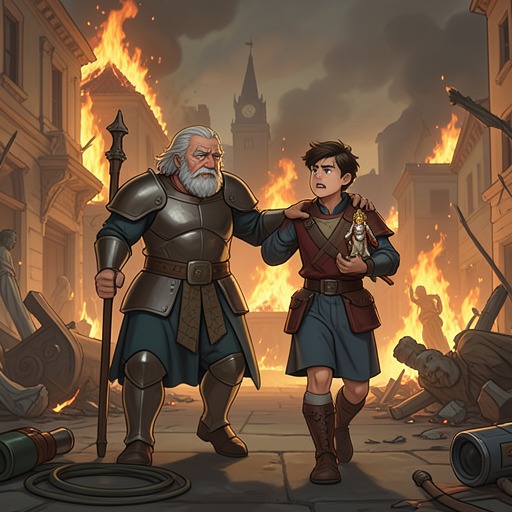
The violence of the conquest reaches its most shocking form in the assault on Priam. Pyrrhus orders the old king to go to his fate and to report his deeds to his father, then drags him through clotted blood and sacred mire. The blood is that of Priam’s murdered son, so the space of royal and religious meaning is physically mixed with family slaughter. Troy’s fall thus destroys not merely a polity but the bodies and bonds through which that polity had been represented.
Homeland of the Exiles
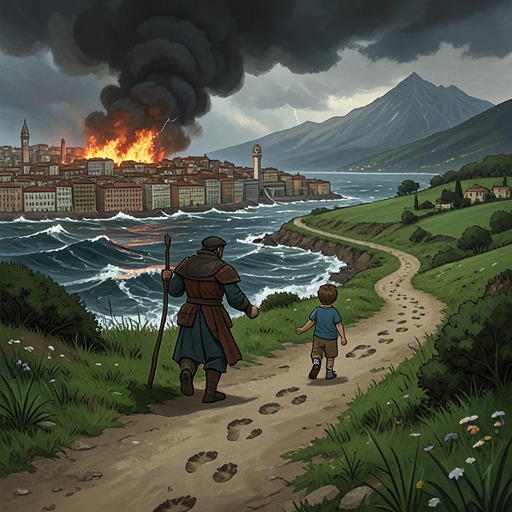
After the city has become the Greeks’ prey, Aeneas narrates what follows as a departure from a destroyed world. When Anchises calls the people to the sea, the crew obeys both the father and the Fates. Aeneas leaves his native shore with sighs and tears, abandoning the empty fields where Ilium had stood. The city’s defining feature after its fall is absence: it survives in the contrast between the homeland once inhabited and the vacant ground left behind.
The departing company carries more than refugees. Aeneas leaves with Anchises, Ascanius, and the household gods, joining family continuity to religious continuity. Troy is consequently displaced without being wholly severed from its people. Its sacred inheritance travels with the fleet, and the ruined city becomes the point of departure for a mobile Trojan identity rather than a final endpoint.
Troy also remains the background against which later peoples and traditions are measured. The poem repeatedly places Trojan ancestry in relation to other heroic lines. In the temple encountered during the journey, the old heroic race of Teucer is remembered as belonging to better and happier times; Assaracus and Ilus are among those whose names preserve the ancient genealogical world. Such remembrance makes Troy more than a battlefield. It is a reservoir of descent, a past whose surviving names authorize the future.
Memory, Genealogy, and Sacred Space
The memory of Troy is not confined to the living. In the Elysian Fields, Anchises reviews the muster of the race appointed by fate, presenting the ancestral order as something that can be surveyed and counted. The ruined homeland is thus reconstituted through genealogy: although its walls have fallen, its line continues as an intelligible succession. The city’s political destruction is answered by the persistence of its descendants.
Other sacred landscapes preserve or reinterpret the old heroic past. The temple containing the story of Daedalus records a flight from the Cretan shore and turns escape into an image capable of being housed, viewed, and transmitted by Fame. The episode does not restore Troy, but it places Trojan experience within a wider Mediterranean archive of displacement, skill, danger, and survival. Troy’s story becomes part of a tradition in which catastrophe can be transformed into cultural memory.
The poem also contrasts Trojan inheritance with the religious histories of places encountered after exile. A sacred forest is associated with the first inhabitants of Greek blood, who vowed it to Silvanus as guardian of flocks and fields. Against such established local sanctity, the Trojans carry their own gods and ancestral obligations. Their movement through foreign spaces therefore becomes a gradual negotiation between an inherited homeland and the new sacred geographies in which their future must be made.
Ruin Repeated in Later Conflict
Troy’s destruction casts a long shadow over subsequent scenes of war. When Misenus is found lying extended on the shore, his death recalls the recurring vulnerability of the Trojan company even after escape from the city. Aeneas responds by ordering a stately tomb topped with a trumpet, a soldier’s falchion, and a seaman’s oar. The monument joins battle, voyage, and mourning, converting the dispersed experience of the Trojan exiles into an object of remembrance.
The same connection between private death and public memory appears when the Arcadians carry the breathless body of Pallas back from the unhappy field on a shield. The transport of the fallen warrior echoes the obligations created by Troy’s fall: bodies must be borne away, identified, mourned, and given meaning within a larger history. War repeatedly produces displaced corpses and damaged communities, while ritual attempts to impose form on the disorder.
The grief over Lausus intensifies this pattern. When the pious prince sees the young man dead, sorrow and tears follow, and the sight brings an image to his mind. The dead body becomes a vehicle of recognition, linking the present battlefield to an earlier catastrophe and to the human cost of inherited conflict. Troy’s ruin is therefore not a closed episode; its emotional structure—loss witnessed through the body, followed by memory—recurs in the wars that arise after the Trojan migration.
From Trojan Ruin to Historical Continuity
The poem places Troy within a chain that extends from Greek destruction to Trojan survival and then toward Roman identity. The Greeks who came to Troy’s destruction speak of themselves as a collective defined by that campaign, while the surviving Trojans represent the other side of the same historical rupture. The conflict is remembered not as an isolated quarrel but as an origin point for competing peoples and narratives.
At the end of the poem, the violence associated with Troy is answered by another decisive blow. Aeneas raises his arm and drives a shining sword deep into Turnus’s bosom after seeing the belt of Pallas. The act belongs to the Italian war, yet it carries the moral pressure of the Trojan past: abandoned homes, murdered kin, violated bodies, and the demand that the dead be remembered. Troy’s fall has become part of the force shaping the new order.
Troy’s narrative role is consequently paradoxical. It is the place that must be lost for the exiles to move toward their destined future, but it is also the place that gives that future its names, gods, family line, grief, and authority. Its walls collapse, its fields become empty, and its royal house is destroyed; nevertheless, its identity survives in the people who leave, the tombs they build, the ancestors they recount, and the political destiny that claims descent from its ruin.