Pallanteum
AeneidPallanteum is the small Arcadian town established by Evander after his people were driven from their homeland. Though poor in its present form, it occupies a decisive place in the poem’s geography of destiny: Aeneas sees its humble dwellings, turns his ships toward the shore, and enters a community whose name, ancestry, and future are bound to the rise of Rome.
Foundation and Name
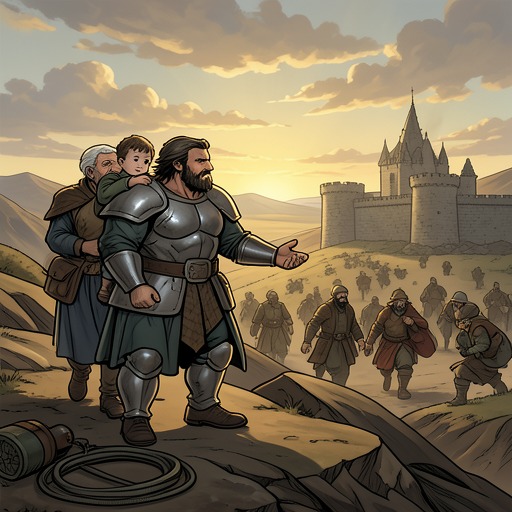
Pallanteum is presented as a settlement founded by Evander and named after Pallas, his great-grandfather. Its origin is therefore inseparable from displacement: the Arcadians arrive as a banished band, driven from their former land, and establish themselves behind elevated walls. The town is not introduced as an ancient metropolis or a finished power. It is a refuge made into a polity, its fortification marking the first claim of a displaced people to a new territory.
The name preserves a genealogy within the landscape. Pallanteum commemorates Pallas through Evander’s act of naming, making the settlement a material record of ancestry even before Pallas becomes important in the later Italian war. The city thus joins family memory to political foundation: a community’s identity is carried forward through a place whose name gives public form to private descent.
Appearance and Setting
When Aeneas approaches, Pallanteum appears as a poor and rudimentary kingdom. Its dwellings are described as huts that stand in a thin settlement, made of humble clay at that time, although later Roman power will raise such structures in marble. The contrast compresses an entire historical transformation into the town’s architecture: the modest beginnings visible to Aeneas are set against the monumental future associated with Roman rule.
The settlement’s poverty does not make it narratively insignificant. Its clay cottages are the visible starting point of a process in which exile becomes settlement, settlement becomes alliance, and alliance contributes to imperial history. Pallanteum is important precisely because it has not yet become grand. The scene allows the future greatness of Rome to be measured against the fragility of its remembered origins.
Aeneas’s Arrival and Alliance
Aeneas sees Evander’s humble kingdom from the sea and turns his ships toward its shore. This movement makes Pallanteum a point of transition for the Trojan expedition. The voyage does not end there, but the change of direction brings Aeneas into contact with an Italian community already shaped by migration and forced departure. Evander’s experience gives a local counterpart to the Trojan condition of exile.
The encounter also initiates the alliance between Aeneas and Evander. The town functions as more than a place of reception: it is the political setting in which Trojan purpose meets Arcadian memory and Italian resistance to the coming conflict. Through Pallanteum, Aeneas’s search for a future homeland becomes connected with existing communities, inherited names, and the networks that will support the struggle in Latium.
Historical and Narrative Significance
Pallanteum occupies a foundational position in the poem’s Roman genealogy. Its humble scale contrasts with the later splendor of Roman buildings, while its foundation by an exiled people anticipates the larger history of Rome as a power formed through migration, incorporation, and the conversion of precarious settlements into enduring institutions. The town is therefore both a real scene in the action and a miniature model of the poem’s larger historical imagination.
Its significance is strengthened by the surrounding legendary and genealogical traditions. In the Underworld, the poem places earlier heroic lines within a larger account of Roman futurity, including the old heroic race descended from Teucer, with figures such as Assaracus and Ilus. Elsewhere, sacred groves and ancient settlements preserve the memory of peoples who preceded or accompanied the rise of new communities. Pallanteum belongs to this same pattern of layered beginnings: it is a place where the past is retained in names and ritual memory while the future is already implied by the settlement’s later transformation.
The town also links heroic inheritance with political expansion. The poem repeatedly gathers Greek traditions, Trojan survival, and Italian foundation into a single Roman ancestry. Pallanteum embodies that synthesis in spatial form. It is Arcadian, yet destined to stand within the story of Rome; poor, yet associated with marble monuments to come; founded by exiles, yet positioned to assist the arrival of another displaced people. Its narrative power lies in this tension between what Aeneas sees and what the audience knows the place will signify.