Italia
AeneidItalia is the land that gives the Trojan wanderings their destination and historical direction. First announced under the older name Hesperia, it is described as fertile and inhabited by bold natives; the name Italia is associated with a later leader. The land is not merely a geographical refuge but the place to which the Trojans must return, converting exile into the beginning of a new political order.
Names, Origins, and Promised Destination
Italia enters the narrative through a correction of the Trojans’ mistaken settlement in Crete. A divine message declares that Crete is not the home granted to them and directs them toward Hesperia, identified with Italia. The revelation gives the journey a precise destination: the Trojans are told that Jasius and Dardanus were born there, and that the people descended from that land must return to it. Italia therefore functions simultaneously as homeland, inheritance, and future foundation.
The language of return is significant because the Trojans have not previously possessed Italia as an ordinary remembered homeland. Its status is established through divine genealogy and destiny rather than through immediate political control. The land becomes the meeting point between ancestral origin and historical future, where a displaced people will recover a place prepared for them by forces beyond their present knowledge.
From Distant Coast to Reachable Land
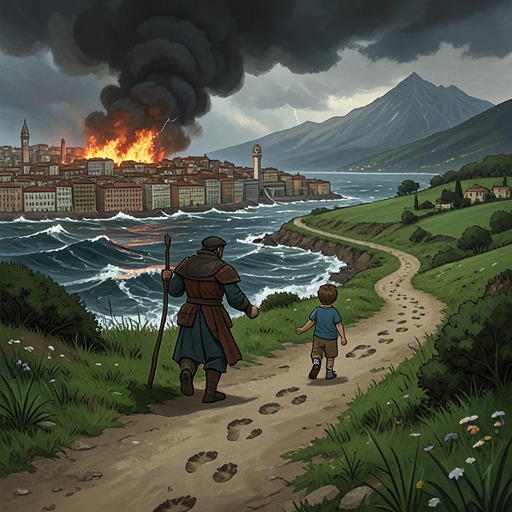
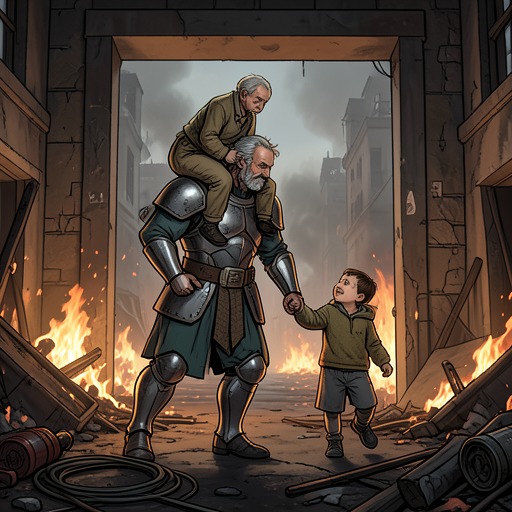
Italia remains at first a desired coast viewed from afar. Anchises, described as twice preserved by Venus when Troy was lost, is urged to recognize the Ausonian shore and land there, though he is instructed to take a wider course around it. This image places Italia at the end of a dangerous maritime passage while also linking its arrival to Anchises’s survival and to the protection of Venus.
The coast thus gathers several strands of the poem’s movement: the survival of the Trojan household, the guidance of divine powers, and the gradual conversion of prophecy into physical arrival. Italia is not reached as an accidental harbor. It is approached as the shore toward which the entire voyage has been ordered, and its appearance confirms that the losses of Troy have not erased the Trojan future.
A Land Made Political by Conflict
Once the Trojans’ promised destination becomes the setting of settlement, Italia is no longer represented only as fertile or divinely assigned. It becomes a space in which competing peoples, rulers, and claims must be ordered. The conflict between the Trojans and the Latins turns the land into a battlefield, while the walls, gates, camps, and courts through which the fighting proceeds show that possession of Italia is produced through control of bounded spaces.
The struggle is eventually interrupted when suppliants from Laurentum approach with olive branches and request a truce. Aeneas grants their petition and speaks against the severity of the quarrel that has armed the Latian state against an unoffending man. Italia’s political life is therefore shaped not only by force but also by recognized claims of supplication, clemency, and negotiated pause. The land’s future depends on whether violence can be brought under a lawful and ritual form.
Treaty, Sovereignty, and Settlement
The movement from war toward order is made public when peace is tied with solemn vows and sworn on both sides, with the required holy rites performed. Italia becomes the place where a divided political world is formally reconstituted through reciprocal obligation. The treaty is not a private promise: it is enacted in public view, witnessed by communities, and secured through ritual language and religious procedure.
The settlement is also connected to dynastic legitimacy. Aeneas is told that the conquest and the royal wife belong to him, but the final confrontation makes clear that victory over a yielded man would be ignoble. The land’s future cannot be secured by unrestrained triumph alone. It requires a distinction between rightful conquest and dishonorable violence, between the end of resistance and the duties owed after submission.
Sacred Geography and Historical Future
Italia contains spaces marked by radically different kinds of passage. The poem places gates, walls, courts, forests, temples, lakes, and shores within the larger geography through which heroic and divine powers move. The approach to the Stygian lake, Daedalus’s flight from the Cretan shore remembered in a golden-roofed temple, and the public rites that conclude the Latin conflict all connect land with memory, myth, and sacred boundary.
At the same time, Italia is repeatedly associated with acts of communal formation. Aeneas spreads a table beneath a shady tree and feeds with his chiefs on bread and forest fruits, an apparently modest meal that gives the arriving people a shared center before later political institutions are secured. Elsewhere, crowds gather around their general awaiting command, showing the land becoming a military community organized under leadership. Italia’s significance lies in this transformation: a promised coast becomes a lived territory, a battlefield becomes a treaty ground, and an ancestral name becomes the geographical foundation of Roman imperial destiny.