Latium
AeneidLatium is the Italian land in which exile is transformed into settlement and a promised future becomes political reality. It receives Aeneas as a potential ally and guest, but its succession, marriage politics, and inherited conflicts turn that welcome into war. By the end, Latium has become the ground on which Trojan destiny and Latin sovereignty are joined through treaty, violence, and the prospect of peace.
Prophecy and the Italian Future
Latium first appears within Cassandra’s remembered prophecy. Anchises tells Aeneas that Cassandra had foretold the renewal of Troy in Italy and in the Latin lands, a prediction whose meaning could not have been understood when it was spoken. Latium therefore enters the narrative not merely as a geographical destination but as the place where the fallen city’s identity is to be renewed. Its significance lies in the reversal by which Troy’s destruction becomes the precondition for another political beginning.
The land’s future is also tied to succession. Latinus, its king, receives Aeneas and offers him Lavinia, his only daughter and heir to the crown. That offer makes Latium’s dynastic order the immediate point of contact between the Trojan exile and the established Italian kingdom. Marriage is consequently not a private arrangement alone: it determines who may inherit the land and which people will become attached to its royal line.
Hospitality and Political Order
Latium is presented as capable of receiving strangers through consent rather than compulsion. Its people are said to be willing to show kindness, and their disposition is connected with the memory of Saturn’s holy reign. This recollection gives Latin hospitality a moral and historical foundation: the land preserves an image of an earlier order in which political conduct is governed by peaceable custom rather than sheer force.
That ideal is tested by the arrival of Aeneas. Latinus’s welcome establishes a legitimate basis for alliance, while his promise of Lavinia offers the Trojans more than temporary shelter. It offers them a recognized place within the political structure of Latium. The later conflict is therefore not caused by an absence of lawful possibilities; it arises when those possibilities are challenged by competing desire, family influence, divine hostility, and armed resistance.
War at the Threshold of Settlement
The marriage arrangement provokes Turnus, who loves Lavinia and is supported by her mother, Amata, as well as by Juno and Alecto. Their opposition breaks the treaty and draws neighboring leaders into the quarrel, including Mezentius, Camilla, and Messapus. Latium thus becomes a divided political field: the authority of its king points toward Aeneas, while powerful figures within and around the kingdom mobilize against the settlement that authority proposes.
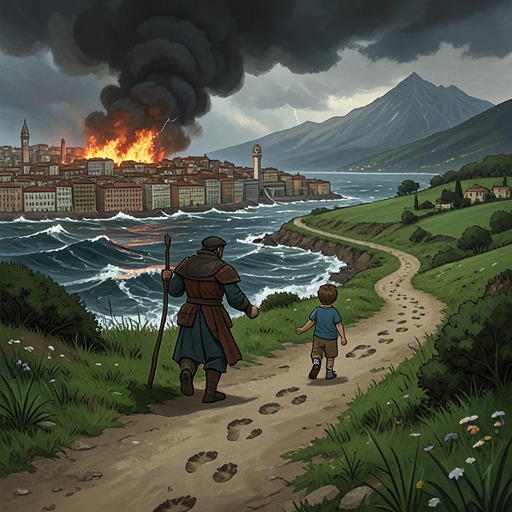
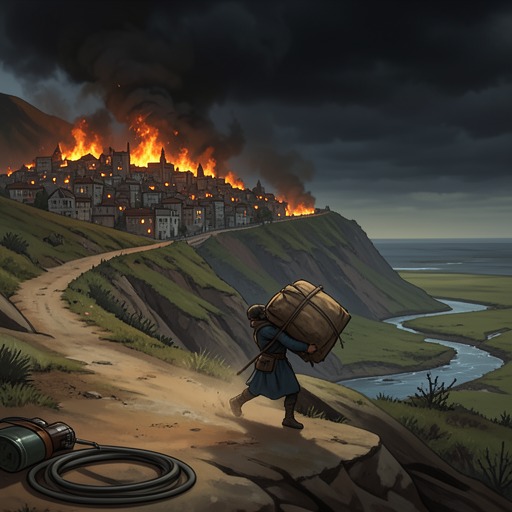
The war reaches the physical spaces through which Latian sovereignty is defended. Trojan and allied forces fight to hold walls, while attacking troops force a gate, rush through the opened passage, and enter a court amid shouts. Firebrands rise toward the roofs as the court is invaded and buildings are threatened by flame. These actions turn Latium’s civic boundaries into visible signs of the conflict over possession: the gate separates ordered political space from the violence seeking to capture it, and the burning roofs show that dynastic dispute has become devastation of the community itself.
The land also contains the memory of older peoples and heroic traditions. In the sacred grove dedicated by the first Greek inhabitants to Silvanus, guardian of flocks and fields, the narrative preserves a stratum of settlement older than the current war. The grove’s sanctity places agriculture, herding, and ritual protection beneath the political crisis. Latium is therefore not an empty territory awaiting conquest; it is a layered place inhabited by memories, cults, and communities whose past gives weight to the struggle over its future.
Truce, Treaty, and Reconciliation
After the fighting, suppliants sent from Laurentum approach with olive branches and ask for a truce. Aeneas grants their request because their suit is just, and the gesture temporarily replaces the logic of battle with the claims of mercy and lawful appeal. The truce shows that Latium’s political order can still recognize obligations even after violence has fractured it. The defeated or endangered community retains a voice, and that voice is answered rather than silenced.
Aeneas then addresses the Latian princes by condemning the severity of a fate that has drawn their state into causeless quarrels and armed it against an unoffending man. His appeal frames the war as a failure of judgment rather than an inevitable expression of national hatred. The language also distinguishes legitimate defense from needless aggression, making the conflict a dispute over the moral basis of arms as much as over Lavinia or territory.
The restoration of order is made public and ritualized. Latinus is urged to cease the rage of arms and ratify peace; on the following morning, the agreement is bound in public view with solemn vows sworn on both sides, and all dues required by sacred rites are performed. Latium’s peace is thus not a private reconciliation or an unspoken exhaustion. It is a formal act witnessed by the community and secured through oath and ritual, converting an unstable cessation of violence into a recognized political settlement.
The Land’s Decisive Narrative Role
Latium gathers the poem’s central movement from displacement toward foundation. It is the destination announced by prophecy, the kingdom whose marriage alliance can absorb the Trojan newcomers, the society whose internal divisions unleash war, and the political space where peace must finally be sworn. Its apparent hospitality and its susceptibility to violence remain in tension throughout: the land can welcome outsiders, yet its succession and identity are vulnerable to passions that turn welcome into conflict.
The final suspense belongs to the human representatives of Latium and Troy. Aeneas stands prepared to strike Turnus, then represses his hand as he considers what he sees. The decision at that moment determines whether the land will remain governed by vengeance or pass into a new order. Latium’s importance therefore culminates not simply in military victory but in the possibility that its royal and territorial future will be reorganized through the union of Trojan and Latin claims. It is the setting in which the poem’s promised renewal becomes both a political fact and an ethical test.