Tiber
AeneidThe Tiber is the river through which the poem’s geography of exile becomes a geography of foundation. First perceived by the Trojan fleet as it moves along the Italian coast, it carries the exiles toward the land promised by prophecy; later, its banks hold scenes of mourning, negotiation, and public reconciliation. The river therefore joins natural landscape to political destiny, standing at the meeting point of movement, settlement, and the emerging order of Italy.
Setting and Discovery
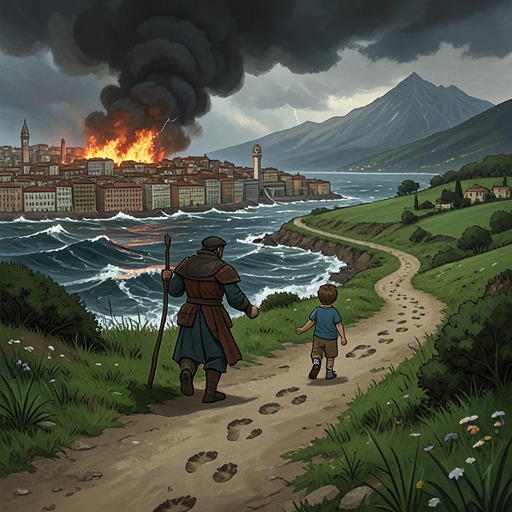
The river enters the narrative as part of the landscape seen by the Trojans from the sea. After a sudden stillness on the water, the oars drive the fleet forward, and the Trojan hero observes a dark, densely shaded wood through which the Tiber takes its course. The river is not introduced as an already inhabited civic center but as a feature of a solemn, wooded country. Its appearance signals that the voyagers are approaching the territory where their uncertain search for a home will acquire a definite direction.
The Tiber’s importance is also prepared by the prophecy concerning the journey to Italy. At Cumae, the Sibyl directs the hero toward the waters of black Avernus and the prophetic landscape surrounding it, placing the river within a larger chain of sacred and geographical signs. The Tiber thus belongs to a route whose physical landmarks are inseparable from divine instruction: the sea voyage opens into a riverine passage, and the riverine passage opens toward the historical future of the Trojans.
The River as Personified Power
The Tiber is not merely scenery. While the Trojan leader lies grieving on its banks and finds temporary relief in sleep, the father of the Roman river rises through the shadows of the poplar wood. He appears with an azure robe over his body, assuming the form of a local divinity who can address the founder directly. This apparition gives the river a voice and a political function: the landscape itself becomes an interpreter of destiny rather than a passive obstacle or backdrop.
The personified river embodies continuity between the natural world and the future community. Its waters belong to the land the Trojans seek, yet its divine manifestation also recognizes the hero’s arrival as part of a larger order. The river’s emergence from the poplar shadows transforms private grief into prophetic orientation, allowing the scene to move from emotional exhaustion toward renewed purpose.
Banks of Grief and Negotiation
The Tiber’s banks later become associated with the human cost of the conflict. Grief is not confined to the battlefield; the river’s presence frames the mournful aftermath in which suffering is absorbed into the landscape of the new settlement. Its banks are therefore a threshold between death and political action, a place where sorrow can lead to counsel, appeal, or renewed obligation.
This function becomes explicit when suppliants from Laurentum approach with olive branches and ask for a truce. Their appeal is made within the political world that the Tiber helps define, and the river’s presence lends the negotiations a setting broader than military command. The hero grants the request because the petition is just, then addresses the Latian princes by condemning the severity of the fate that has drawn them into causeless quarrels against an unoffending man. The river landscape thus holds a temporary reversal in the logic of war: arms give way to speech, and hostility is measured against justice.
Peace and the Founding Landscape
The Tiber also belongs to the formal transition from conflict to settlement. The hero sends word to the Latian king to cease the rage of arms and ratify peace; afterward, peace is tied publicly with solemn vows, with both sides swearing and performing the rites required by religious custom. The river’s world consequently becomes associated not only with arrival but with the creation of binding political relations. Its banks witness the movement from improvised alliance to an order sanctioned by oath and ritual.
That order remains precarious. At the later confrontation, the Trojan appears in deep suspense, prepared to strike but restraining his hand for a moment. The river’s earlier association with truce and solemn vows stands in sharp contrast to the renewed immediacy of violence. The Tiber does not erase conflict; rather, it marks the contested space in which war, clemency, obligation, and the prospect of a shared future are repeatedly brought into relation.
Narrative Significance
Across the poem, the Tiber gathers several meanings into one recurring image. It is a route by which displaced people approach Italy, a sacredly charged landscape capable of producing a prophetic figure, a bank where grief is endured, and a political setting where enemies seek truce and swear peace. Its movement from distant natural feature to personified power mirrors the Trojans’ movement from uncertain wandering toward a land that will become the foundation of Roman history.
The river also mediates between older heroic memory and a new Italian destiny. The poem recalls Trojan warriors such as Ripheus and Iph’itas, the groves near old Antandros and the foot of Ida where the fleet is built, and the ancient heroic race descended from Teucer; against this background, the Tiber represents the destination in which inherited memory will be reorganized into a future polity. Its waters connect exile to settlement, but the scenes on its banks insist that settlement is achieved through suffering, negotiation, ritual, and the difficult restraint of violence.