Kislovodsk
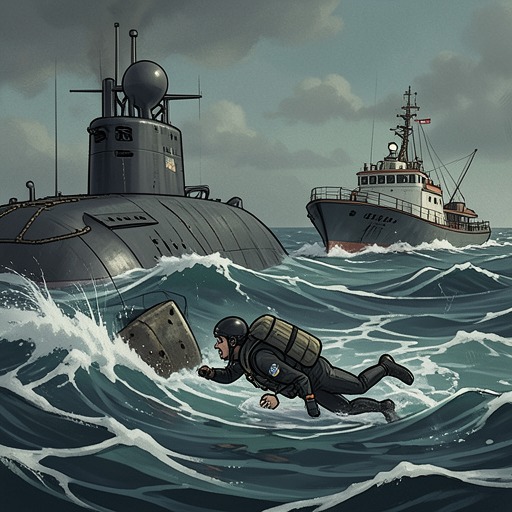
AfterburnKislovodsk is a Russian submarine assigned to follow an American battle group into the Black Sea, where concealment and proximity become competing demands. Its surveillance mission places it within scant meters of American helicopter-mounted sonar, and its later catastrophic structural failure turns the covert pursuer into a wreck. The novel makes the submarine’s fate a material measure of how quickly a calculated effort to remain close and unseen can become exposure and destruction.
Identity and Mission
Kislovodsk appears as a Russian submarine with a role in tracking the American battle group. Another Russian submarine, Krimsky Komsomolets, had already been shadowing the group as it moved up the Aegean. Orders from Balaklava then directed Kislovodsk to take up the pursuit and continue it inside the Black Sea. The change of assignment makes the submarine part of a relay: the target’s movement carries the surveillance operation from one stretch of water into another, while Kislovodsk inherits the task of keeping the American ships under observation.
The orders impose a precise tension. Kislovodsk is to remain unobserved, but also to approach the battle group’s major ships as closely as possible. Concealment is therefore not simply a matter of keeping distance; the mission requires the submarine to risk proximity in order to observe its target. The account identifies the American force as a battle group and stresses the major ships as the objects of surveillance, without reducing the assignment to a single encounter. Kislovodsk’s purpose is sustained shadowing, not a brief appearance alongside the group.
Detection and the Control Room
The submarine’s mission is rendered through the control room, where Captain First Rank Aleksei Aleksandrovich Vyatkin looks up toward the overhead as the sound of the American helicopter-mounted sonars suggests that they are almost directly above the hull. The account measures the danger in physical terms: the sonars seem to be only scant meters away. That compressed distance makes the submarine’s central predicament immediate. Kislovodsk is close enough to carry out the assignment, but its closeness threatens the secrecy on which the assignment depends.
The submarine’s crew recognizes that the Americans have found them quickly. That recognition marks a reversal in the surveillance relationship: Kislovodsk set out to watch the battle group without being observed, yet the American search has brought detection to the control room’s threshold. The scene stays with the submarine’s confined perspective, its overhead crowded with conduits and wiring, while the danger arrives through sonar from outside. The contrast between the maze inside and the nearby aircraft above makes the vessel’s concealment feel increasingly fragile.
The Kukla Device
A later control-room passage introduces the Kukla decoy torpedo. It is described as a standard 533-millimeter torpedo whose warhead has been removed and replaced with sophisticated microelectronics. The device’s name means puppet in Russian, a suggestive label for a torpedo reconfigured to serve as a decoy rather than as a conventional warhead-bearing weapon. Its construction is specific: the familiar torpedo body remains, but its internal function has been transformed by the substitution of electronics for explosives.
The evidence places this description aboard Kislovodsk, but does not establish the device’s deployment or spell out its effect. Its presence in the submarine’s control-room sequence nevertheless connects the vessel to the technical means of underwater deception. That detail echoes the mission’s broader dependence on managing what an adversary can detect: Kislovodsk itself must approach without being seen, while the decoy embodies another form of misleading the senses and systems used to track objects beneath the surface.
Destruction and Narrative Significance
The account of Kislovodsk’s destruction focuses on the hull’s failure. The submarine is caught in a temporary balance between buoyancy and flooding; then a final grinding shudder precedes the keel parting just beneath the reactor compartment. Hull plates and internal ribbing are shredded, and the aft third tears free and plunges downward. The failure is presented through successive physical changes rather than as an abstract report of a vessel lost: unstable balance, a break in the keel, the tearing of the structure, and the separation of the stern section.
That sequence gives the submarine a sharp narrative reversal. Kislovodsk first appears as a concealed instrument of observation, tasked to close on a powerful target while remaining hidden. It is then exposed to the American search, and its eventual structural breakup makes the act of remaining in the depths no guarantee of safety. The narrative’s attention to the keel beneath the reactor compartment and to the aft third pulling away gives the loss a specific mechanical form. Kislovodsk is not merely removed from the pursuit; its hull is divided, and the submarine’s carefully maintained balance between buoyancy and flooding gives way to disintegration.