E-2C Hawkeye
AfterburnThe E-2C Hawkeye is the airborne eye of the carrier force in the Black Sea: a radar platform that can watch a broad area, report contacts, and help coordinate the aircraft operating around it. The narrative presents it not as a substitute for the fighters, but as the high, persistent node that helps the fleet see and organize a changing air picture. Its importance becomes especially clear when that picture is obscured by distance, terrain, or electronic interference—and when the air wing’s ability to keep flying is threatened by dwindling supplies.
Design and Role
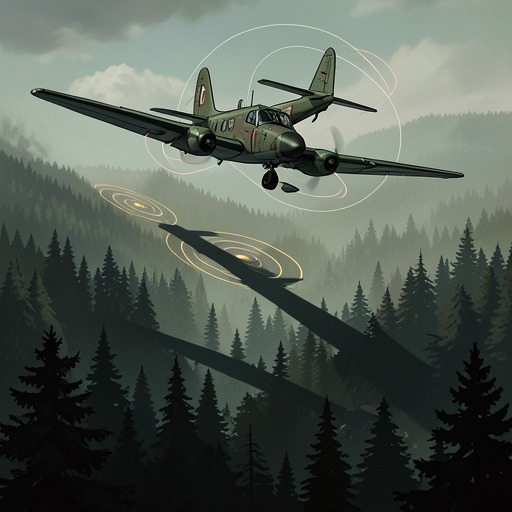
One of the carrier’s four E-2Cs, assigned to VAW-130, the Hawkeye looks markedly different from the jets around it. It is a gray, twin-engined turboprop with a large, flat radome mounted above the fuselage, an unusual silhouette among the carrier’s sleek, high-powered aircraft. The radome houses the APS-125 radar, the system that makes the aircraft the fleet’s eyes. Its electronics can follow air and surface activity across a circle nearly five hundred nautical miles in diameter, giving the carrier a view that extends far beyond the reach of a single fighter’s immediate sensors.
That role is also expressed in how the air wing is organized. The Hawkeyes form the hub of a structure compared to a wheel, with the other aircraft connected to them like spokes. The comparison describes more than a formation: the Hawkeye’s value lies in collecting and distributing information that other aircraft can use. When one is being prepared on Cat One, it is not simply another aircraft being launched; it is a means of extending the fleet’s awareness as the carrier adds its air wing to the United Nations mission near Poti.
Surveillance over the Black Sea
The Hawkeye’s work is shown through the procedures of its crews. At one point an E-2C orbits a fixed position fifty thousand feet above the Black Sea while its electronics monitor air activity across the wide radar circle. From there, the crew calls to Bird Dog, seeking a response while maintaining the airborne surveillance picture. The aircraft’s altitude and station allow it to keep watch over a broad area rather than follow a single contact at low level.
The information it gathers is not always clear. In a later surveillance exchange, Lieutenant Arnold Brown is aboard E-2C Hawkeye Tango 61 over the Black Sea, checking the radar sweep’s green-white fuzz. He reports a contact designated Mike One-five, bearing two-zero-five at a range of one-zero-eight. Heavy electronic countermeasures interfere with the picture, but he assesses that the contact consists of multiple aircraft flying low. The scene makes the Hawkeye’s function concrete: its crew must interpret imperfect returns and communicate an assessment before the identity and intentions of the contacts are certain.
Another radar return is tracked off the mountains near Poti. The blip appears to be about thirty miles from the city and moving away at 150 knots; the operator adjusts the gain while watching it crawl across a tangled pattern of returns. The specific distance and speed turn a broad surveillance capability into a tactical report. The Hawkeye does not make the situation self-explanatory, but it gives the fleet a contact to evaluate and a direction in which to focus attention.
Coordination with the Fighters
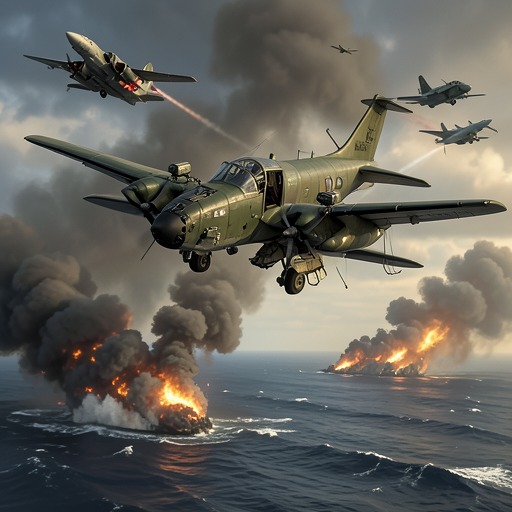
The Hawkeye’s radar picture is part of a shared system rather than a final view of every engagement. As F-14s close on their contacts, their AWG-9 radars provide a better picture than the Hawkeye’s more powerful but more distant sensors. The aircraft can share information through a data link, allowing the Hawkeye’s broad-area awareness and the fighters’ nearer, more detailed readings to complement one another. The distinction matters: the airborne controller can locate and track activity at range, while the fighters improve the picture as they approach.
The fleet’s dependence on that surveillance is made explicit in its operating plan. Hawkeye and Prowler electronic-surveillance flights are to continue, and the E-2Cs must remain airborne around the clock; without them, the carrier group is described as sailing blind. Continuous coverage is therefore not an incidental advantage but a requirement of operating in a contested area. The Hawkeye’s effectiveness depends on the wider air wing, the communications between its aircraft, and crews able to keep interpreting the returns under pressure.
Endurance and Supply
That requirement has a material cost. A modern carrier such as the Jefferson needs at-sea replenishment of expendable stores every two to three weeks. Nuclear power means the carrier itself does not need fuel, but its aircraft consume aviation fuel and other supplies. The air wing’s practical margin is no more than ten days, and less if the flight schedule is heavy, a major strike is launched, or an extended battle develops. The only sources of resupply are the UNREP tankers following the battle group, making sustained airborne coverage dependent on a supply chain that can itself be placed at risk.
The danger sharpens when the Bosporus Strait is closed. Heavy flying can cut the carrier’s remaining margin from ten days to two to four; once the supplies are exhausted, the carrier and its escorts would be trapped in the Black Sea as large but useless ships. This constraint bears directly on the Hawkeye’s round-the-clock mission: the fleet cannot remain continuously alert simply by ordering aircraft into the air. Every surveillance flight consumes resources needed to keep the whole air wing operating.
The scale of replenishment is visible in the plan to pump nearly three million gallons—about nine thousand tons—of aviation fuel aboard, after the fuel has been judged to meet the Jefferson’s demanding standards. Flight-deck operations are suspended during the pumping because the fuel is highly flammable. The pause exposes the tension built into carrier aviation: the Hawkeye helps prevent the fleet from sailing blind, but keeping it aloft requires fuel handling on a scale that temporarily stops flight operations.
Significance in the Mission
The Hawkeye’s place in the story joins tactical visibility to political and logistical uncertainty. The Jefferson enters the waters off Poti to add its air wing to the United Nations’ leverage, amid longstanding debate over placing American forces under United Nations command. Later, Washington grants United Nations operational authority over U.S. forces in the Crimean Peacekeeping Operational Zone, and the American commander orders his officers to operate under that authority until the President says otherwise. The Hawkeye is part of the air capability deployed within this changing command arrangement, even as the text’s operational detail remains focused on what its radar crews can observe and report.
Its recurring function is to make distance usable without pretending that distance has disappeared. The large radar circle supplies warning; electronic interference and clutter preserve uncertainty; fighter sensors refine the picture; and the fuel crisis limits how long the whole system can stay aloft. The Hawkeye is thus both an aircraft and a dependency within the carrier group: a central instrument of awareness whose value is inseparable from coordination, interpretation, and endurance.