CH-53 Sea Stallion
AfterburnThe CH-53 Sea Stallion is a large military helicopter used in the novel to move personnel between ships and shore locations. Its appearances give it two sharply different roles: a means of carrying senior officers away from the White Palace grounds, and a vulnerable aircraft caught in an attack at Yalta. Later, five helicopters from USS Guadalcanal bring Marines and sailors into a landing zone at night, presenting rotary-wing transport as a practical link between naval forces and operations ashore.
Role and Operational Setting
The novel offers no technical specifications for the CH-53 Sea Stallion; it defines the aircraft through what it carries and where it is expected to go. At the White Palace, one is waiting on the east side of the grounds for Boychenko and his senior staff officers, together with Admiral Tarrant and his staff. Their departure is to follow a brief opportunity for the press to ask questions, making the helicopter the planned next step in moving the principal figures away from the site.
That scheduled movement places the aircraft within a larger operation involving political and military leaders, but its function remains concrete: it is the transport waiting to take people from the grounds. The scene also establishes how much depends on a vehicle being ready at the right place. The plan names the east side of the White Palace grounds, and the CH-53 is already there before the passengers arrive.
At Yalta: Transport Under Attack
At 1014 hours, Matthew “Tombstone” Magruder is alighting from a CH-53 at the White Palace in Yalta when he hears aircraft approaching. The arrival is interrupted almost immediately by the sound of the incoming planes. After the attack, Magruder rises from his hiding place and runs back toward the helicopter, fearing that it has been targeted.
His fear is confirmed: the Sea Stallion has been hit in the strafing run. It is left at a sharp angle, with flames visible. The helicopter that had just brought Magruder to the site is no longer simply a way out or a means of movement; it has become another object of danger on the ground. The scene makes the aircraft’s usefulness conditional: transport can place personnel at a destination, but it cannot guarantee that the landing site or the aircraft will remain safe.
Night Landing from USS Guadalcanal
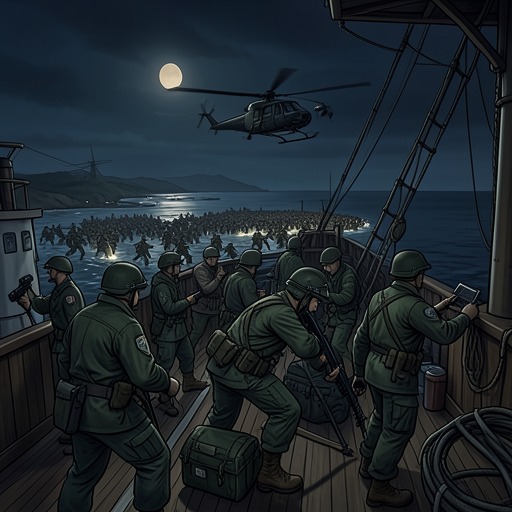
A later landing scene offers a different picture of the Sea Stallion’s operational use. After a conversation about the landing zone, Matthew “Tombstone” Magruder hears rotors offshore. The sound grows from a distant flutter into a heavy drone as five large, gray CH-53 Sea Stallions from USS Guadalcanal come in at night.
They approach fast, flare out one after another, and are directed in by Marines and sailors using flashlights as landing signals. The specific details—the five aircraft, their shipboard origin, the dark, and the improvised visible signals—show the coordination required to bring a group of helicopters into a landing zone. Unlike the damaged aircraft at Yalta, these Sea Stallions arrive as a coordinated transport force, carrying Marines and sailors toward shore.
Mobility and Vulnerability
Across these scenes, the CH-53 Sea Stallion connects ships, shore positions, and the movement of people. At the White Palace, it waits for senior personnel; at Yalta, one has delivered Magruder but is then struck by an attack; from USS Guadalcanal, five aircraft arrive to support a nighttime landing. The repeated transport role is therefore not an abstract capability but a sequence of specific situations, each shaped by the conditions at the destination.
The contrast is especially clear between the planned departure from the White Palace and the damaged helicopter at Yalta. In one scene, the aircraft is part of an orderly arrangement for moving officials after a press opportunity. In another, the noise of approaching aircraft turns a landing into an immediate threat, and the Sea Stallion itself is left burning. The later arrival from USS Guadalcanal restores the image of coordinated mobility, but not of safety: the aircraft can carry forces into a landing zone without removing the danger that defines the operation.