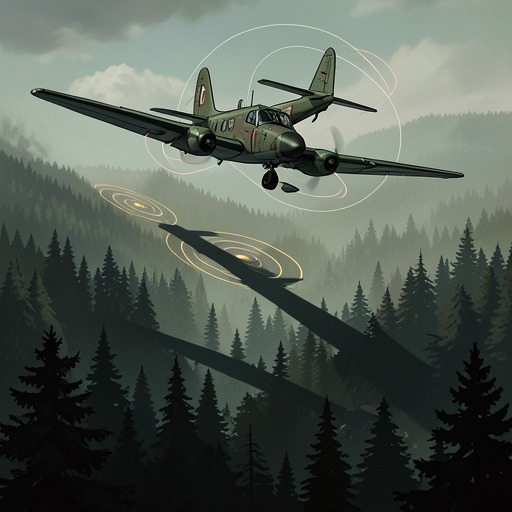
UH-60 Black Hawk helicopter of UN Flight 27
AfterburnThe UH-60 Black Hawk helicopter of UN Flight 27 was an Army aircraft supporting a UN mission in the Republic of Georgia. Its shootdown by a U.S. Navy jet turned a failure of coordination into a visible crisis: the helicopter had been sent to work with the UN team, but the fighter crews had not been told it was there. The aircraft crashed, its crew was injured but survived, and the incident exposed how a mission intended to help stabilize a dangerous region could itself become a source of danger.
Mission and operational setting
The helicopter was operating in the Georgia no-fly zone during a period when the UN sought to use a substantial military presence to contain regional problems. The Army aircraft had been sent into Georgia to work with the UN team. That assignment placed a support helicopter and Navy combat aircraft within the same operational environment, making reliable coordination essential even though the units belonged to different services and were acting in support of the same broader mission.
The fighter plan, as one Navy pilot understood it, called for the fighters to fly racecourse tracks over the sea unless a specific reason required them to go inland. That detail matters because it shows that the airspace was being managed through a plan with defined expectations, while the helicopter’s presence depended on information that had not reached the fighters. The account does not present the incident as a simple malfunction of the helicopter’s identification equipment. When a pilot later asked what had happened with the helicopter’s IFF, the response was that no one had told the fighters Army helicopters had been sent into Georgia to work with the UN team. The failure described is therefore a breakdown in notification, not a confirmed technical failure of IFF.
Attack and crash
At 0930 hours, Zulu plus four, the helicopter was flying in the UN no-fly zone over the Republic of Georgia. A warning came from Dom: a missile was inbound. Marty Cole reacted instinctively, pitching the Black Hawk’s nose up and turning hard to the right. The helicopter could not outrun the missile. The AIM-9 Sidewinder approached from above and behind at 660 miles per hour, drawn toward the bright exhaust flares beneath the helicopter’s two engine shrouds.
The account records the narrowness of the escape without turning it into a rescue: the missile struck before it could correct, and the aircraft nearly made it. The impact initiated a chain of physical failures. The engine blew, while a ruptured fuel line spilled aviation gasoline across a red-hot manifold. The helicopter hit soft ground hard. Its right-side ESSS crumpled and broke away, partly softening the crash; Cole slammed against his safety harness. The aircraft’s evasive turn had not prevented the hit, and the crash damage followed immediately from the missile strike.
Rescue and official recognition
The immediate outcome for the crew was serious but not fatal. A report from operations later said the flight crew was all right, though banged up, and had been picked up by a Marine medevac. The account gives no comparable resolution for the helicopter itself: it establishes the missile strike, engine failure, fuel spill, and ground impact, while its human focus shifts quickly to the surviving crew and their evacuation.
Two days after the shootdown, Samantha Reed addressed the incident in a meeting, stating that a Navy jet had shot down a U.S. Army helicopter flying a UN mission. That description made explicit the institutional contradiction at the center of the episode: American forces supporting an international operation had fired on another American service’s aircraft while it carried out that operation. The helicopter’s loss was not treated simply as an isolated aircraft accident; it had become an event requiring senior political attention.
Significance
The shootdown links a cockpit emergency to a wider organizational failure. In the air, the threat arrives with almost no time for deliberation: a missile warning, Cole’s hard turn, the Sidewinder’s approach, then impact and crash. The later discussion slows the sequence down and identifies what the pilots lacked before the crisis began—the information that Army helicopters were operating with the UN team. The contrast shifts attention from individual reflexes to the coordination system around them. Cole could maneuver, and the helicopter could carry flares, but neither could compensate for a mission that had not been communicated to the force responsible for operating in the airspace.
The episode also recalls the 1994 incident in which U.S. Air Force fighters destroyed two Army helicopters in the no-fly zone over northern Iraq. That comparison places the Georgia shootdown within a recurring danger of modern air operations: friendly forces can become targets when identification, notification, and command arrangements fail to align. The Black Hawk’s crash gives that danger a concrete form, while the surviving crew and Marine evacuation mark the limited good fortune within an otherwise grave failure. Its decisive significance is not only that a U.S. aircraft was lost, but that a UN mission’s own supporting forces proved capable of endangering one another.