F-14 Tomcat
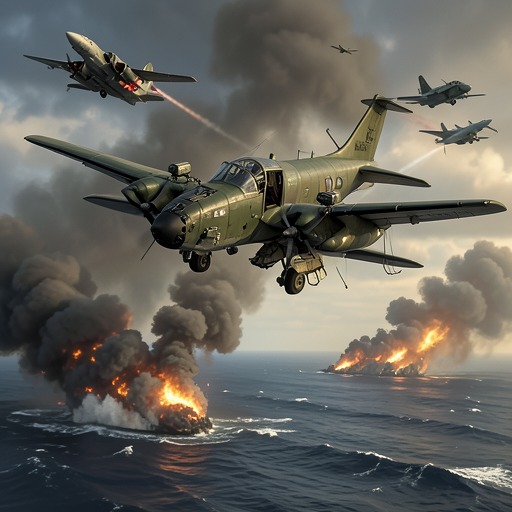
AfterburnThe F-14 Tomcat recurs as a working aircraft of the USS Thomas Jefferson’s air wing, carrying the story from carrier operations into patrol, interception, and ground attack. Its significance lies less in technical exposition than in the range of tasks assigned to it: the novel follows particular Tomcats by number, shows crews making weapon and maneuver decisions, and eventually places one aircraft in a strafing attack after its missiles are gone.
Carrier Aircraft and Deck Context
The Tomcat is tied to the carrier not only by its deployments but by the novel’s language of shipboard aviation. One passage describes the F-14 approaching for a carrier trap, placing the aircraft in the demanding final phase of returning to the ship. The surviving fragment does not complete its comparison of what the carrier looks like from that approach, but it makes the pilot’s perspective at the point of recovery part of the book’s aviation vocabulary.
The flight deck of the USS Thomas Jefferson is also identified with the command of Edward Everett Wayne. Elsewhere, Matthew “Tombstone” Magruder is described as CAG, the commander of CVW-20. These details situate the F-14 within an organized carrier air wing rather than as an isolated machine: its appearances belong to a deck, a command structure, and the coordinated work of aircraft and crews. The evidence identifies that institutional setting without supplying a full technical account of the Tomcat or the air wing’s organization.
Aircraft numbers give the recurring type a more specific presence. Tomcat 201 appears over the Black Sea, while Tomcat 218 is associated with combat air patrol and Tomcat 207 with later operations over Arsincevo. These labels distinguish successive episodes and make the aircraft’s work legible at the level of individual sorties, even when the narrative’s focus shifts among pilots and missions.
Patrol and Interception
Tomcat 218 is explicitly placed on CAP, and Dixie’s aircraft is described as carrying a standard Barrier CAP interception. The pairing of a numbered aircraft with a defined patrol role shows the F-14 being used to guard airspace and intercept approaching aircraft, not simply to launch into an unspecified combat. The phrase Barrier CAP identifies the particular form of the task; the evidence does not give the details of its full route or duration.
The account of Tomcat 201 over the Black Sea presents an engagement as a sequence of judgments. Batman holds the Tomcat steady, and the flight calls for visual confirmation before proceeding. A later fragment refers to a sighting picture in which an aircraft might suddenly pop up out of view, emphasizing how an approaching target’s visibility shapes the tactical problem. Rather than treating the F-14 as an automatic instrument, these moments make the pilot’s assessment of what can be seen part of the engagement.
The weapon decision is specific: Batman chooses a heat-seeking missile instead of a radar-guided AMRAAM. He then calls the launch as the firing switch closes, and the Tomcat enters a four-G turn. The passage thus connects identification, weapon selection, firing, and maneuver in a compact sequence. It shows that the aircraft’s role depends on a decision made under the conditions of the encounter, while stopping short of establishing, in the supplied evidence, the target’s ultimate fate.
The patrol and interception scenes also sit alongside the call for two flights of Tomcats, designated Air Hammer One and Air Hammer Two. That order suggests the use of aircraft in coordinated flights rather than in isolation. The available material identifies the two flight names and the type assigned, but does not specify their complete composition or the full course of their mission.
Weapons, Loading, and Changing Tasks
The book connects the Tomcat with both missile systems and the work of preparing weapons. One passage names the AIM-54C Phoenix together with the Tomcat’s AWG-9 radar fire-control system. Elsewhere, a scene invokes a figure for the aircraft’s full-loaded weight and shows an ordnance handler holding a bundle. Together, these details locate the aircraft within the practical business of weighing and arming a combat aircraft, as well as the targeting and weapons systems involved in its air operations. The fragments do not provide enough information to reconstruct the loading procedure or specify what the bundle contains.
Tomcat 207 is associated with Joyce “Tomboy” Flynn over the USS Thomas Jefferson. During a later sequence, Tomboy orders that the missiles be taken, and the account then makes clear that she has shifted to the aircraft’s gun because it is the only weapon available to her in that moment. The progression is important: the Tomcat’s armament is not presented as an unlimited reserve, and the aircraft’s next action follows from what remains after its missiles are no longer available.
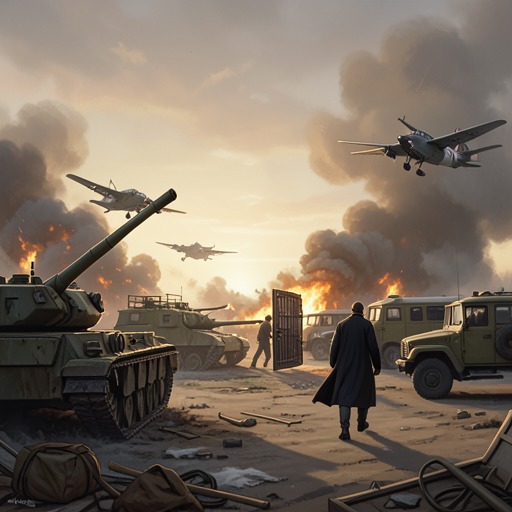
Over Arsincevo, Tomboy is out of missiles but still has the gun. She spots four tanks stretched out below and prepares to attack them. The aircraft has therefore moved from carrier-based operations and air-to-air interception into a ground-attack role. The evidence supports the change of target and weapon, but not an assumption about the result of the attack. What it establishes is the tactical consequence of depletion: the mission continues with a different weapon and against visible ground vehicles.
Narrative Function
Across these episodes, the F-14 links the large structures of carrier warfare to small, consequential decisions made in the aircraft. A CAP assignment, a request for visual confirmation, the choice between a heat-seeking weapon and an AMRAAM, a four-G turn, and the switch from missiles to guns each gives a different practical dimension to the same aircraft. The recurring model is not a static catalogue entry but a platform whose task changes with the situation and its remaining weapons.
The numbered callsigns and settings also create continuity without making every appearance identical. Tomcat 201 belongs to an engagement over the Black Sea; Tomcat 218 is identified with CAP; Tomcat 207 carries the narrative into the attack over Arsincevo. The changing numbers and locations keep the aircraft type in view while distinguishing separate operational contexts. In that structure, the F-14 is both a piece of carrier equipment and a narrative hinge between shipboard readiness, air defense, missile combat, and the more immediate threat posed by tanks on the ground.