MiG-27
AfterburnThe MiG-27 is presented as a veteran Russian attack aircraft and a direct threat to a carrier operating in the Black Sea. In the hands of Major Yevgenni Sergeivich Ivanov, its extreme-low-altitude, near-supersonic approach turns a strategic confrontation into a problem measured in seconds: the aircraft must avoid the sea, reach its target, and act before Turkish interceptors arrive. Its significance lies not only in its capacity to attack, but in the pressure it places on a U.S. carrier force already exposed by the limits of fuel and access to resupply.
Identity and Design
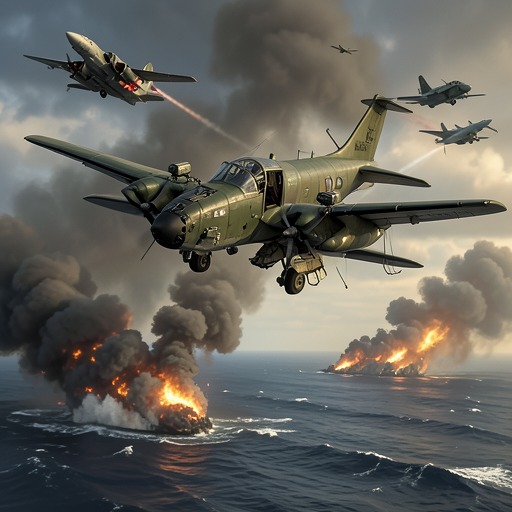
The aircraft appears in the narrative as a MiG-27M, a high-performance attack variant. Its variable-geometry wings sweep back along the fuselage, giving the plane a compact, predatory profile as it hurtles just above the speed of sound. Ivanov flies at Mach 1.1 at extreme low altitude, where even a small miscalculation could send aircraft and pilot into the sea. The description makes the aircraft’s speed inseparable from its danger: the same flight profile that brings it rapidly toward its objective leaves little margin for error.
The MiG-27’s broad, wedge-shaped nose was affectionately called the utkanos, or duck nose, by its pilots. That familiar nickname sits beside its NATO reporting name, Flogger-D, and the more formal designation MiG-27M. Together, the names locate the aircraft between the intimacy of its pilots’ working world and the opposing military system that identifies it as a potential threat. It is already described as venerable: the type entered service with Russian Frontal Aviation in 1974, long before Ivanov’s flight over the Black Sea.
Ivanov’s Mission
The MiG-27’s main combat appearance follows Ivanov’s divided attention between his radar display and the view from the cockpit. Flying low and fast, he tries to approach the primary target without being intercepted. When a warning light indicates that he is within range, the mission parameters call for a launch at maximum range because Turkish interceptors may arrive at any moment. The scene establishes the aircraft as part of a timed attack, but the available account does not establish the result of that launch; its importance here is the tightening window in which Ivanov is expected to act.
The radio exchange adds another layer of urgency. Ivanov calls the control station as Black One and repeatedly calls for Seagull. The aircraft is not operating in isolation: its attack depends on communication and coordination even as its low-altitude speed compresses the time available to respond. The scene therefore presents the MiG-27 both as a weapon and as a mobile point in a larger operation, one whose effectiveness depends on reaching the target before the opposing defenses can intervene.
The Carrier and the Strategic Setting
The MiG-27’s threat acquires weight from the carrier’s particular vulnerabilities. A modern nuclear-powered carrier does not need fuel for its own propulsion, but its aircraft consume aviation fuel, and their supply places a limit on sustained flight operations. The carrier’s aircraft stores are described as lasting no more than ten days, and less under a heavy schedule or a prolonged engagement. Its only resupply comes from tankers accompanying the battle group. If access to those tankers or the route out of the Black Sea is denied, the carrier’s power can diminish without the ship itself being sunk.
That logistical vulnerability sharpens the contrast between Ivanov’s short attack window and the carrier force’s longer struggle to remain operational. Later, estimates warn that intensive operations could reduce the carrier’s remaining leeway to two to four days, leaving it and its escorts effectively trapped if the Bosporus Strait closes. In another refueling effort, nearly three million gallons—about nine thousand tons—of aviation fuel must be pumped aboard, with flight-deck operations suspended during the process. These details do not make the MiG-27 responsible for the carrier’s supply crisis; they show the wider environment in which an attack aircraft can threaten a force whose endurance depends on vulnerable routes, tankers, and enormous quantities of fuel.
Military and Narrative Significance
The aircraft enters a conflict shaped by overlapping military and political authority. The U.S. deployment is framed by a longstanding dispute over whether American forces should serve under United Nations commanders. The National Command Authority also directs that U.S. forces not become involved in fighting between the Red and Blue Russian factions, while the mission places U.S. forces under United Nations operational authority for the duration of the operation. These constraints define the wider crisis around Ivanov’s flight; they do not, by themselves, establish the MiG-27’s factional allegiance or the precise outcome of its attack.
As a narrative object, the MiG-27 brings the scale of the confrontation down to a single cockpit, a warning light, and an approaching target. Its veteran status connects the current crisis to decades of service, while its speed and low-level approach make the danger immediate rather than historical. Set against the carrier’s slow-burning fuel problem, the aircraft also helps create a contrast between tactical velocity and strategic endurance: Ivanov’s mission unfolds in moments, but the consequences of a threatened carrier force accumulate across days of operations and the closing of maritime routes.