USS Orlando
AfterburnUSS Orlando is a Los Angeles-class attack submarine whose defining contribution to the Black Sea campaign is the power of what remains unseen: it tracks enemy vessels by sound, waits beneath the surface, and strikes before an air attack can be ordered. Its pursuit of a Russian submarine and its later missile attack on Pobedonosnyy Rodina give the boat two distinct roles—as a close underwater adversary and as a concealed force capable of deciding a larger battle from afar.
Identity and Underwater Surveillance
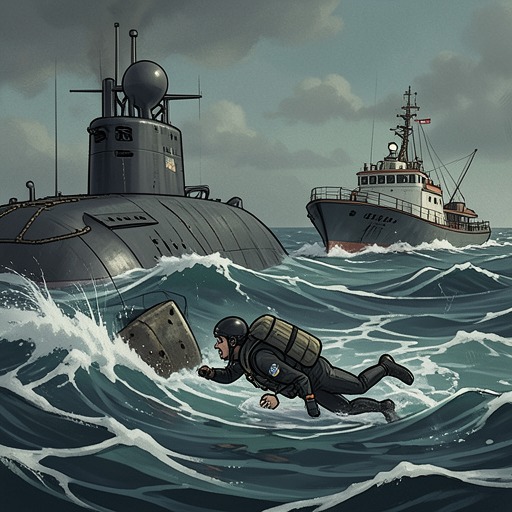
USS Orlando enters the Black Sea in the wake of the Aegis cruiser USS Shiloh. The Russian Victor III submarine it is assigned to watch has itself followed the cruiser, creating a chain of pursuit in which each vessel is monitoring another. Orlando picks up the Victor III only three hours after entering the sea the previous day. The account presents this as a return to an older kind of naval contest: the surface deployment is accompanied by an underwater shadow war, in which the submarines’ positions and intentions must be inferred rather than seen.
The assignment is described as listening rather than watching. A few more modern nuclear-powered submarines are in the Black Sea, and the Victor III is one of them; its apparent mission is to keep an eye on the carrier battle group, while Orlando is tasked with keeping an ear on the Russian boat. That distinction captures Orlando’s operating method. Its surveillance depends on acoustic information gathered in the surrounding water, not a visible view of its quarry. The submarine’s value lies in remaining difficult to detect while building a picture from sounds that may signal another vessel’s movement or preparation to attack.
The Kislovodsk Encounter
The contest becomes urgent aboard Orlando when sonar reports that Kislovodsk is opening its outer doors. The report confronts the boat’s captain, Peter Lang, with a compressed decision: the Russian submarine may be preparing to fire, while the underwater soundscape offers no clear visual confirmation. Lang has only what the sonar operator can hear amid churning water and ping echoes. The narrative stresses the pressure of that uncertainty, describing such moments as decisions on which naval careers can be made or broken.
The rules of engagement do not offer a simple answer. The instruction to fire only if fired upon is identified as inapplicable to submarine combat, where waiting for the other side to shoot first could leave it free to launch a weapon capable of sinking or crippling the carrier group. The danger is concrete: the torpedoes under discussion carry one-ton warheads powerful enough to cause serious damage if they connect. Orlando’s encounter therefore places a general restraint on firing against the immediate risk of allowing a potentially lethal first strike.
An ADCAP torpedo, guided by an operator aboard Orlando, passes just beneath Kislovodsk’s starboard stern plane and strikes its aft trim tank about ten meters forward of the screw. The detail makes the attack a matter of acoustic interpretation and precise underwater guidance rather than a visible exchange of fire. Orlando’s weapon finds the submarine’s stern area, but the documented impact alone does not establish the full extent of the damage or the eventual fate of Kislovodsk.
Concealment and the Carrier Battle
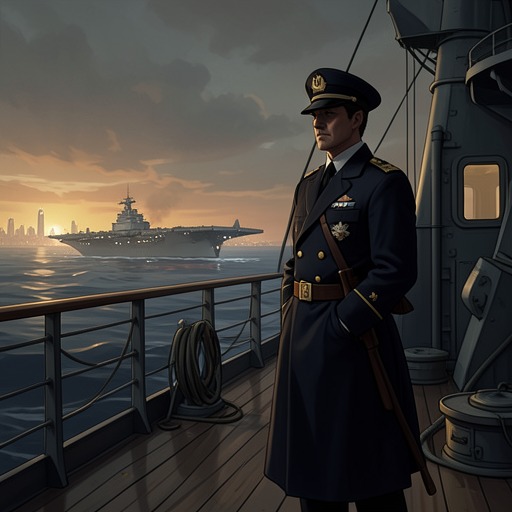
Orlando’s later appearance south of Sevastopol expands its importance from submarine-versus-submarine pursuit to a strike against a major surface vessel. It is described as lurking unseen and unheard in deep water. From that concealed position, the boat picks up the rumble of Pobedonosnyy Rodina’s screws almost as soon as the carrier leaves port. The contrast between the carrier’s movement and Orlando’s hidden station is central to the episode: the large vessel announces its departure acoustically, while the submarine remains out of sight.
More than one hundred miles away, Orlando launches four Tomahawk Land Attack Missiles from its vertical launch tubes. Rocket motors drive the missiles up through the water and into the air at a fifty-degree angle. The account gives the salvo a physical trajectory—from concealed tubes, through the sea, and upward into open air—without bringing the submarine itself into view. This is a different use of Orlando’s stealth than the close tracking of Kislovodsk: the boat does not need to approach the carrier visibly to affect the battle around it.
The battle is over within minutes, before an air strike by A-7s and Hornets can be ordered. In the account of Pobedonosnyy Rodina’s destruction, Orlando’s four-missile launch is placed at the decisive point in that compressed sequence. Its effectiveness comes not from prolonged engagement or spectacle but from being present, listening, and able to act from a position the enemy has not detected.
Narrative Significance
Across these episodes, Orlando links acoustic knowledge to decisions with consequences at very different scales. Against Kislovodsk, sonar provides Lang with the limited evidence on which a tense, immediate choice must be made. Against Pobedonosnyy Rodina, hearing the carrier’s screws gives the hidden submarine the opportunity to launch from far away. The recurring movement is from sound to action: a contact is first something registered beneath the surface, then the basis for a weapon’s release.
The submarine’s two engagements also distinguish tactical proximity from strategic reach. Its torpedo attack takes place close enough for the weapon to pass beneath Kislovodsk’s stern plane and hit a specific tank. Its later missiles travel from a submerged boat more than one hundred miles from the carrier, helping end a battle before an air strike begins. In both cases Orlando exerts force without becoming a visible participant in the surface scene. The boat’s narrative significance rests on that paradox: its presence is established by what it hears and by the consequences of weapons launched from concealment.