Pobedonosnyy Rodina
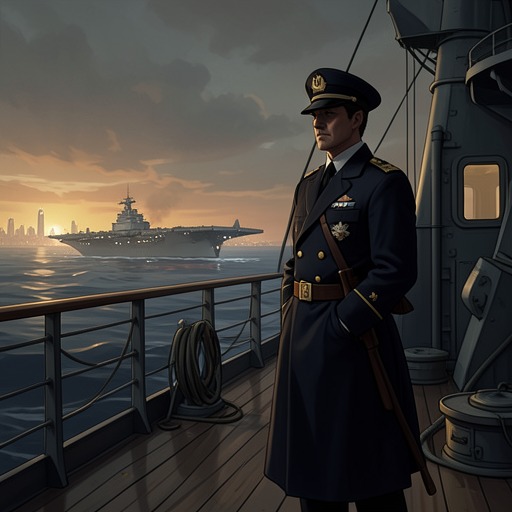
AfterburnPobedonosnyy Rodina, whose name means Victorious Motherland, is the sole surviving aircraft carrier of Russia’s old fleet and the largest ship in the harbor. Its history carries the novel’s contrast between former superpower status and present weakness: the carrier remains imposing, but the fleet and country it represents are coming apart. When it finally puts to sea, its size cannot protect it from a hidden submarine attack that ends the battle in minutes.
Identity and Background
Pobedonosnyy Rodina is a nuclear-powered carrier and the largest remaining ship in the Red fleet. It was the only one of three aircraft carriers commissioned with the old fleet still afloat; the other two, Kreml and Soyuz, were accounted for during the Norwegian War. The Rodina itself had not been ready for action when that fighting began, because it was still undergoing sea trials in the Black Sea. Its survival thus reflects circumstance as much as strength: it remained in port while the other carriers were lost, and emerged as the fleet’s last carrier.
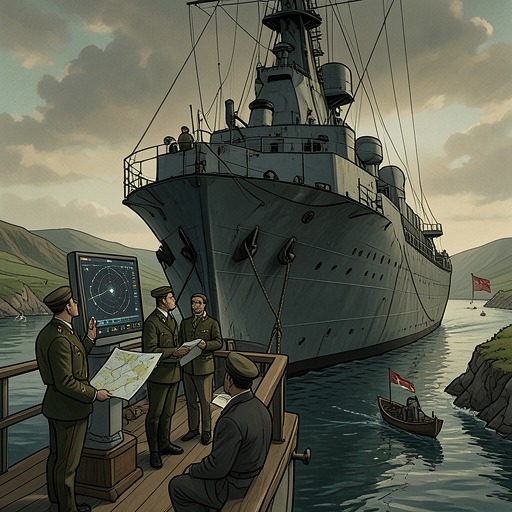
The ship’s nuclear propulsion gives it the scale and status associated with a supercarrier, but the novel does not present it as proof that the fleet remains a functioning superpower. By the time Dmitriev sees it in the harbor, the Russian navy has contracted along with the country’s broader naval power. Few sailors remain to man the ships still capable of putting to sea, and many of those vessels are rusting. Dmitriev’s promotion to command of the entire Black Sea Fleet, awarded for loyalty to Krasilnikov, therefore feels hollow: the title suggests command over a formidable force, while the fleet’s practical strength has dwindled.
Strategic and Political Value
Pobedonosnyy Rodina matters not only as a weapon but as a prize whose possession could confer military capacity and national prestige. In a discussion of Ukrainian aims, Matthew Magruder identifies the carrier alongside military supplies, materiel, bases, and ships of the Russian Black Sea Fleet that have not been seized or defected. He explains to Samantha Reed that the name means Victorious Motherland and identifies the ship as the Red fleet’s largest remaining vessel. Herb Waring recalls that the United States had accounted for two Russian carriers during the Norwegian War; Magruder clarifies that the Rodina escaped because it was not yet operational.
The carrier’s possible transfer to Ukraine is framed as more than an acquisition of hardware. Magruder observes that a supercarrier could enhance a country’s image as a world power, making the Rodina an emblem of status as well as a military asset. That symbolic weight sharpens the irony of its condition. It is still imposing enough to represent a national inheritance, but its survival does not restore the fleet that once surrounded it, and its eventual sortie exposes how little protection its prestige can provide.
Final Sortie
In the closing sea battle, Dmitriev’s small, ill-prepared carrier force steams around the southwestern tip of Crimea, apparently hoping to trap the opposing battle group at Kerch. The Rodina is part of this attempt to shape the encounter through the surviving force’s presence, but the balance has already shifted: by the time the opposing squadrons come within range, Dmitriev has only a handful of aircraft left. The carrier is described as a sitting duck, not because its size has changed, but because its remaining air strength and tactical circumstances leave it exposed.
The threat comes from below rather than from the aircraft engagement the opposing force might have expected. The Los Angeles-class attack submarine Orlando has been lying unseen and unheard in deep water south of Sevastopol. It detects the Rodina’s screws almost as soon as the carrier leaves port. More than one hundred miles away, Orlando launches four Tomahawk Land Attack Missiles from its vertical launch tubes. The missiles skim only a few feet above the surface as they race toward the carrier at Mach 7. The sequence makes the ship’s departure itself decisive: the moment it ventures from harbor, its movement gives the concealed submarine the opportunity to strike.
Destruction and Significance
The attack resolves the battle in minutes, before an air strike by A-7s and F/A-18 Hornets can be ordered. The Rodina never has a chance to answer the missile salvo. Its escorts turn back even before the carrier capsizes beneath a pall of roiling black smoke. The destruction is thus not a climactic contest between two evenly matched fleets, but a swift defeat made possible by the disparity between a depleted carrier force and an attacker already in position.
The Rodina’s fate completes the contrast established when Dmitriev first sees it in the harbor. There it is at once the largest ship present and a reminder of a diminished navy; at sea, it becomes an enormous target whose scale cannot compensate for the loss of aircraft, readiness, and situational advantage. Its destruction removes the last surviving carrier of the old fleet and turns an emblem of former power into evidence of the fleet’s vulnerability. The ship’s name promises a victorious homeland, but its final image is smoke over the water and escorts withdrawing.