Tomahawk Land Attack Missile
AfterburnThe Tomahawk Land Attack Missile becomes the decisive weapon in the destruction of Pobedonosnyy Rodina: four missiles launched from the unseen submarine USS Orlando resolve the battle before Coyote can order an air strike. The passage gives the salvo force through its exact sequence of detection, launch, ascent, and low-level flight, then contrasts that rapid, remote attack with the carrier’s enormous but helpless presence on the surface.
Identity and Role
The passage identifies the weapons as TLAMs, expanding the abbreviation as Tomahawk Land Attack Missiles. Four are launched from USS Orlando’s vertical launch tubes against the approaching Pobedonosnyy Rodina. Their role is not merely to join an ongoing exchange: the narrative says the battle is resolved before Coyote can order an air strike by A-7s and Hornets. The missiles therefore make the aircraft strike unnecessary before it can begin.
The weapon’s significance is established by its contrast with the target. Pobedonosnyy Rodina is described as a huge vessel and a sitting duck, while the submarine carrying the missiles remains unseen and unheard in the deep water south of Sevastopol. The carrier’s size does not confer protection in this encounter. The missiles’ decisive advantage, as the scene presents it, lies in an attack delivered from a position the target has not detected.
Detection and Launch
USS Orlando has been lurking underwater south of Sevastopol. It picks up the rumble of Pobedonosnyy Rodina’s screws almost as soon as the carrier leaves port. That acoustic cue links the submarine’s concealed position to the carrier’s movement: the target is tracked at the opening of its approach, well before the scene reaches the launch itself.
The four missiles burst one after another from USS Orlando’s vertical launch tubes. They travel more than one hundred miles from the submarine toward the Russian carrier. The account lingers over the transition from underwater launch to flight: rocket motors drive each missile upward through the water and hurl it into the air at a fifty-degree angle. This staged description makes the launch a process rather than a single flash of action, but the interval it occupies is brief beside the distance the missiles must cover.
Flight and Approach
Each missile is twenty feet long. Its solid motors burn out and fall away; the cruise missile then takes in air and steadies on course only a few feet above the surface. The passage thus marks a change in the weapon’s mode of travel, from a rocket-powered climb out of the water to a low, sustained approach through the air. The detailed sequence gives the attack a visible mechanics even though USS Orlando itself remains concealed.
The missiles arrow toward the distant carrier at Mach 7. The description moves from the launch’s steep angle to the cruise missiles’ very low altitude and extreme speed, emphasizing how quickly the weapons close the distance after their departure. Their course is presented as steady and directed at the carrier; no detour or response by the target interrupts the account. The numerical and physical details make the salvo legible as an operation while preserving its abrupt effect on the battle.
Outcome and Narrative Significance
The battle is over in minutes, and its outcome is settled even before Coyote can order the planned air strike. The passage places that unrealized order beside the completed submarine attack: aircraft remain a possibility in the chain of command, but the four missiles have already decided the encounter. The contrast makes the attack’s speed consequential, not just spectacular; it closes the window in which the other strike could be ordered.
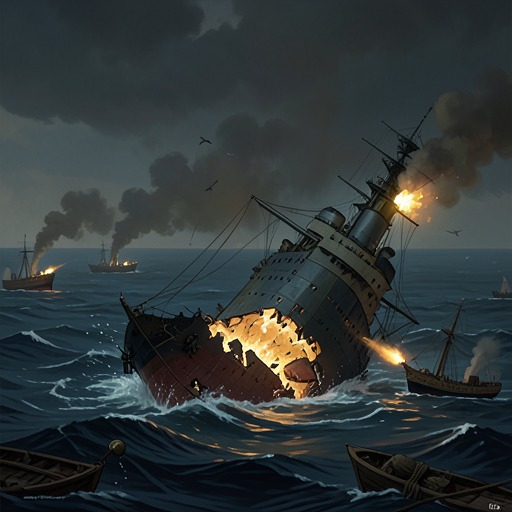
Pobedonosnyy Rodina never has a chance. Its escorts turn back before the huge vessel capsizes beneath a funeral pall of roiling black smoke. The account does not specify the individual impact of each missile, but it places the salvo immediately before the carrier’s defeat and presents the submarine-launched attack as the battle’s decisive action. The final image reverses the carrier’s imposing scale: the vessel that seemed to dominate the scene becomes a capsizing target, while the submarine and its weapons have already disappeared from view.