Cedar Tavern
BluebeardCedar Tavern is the regular meeting place of Rabo Karabekian and a circle of painters: a back-room table where drinking, jokes, financial anxiety, and practical favors briefly make an artistic community out of people who are not yet earning enough to live on. The tavern’s liveliness is shadowed by what follows. Rabo remembers that the evening’s joking turned, within six years, into the grim fates of Jackson Pollock and Terry Kitchen.
Setting and Regulars
Rabo calls Cedar Tavern the place where he and his companions had settled into a regular routine. He and his former Army sleeping buddy went there for an early supper that was also an early drinking session. Three painters were already at their usual table. Rabo withholds their identities under the names Painters X, Y, and Z, and carefully distinguishes them from a long list of better-known Abstract Expressionists. The distinction resists the easy story that the movement’s first painters were simply a band of famous, hard-drinking wild men.
Jackson Pollock appeared that evening, but he was on the wagon, said nothing, and soon went home. Another presence at the table was not, as far as the group knew, a painter at all: Isadore Finkelstein, a tailor whose shop was directly above the tavern. After a couple of drinks, Rabo says, Finkelstein could talk about painting as well as anyone. He also brought an inherited connection to art history, recounting that his grandfather, a tailor in Vienna, had made several suits for Gustav Klimt before the First World War. The tavern thus gathers artists and an attentive outsider in a setting where talk about art is not confined to professional credentials.
Money, Clothes, and the Suit Deal
The conversation turned to an awkward material fact: although the painters had received exhibitions that excited some critics, and Jackson Pollock had prompted a major story in Life magazine, the group still could not earn enough to live on. They jokingly decided that clothing and grooming were holding them back. Rabo emphasizes that everything they said seemed to be a joke, a tone that made their financial predicament easier to handle without making it any less real.
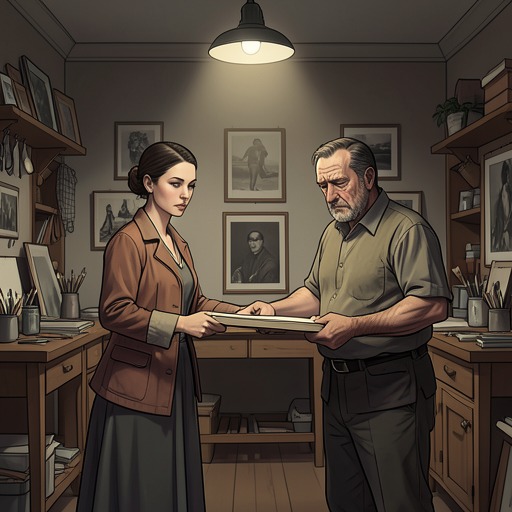
Finkelstein offered to solve the clothing problem for anyone who thought they had one. He proposed a small down payment followed by manageable installments, and the conversation moved upstairs from the tavern to his shop: Painters X, Y, Z, Terry Kitchen, and Rabo were measured for suits. Pollock and Paul Slazinger came along as spectators. Since the others had no money, Rabo used the traveler’s checks left over from his trip to Florence to cover everyone’s down payments. A boisterous evening had produced a concrete act of financial assistance, with Rabo using his resources to help a group whose artistic ambitions had not yet brought them a livelihood.
The exchange continued the next afternoon. Painters X, Y, and Z repaid Rabo with paintings. One of them had a key to Rabo and Dorothy’s apartment; after being expelled from a cheap hotel for setting his bed on fire, he used it to let the three painters deliver their work and leave before Dorothy could object. The tavern’s social improvisation therefore extended into Rabo’s domestic life: the suits were financed through his generosity, and the repayment arrived as art, deposited in an apartment without Dorothy’s consent.
Paul Slazinger’s First Meeting with Rabo
Cedar Tavern is where Rabo first met Paul Slazinger. Slazinger was gathering material for a novel about painters, one among numerous novels he never wrote. His presence gave the gathering an observer as well as its participants: someone listening to a group whose passion for painting sat beside a deliberately unserious manner.
At the end of the evening, Slazinger told Rabo that he was struck by how passionate the painters were and how unserious they seemed. Rabo answered that everything about life was a joke; Slazinger replied that he did not know that. Their exchange distills the gap between the painters’ playful surface and the seriousness of their investment in art. Rabo’s humor is not proof that the work matters little. At the table, joking becomes a way of speaking from inside uncertainty and hardship without pretending that either has been overcome.
Retrospective Meaning
Rabo remembers the tavern evening from a later vantage point, after the futures of Pollock and Kitchen have made its banter painful to recall. He says he still does not understand how things became so gruesomely serious for them after only six more years. The sentence alters the scene without erasing its comedy: the suit measurements, drinks, and talk of grooming remain funny, but the reader knows that the companions’ lives will not remain safely within the joke.
Rabo also resists treating the evening as evidence for a ready-made myth about Abstract Expressionist excess. He names numerous painters who were not among the three anonymous regulars and notes that Pollock was sober, silent, and quick to leave. Finkelstein’s presence further unsettles the boundary between artist and audience: a tailor above the tavern could enter the conversation about painting with authority, while the painters themselves were still debating how to afford ordinary clothes. The remembered Cedar Tavern is consequently both a social space and a compact portrait of artistic life before its later legends had hardened: lively, materially precarious, generous, and already marked by an ending its participants could not yet see.