New York City
BluebeardNew York City is the city of Rabo Karabekian’s successive beginnings: the destination he chose in 1933 when his life in California seemed closed, the setting where he learned how poverty and loneliness could coexist with education and ambition, and the place he revisited in old age to test whether he remained independent. Its streets frame both his private effort to remake himself and the historical reversal in which New York, rather than Paris, became the center of the art world.
Arrival and the Great Depression
In 1933, during the Great Depression, Rabo left California for New York City. His father gave him an old photograph of a house supposedly bought in San Ignacio with the family’s jewelry, asking Rabo to tell him where it was if he ever found it. The photograph carried the memory of the family’s loss and of the unfulfilled promise that they might have built a happier life elsewhere; it accompanied Rabo as he set out to seek his fortune.
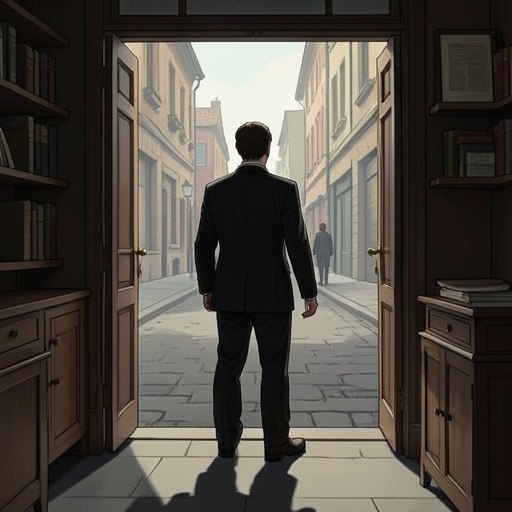
The city’s first appearance is not a clean slate. Homeless people filled Grand Central Station and the streets, while newspapers reported layoffs, farm foreclosures, and bank failures. A policeman directed Rabo to Dan Gregory’s address, eight blocks away, describing the city’s grid as simple enough that he could not get lost. Rabo walked through that ordered checkerboard toward the door of the artist who would employ him. The contrast between navigable streets and an uncertain future gives his arrival its defining tension: the city offers a route, but not a guarantee of security.
Rabo later described his decision as going to New York City to be born again. Unlike his parents, he felt he had no supposedly sacred piece of land or large circle of relatives and friends to leave behind. The American possibility of starting over therefore appeared to him as a kind of zero: an opening created by having little attachment to what came before, but also by having little protection against failure.
Poverty, work, and chosen families
The new beginning did not spare Rabo from hunger and homelessness. During the Depression he was often a bum among other bums, relying on soup kitchens and shelters. He spent time in libraries to keep warm, reading histories, novels, poems, encyclopedias, dictionaries, and popular advice books about getting ahead, winning trust, starting a business, and learning from failure. He accumulated knowledge and cultivated an educated manner, but came to see that neither alone could provide the belonging he wanted.
While making paid caricatures of willing sitters in Central Park, Rabo met Marc Coulomb, a Bulgarian Armenian whose family had become part of the Armenian community in Paris. Coulomb admired his drawing and argued that an aspiring artist should go to Paris. Instead, he used his influence to help Rabo secure work: he bought him a suit, shirt, tie, and shoes, then brought him to the advertising agency Leidveld and Moore and offered the agency the Coulomb account if it hired Rabo. The agency did. The encounter briefly supplied the practical help that Rabo’s knowledge and polished speech could not, though he never saw Coulomb again.
Rabo understood this period as a lesson in the social function of education. In his account, the great universities offered not simply knowledge but lifelong membership in a respected artificial extended family. His own later versions of such a family would be the wartime Officer Corps of the United States Army and, after the war, the Abstract Expressionist school. New York City thus matters not only as a place where he sought work, but as the setting in which he learned to distinguish self-improvement from social membership.
Art, ambition, and a change of world capitals
Rabo’s New York years began under the shadow of his apprenticeship to Dan Gregory. He had worked as Gregory’s apprentice from age seventeen until he was thrown out shortly before turning twenty. The rejection narrowed his employment prospects: Rabo believed, without proof, that Gregory had told companies who knew him as a messenger boy that he was self-serving, disloyal, and untalented. In a period when jobs were scarce, Rabo also felt that his Armenian identity made it easier for employers to pass him over.
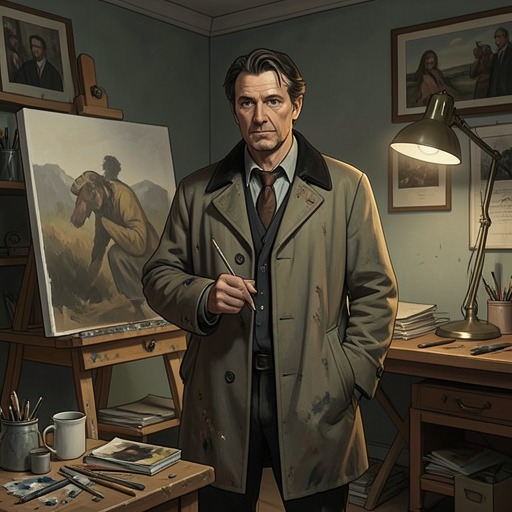
Even so, he found work as an artist in an advertising agency and eventually became part of the postwar Abstract Expressionist community. The city’s importance changes across that career. Marc Coulomb had once urged him to go to Paris because it was the art capital of the world; Rabo later belonged to a small group of painters that made New York City, rather than Paris, the new center. That historical change gives his personal arrival an irony he could not have known at the time: the city he entered as a poor young artist would become the place from which an American art movement asserted its international importance.
Rabo’s ambitions could also make the city’s rise feel like a campaign of conquest. His wife, Marilee Kemp, objected to his grand talk of making New York City rather than Paris the art capital, reminding him that France had been on their side in the war and asking why he had to conquer it. The exchange exposes a tension between artistic ambition and wartime habits of struggle: even after the war, Rabo could describe cultural influence in the language of victory and territory.
The city was also connected to a consequential change in the art market. Rabo’s own Abstract Expressionist collection had once been unwanted at any price, and its storage costs burdened his family. Marilee later ordered ten paintings sight unseen, leaving the selection to Rabo and paying one thousand dollars for each. Her purchase began what Rabo called the second great collection of American Abstract Expressionist art. New York’s artistic ascent therefore involved not just painters and reputations but the movement of money, ownership, and works that had recently seemed impossible to sell.
Return and retrospective meaning
In old age, Rabo made a return trip to New York City after two years away. Circe Berman proposed that he make the journey alone, as a way to establish to himself that he was healthy and did not need assistance. She imagined that revisiting the route of his first arrival might restore some of the physical spring and youthful confidence he had possessed when he came from California. The trip was thus less a tourist excursion than a test organized around memory: the older man was asked to encounter the city in relation to the younger one who had first walked its streets.
That return takes place against the loneliness of Rabo’s later life. His first wife and sons left him in 1956; after giving up painting, he sought isolation and lived as a hermit for eight years. By the time of his journey, his second wife, Edith Taft, had died, and he lived in her nineteen-room house in East Hampton. New York City stands in contrast to that later home and its private collection: it is the crowded place where he once struggled to find work and where his artistic world took shape, rather than a refuge from other people.
The novel places these episodes within a deliberately self-conscious account of a life. Rabo’s first-person narrative repeatedly returns to New York City from the vantage of old age, revising the meaning of his arrival as later disappointments and achievements come into view. His account makes the city at once a practical geography of addresses, jobs, shelters, and streets, and a measure of changing identity: the place where he tried to become someone new, discovered that knowledge alone could not make him belong, and eventually saw his adopted artistic community help make the city a center of modern art.