Museum of Modern Art
BluebeardThe Museum of Modern Art is both a place Rabo Karabekian repeatedly visits and a test of who gets to decide what art means. In his youth, its galleries draw him and Marilee Kemp away from Dan Gregory’s rules; when Gregory catches them leaving, the visit becomes the occasion for a break in their relationship. In the later frame, the museum’s cultural authority is placed beside Rabo’s private collection and his own increasingly public way of presenting art, which prizes the response of ordinary visitors over the approval of solemn critics.
A forbidden destination
While working for Gregory during the Great Depression, Rabo accompanies Marilee to the Museum of Modern Art, a place Gregory has explicitly forbidden them to visit. The trip is not an isolated experiment: by the time of the confrontation, Rabo says he and Marilee have gone there perhaps fifty times. He is nearly twenty and has spent almost three years with Gregory, but now understands himself as an artist’s employee rather than a budding artist. Their repeated visits make the museum a space of chosen curiosity and shared independence, in contrast with the loyalty Gregory expects from those in his household and employ.
The museum also unsettles Rabo’s assumptions about what counts as modern. He observes that many of its works were painted before the First World War and before either he or Marilee was born. The institution gathers paintings under the sign of the new, while their actual dates complicate any simple equation between modern art and the latest thing. For Rabo, the visits are formative not just because of what the museum contains, but because it exposes him to pictures and ideas beyond Gregory’s authority.
The 1936 confrontation
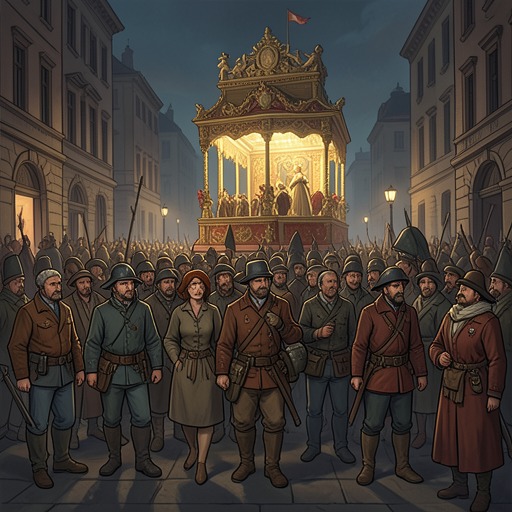
In 1936, Gregory discovers Rabo and Marilee coming out of the museum during the Saint Patrick’s Day parade. His convertible Cord, with Fred Jones at the wheel, is held in traffic on Fifth Avenue near the museum; the parade’s noise and congestion place the encounter in public view. All four are wearing green. The setting makes a private act of disobedience visible, and Gregory responds not by debating the paintings but by denouncing the pair as ungrateful and disloyal.
Gregory’s rule against the museum has a symbolic purpose. He explains that staying away was a way for Rabo and Marilee to prove they were on his side, not the side of the people whose art he rejects. He presents the request as modest and easy to obey, making the museum visit a betrayal in his eyes even though the visit itself is an act of looking. His anger exposes the deeper stakes of the prohibition: the question is not merely whether the museum’s pictures are good, but whether Rabo and Marilee will accept Gregory’s authority over their judgment.
The encounter marks a decisive change for Rabo. Looking back, he describes himself as about to enter the real world and try to stand on his own feet. The museum is thus tied to a threshold between dependent apprenticeship and independence. In a later conversation with Marilee, Rabo recalls their youthful naughtiness as though it referred to intimacy; she corrects him emphatically, identifying the museum visit as what she meant. Her correction restores the event’s particular meaning: the shared transgression that mattered to her was going to the museum.
Collection, home, and museum authority
In the later part of the narrative, the Museum of Modern Art belongs to a wider argument about collection and interpretation. Rabo’s house holds what he calls the most important collection of Abstract Expressionist paintings still in private hands. Visitors ask what the pictures are supposed to mean, and he answers them as a paid museum guard might. He says the paintings are about nothing but themselves; their titles are meant to be uncommunicative. The museum visit of his youth and the questions asked in his home therefore frame two different encounters with art: the public institution’s gallery experience and the private collector’s attempt to explain works displayed in a domestic space.
That domestic space has itself been shaped into a museum-like environment. A 1981 architecture magazine presents the foyer of the Karabekian home as the core of a small museum collection. Rabo credits Edith Taft, not himself, with bringing his paintings out of storage and arranging the house around modern art. His later role as guide is therefore not simply an extension of the Museum of Modern Art; it arises from a private collection, a house transformed for display, and a marriage that made the collection visible.
Display and popular reception
The novel’s closing museum tour combines the foyer’s pictures, early Abstract Expressionist works, and the immense work in Rabo’s potato barn. Visitors pass through the barn by way of its sliding doors, unspiked to let the increased flow move in at one end and out at the other; some make the passage more than once. Rabo reports that no solemn critic has appeared, while lay visitors ask what kind of painting the barn work is. He answers by calling it a tourist attraction, a World’s Fair, and Disneyland, rather than a painting.
This ending shifts attention from institutional classification to the experience of an audience. The Museum of Modern Art is the place that first drew Rabo and Marilee into repeated acts of looking, and its prohibition supplied the terms of Gregory’s judgment. Rabo’s later presentation of art does not merely reproduce the museum’s authority: it makes visitor movement, popular interest, and the difficulty of naming the work part of the display itself. The contrast leaves the museum as a lasting point of reference in a story where art can be a collection, a subject of argument, a route through a building, and an experience that resists a definitive label.