Rabo’s potato-barn studio
BluebeardRabo’s potato-barn studio is at once a practical workspace, a refuge after the collapse of his first family, a locked chamber freighted with withheld meaning, and, finally, the destination of a public museum tour. Its change from potato storage to artist’s home, sealed secret, and crowded exhibition gives the building a plot of its own: what Rabo keeps out of sight becomes the work that draws visitors in.
Origin and physical character
Before Rabo and Edith married, he persuaded her and her husband to rent him their unused potato barn, although the land belonged to Edith rather than her husband. The couple had bought the parcel from a neighboring farmer to prevent development; they had never farmed potatoes, and the barn had simply come with the land. A pragmatic remnant of that purchase thus became the setting for Rabo’s artistic life.
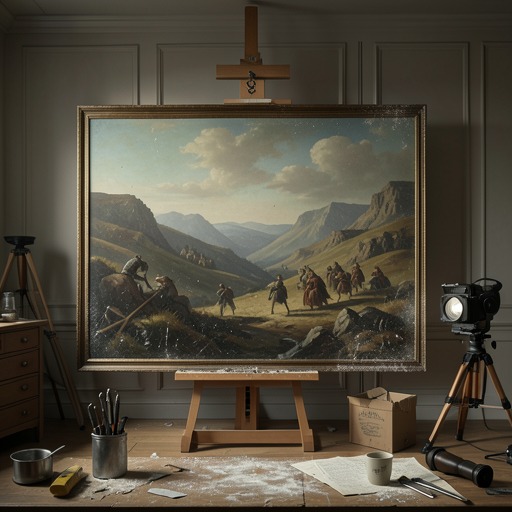
The building’s form suited work on a scale that an ordinary domestic room could not accommodate. Long and narrow, without windows, it had sliding doors and a potbellied stove at either end. The doors and stoves had been designed to keep the temperature even enough to store potatoes without letting them freeze or sprout before sale. Such unusual dimensions, combined with the formerly cheap property in the area, also drew painters working on exceptionally large canvases. Rabo specifically credits the barn with making it possible to work on the eight panels of Windsor Blue Number Seventeen as a single piece.
From studio to home
Rabo did not become close to Edith until her husband had died and his own first household had broken apart: Dorothy and their two sons, Terry and Henri, moved out. He sold the family house in Springs, six miles north, and made Edith’s barn not only his studio but his home. Its remoteness from the main house is part of its character: Rabo says that the improbable dwelling cannot be seen from the house where he later writes.
That separation distinguishes the barn from the grand family residence and its display of art. Rabo’s most important private collection is housed in the main house, which he describes as sheltering a major collection of Abstract Expressionist paintings. The barn, by contrast, is a separate, windowless enclosure whose significance is not announced by a visible façade or an ordinary domestic entrance. It holds a different kind of artistic presence: not the orderly collection visitors can see in the house, but the work Rabo refuses to reveal.
Sealing the forbidden space
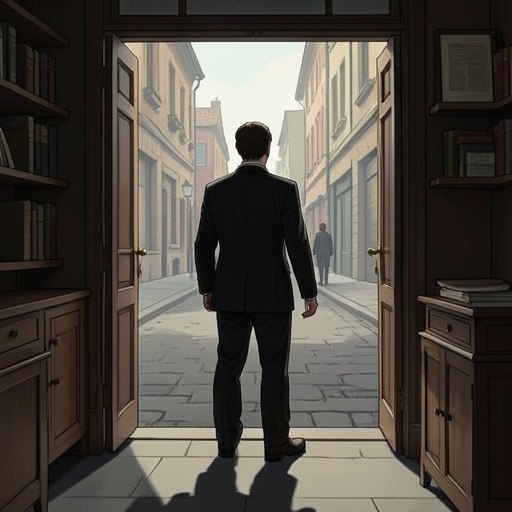
Two years after Edith’s death, Rabo secured the barn against access. He nailed the doors at one end shut from inside with six-inch spikes, then immobilized the doors at the other end from outside with six heavy padlocks and massive hasps. Its lack of windows meant that Circe Berman could not even look inside. Rabo himself had not entered since sealing it, a self-imposed exclusion that makes the room more than a storehouse: its contents and his promise to keep them inaccessible become inseparable.
Rabo confirms that something is inside, while explicitly ruling out several anticlimactic answers: not empty air, a broken paintbrush, his Purple Heart on a clean-swept floor, a painting of potatoes, a comically incongruous religious image, or a self-portrait. The insistence that the secret is neither a conventional symbol nor a joke intensifies the suspense without disclosing what the object is. He says the doors will be opened by his estate’s executors after his death and burial beside Edith. The barn therefore holds its answer in suspense beyond Rabo’s lifetime, under a condition he has set for its eventual revelation.
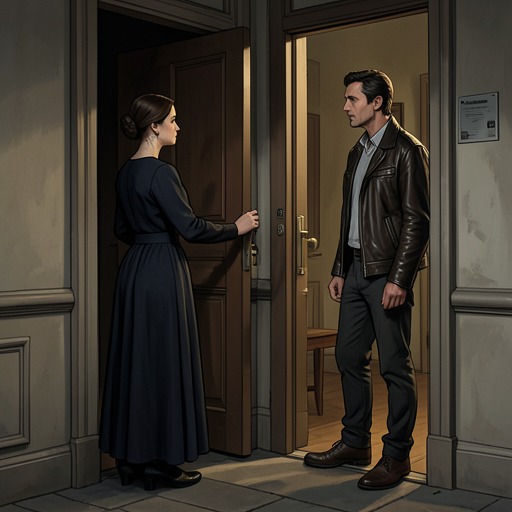
The locked building also gives Rabo a ready-made role in a Bluebeard comparison. He tells Circe that, as far as she is concerned, his studio is his forbidden chamber, and when she presses him for its six keys, he claims they are buried in a golden casket at the foot of Mount Ararat. The fanciful answer supplies no access, only another layer of mystery. The analogy frames the barn as a space defined by the desire to know what has been withheld, while Rabo casts himself as the keeper of a boundary Circe repeatedly tests.
Public opening and changed meaning
The barn eventually becomes part of the regular tour of Rabo’s museum, following the little girls on swings in the foyer and the early work of the first Abstract Expressionists. By then Rabo has unspiked the sliding doors at the far end. The change is practical as well as symbolic: with more visitors arriving, people can enter at one end and leave at the other without producing eddies or backwash. Some walk through the barn more than once, though not necessarily through the rest of the exhibition. A room once inaccessible to even a glimpse is now a passage repeatedly traversed by the public.
The work inside is not given a stable label. When visitors ask what kind of painting it is, Rabo answers that it is not a painting at all but a tourist attraction, a World’s Fair, and Disneyland; he calls it a gruesome Disneyland where nobody is cute. The description deliberately shifts attention from classification to experience. The barn is no longer merely the private studio where a large work could be made, or the forbidden chamber whose contents are deferred until after Rabo’s death. Its open doors now organize visitors’ movement and make the work a spectacle, while Rabo’s own words refuse to settle what sort of art they have come to see.
From private collection to museum
Rabo is already treated like a museum guard in his own house. Visitors repeatedly ask what the paintings are supposed to mean, and he says that the paintings are about absolutely nothing but themselves. The barn’s eventual exhibition extends that uneasy relation between an owner’s authority and a visitor’s demand for explanation. Its work attracts ordinary visitors strongly enough that Rabo imagines a solemn critic may never appear; lay visitors, rather than professional critics, ask him to name it.
The building’s successive uses sharpen this tension. It starts as an agricultural structure inherited with land bought to resist development; its storage design makes it an unusually useful studio; its isolation becomes a domestic refuge and later a deliberately enforced secret; and its opened doors finally serve a high-traffic exhibition route. Each use changes who may enter and what the space asks of them. The barn’s ending is not the disclosure of its contents to the reader, but its transformation into a public attraction whose central work remains unnamed even as crowds pass through it.