Germany
BluebeardGermany is where Rabo Karabekian’s wartime experience turns from military service into injury, captivity, and a defining memory of the war’s end. The country also becomes the landscape of the immense painting he eventually unveils: a springtime valley crowded with survivors and soldiers, recreated from the scene he witnessed after his prison guards disappeared. In the novel, Germany is at once historical terrain and a place carried forward in memory and art.
Wartime Service and Capture
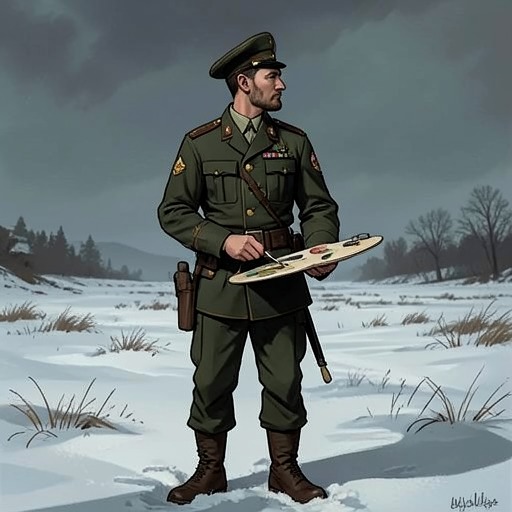
Rabo enters the German campaign as an American officer who has served in North Africa, Sicily, England, and France. At the German border, he is at last forced into combat. He is wounded and captured without having fired a shot; the remembered turning point is a white flash. Earlier, he had commanded a platoon of Army Engineers near the end of the war. Its members were artists in civilian life, selected for camouflage work, but in Germany they had to fight as ordinary infantry to survive.
The platoon’s artistic skill had previously made its camouflage effective: its deceptions misled German forces about what lay behind Allied lines. The unit’s unusual position also shaped its military life. Rather than belonging routinely to a division or corps, it received orders directly from the Supreme Headquarters of the Allied Expeditionary Force and was temporarily assigned to generals impressed by its work. This history makes the contrast at the German border especially sharp: men valued for the illusions they could create were eventually caught in combat without the protective distance of their specialist role.
Captivity and the War’s End
After capture, Rabo is unconscious and remembers neither being hit nor the moment he was taken prisoner. His first clear recollection is of a white German tank and soldiers dressed in white approaching across a snow-covered meadow in Luxembourg. Kept unconscious with morphine, he wakes in a German military hospital in a church across the border. His wound heals quickly, and he is sent to a prisoner-of-war camp as an unremarkable captive. He later describes the pain as slight, a fact that complicates rather than erases the ordeal: the war’s consequences for him include captivity and the loss of an eye even though his injury did not involve prolonged physical suffering.
When the war in Europe ends on May 8, 1945, Rabo’s camp has not yet been captured by the Russians. He and hundreds of officers from many Allied and formerly opposing nations are marched out into countryside that has not yet been secured. One night the guards vanish. The next morning, the prisoners find themselves on the rim of a great green valley near what is now the border between East Germany and Czechoslovakia.
Below them are thousands of people brought together by the collapse of Nazi control: concentration-camp survivors, slave laborers, people released from asylums and prisons, and captured soldiers from armies across Europe and beyond. The last remnants of Hitler’s armies are there too, still equipped to kill despite their battered uniforms. The valley is therefore not a simple image of liberation. It holds people freed from captivity alongside the still-dangerous remains of the force that had held Europe in war, making the end of the conflict feel vast, unstable, and difficult to reduce to a clean victory.
Aftermath and Return
At the end of the war, the United States pays for cosmetic surgery where Rabo’s eye used to be. He recalls being emotionally blank rather than bitter. In retrospect, he understands that blankness through his memory of Fred Jones, who had seemed similarly detached; neither man, he says, had anything to return to. The account links Germany and the experience of captivity to a difficult homecoming, not to a straightforward restoration of a prewar life.
The wider aftermath continues into Rabo’s family and working life. He marries the nurse who treated him, has two sons, and later becomes estranged from both; they legally take the surname of their stepfather, Roy Steel. His first wife, Dorothy, and their sons leave him in 1956, after which he gives up painting and spends eight years as a hermit. Years later, he describes his failure as a husband and the resulting alienation of his sons as a central source of shame. These events do not establish that Germany alone caused his later losses, but they show how the wartime rupture sits within a life marked by separation, loneliness, and the difficulty of returning to ordinary relationships.
Germany Recreated in Painting
Decades after the war, Rabo turns the valley where he waited for the war’s end into the subject of his enormous painting. When he reveals it to Circe Berman in the potato barn, they stand at the extreme right end of a canvas eight feet high and sixty-four feet long. From there, its full scene is compressed into a narrow, foreshortened view; only when Rabo switches on the floodlights does the image open up. The painting shows a springtime valley, with 5,219 people on its rim or below, rendered so realistically that Circe asks where they are. Rabo answers that it is where he was when the sun rose on the day the Second World War ended in Europe.
The reveal gives Germany a second presence in Rabo’s life: not merely the location of his capture, but a remembered place he has preserved and made available to others. The mural’s scale and controlled unveiling turn private recollection into a public image. Rabo’s later museum tour places it after the foyer’s pictures of girls on swings and earlier works by the first Abstract Expressionists, then directs visitors through the potato barn to the immense scene. Germany thus remains legible in the novel both as the landscape of war’s unsettled aftermath and as the ground on which Rabo’s buried history becomes visible.