GEFFCo Building
BluebeardThe GEFFCo Building, later known as the Matsumoto Building, is the corporate site where Rabo Karabekian’s eight-panel Windsor Blue Number Seventeen was once displayed with publicity as a spectacular modern artwork. After Sateen Dura-Luxe paint shed from the canvases, the building’s locked underground chamber became an unintended tomb for the work; its eventual rediscovery brought the panels back into Rabo’s possession and made possible their later display in his potato barn studio.
Corporate Display and Publicity
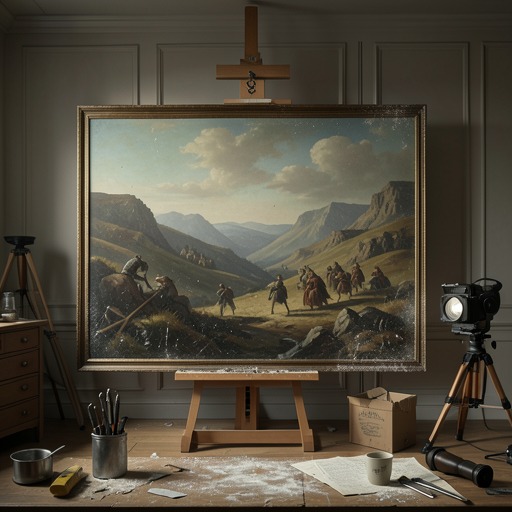
GEFFCo hung Windsor Blue Number Seventeen in the lobby of its Park Avenue headquarters, presenting the exhibition as evidence that the old company kept pace with developments in both technology and the arts. The painting comprised eight separate panels, joined at the back with C-clamps, but the company’s publicity staff hoped to promote it as a record-setting work: perhaps the largest painting in the world, or at least in New York City.
That claim proved difficult to sustain. The work covered 512 square feet, but murals elsewhere exceeded its size, and the fact that it consisted of eight panels weakened any description of it as a single painting hung on a wall. The building’s lobby nevertheless gave the work a conspicuous institutional setting, making it part of GEFFCo’s public image as well as Rabo’s artistic career.
The Locked Basement Chamber
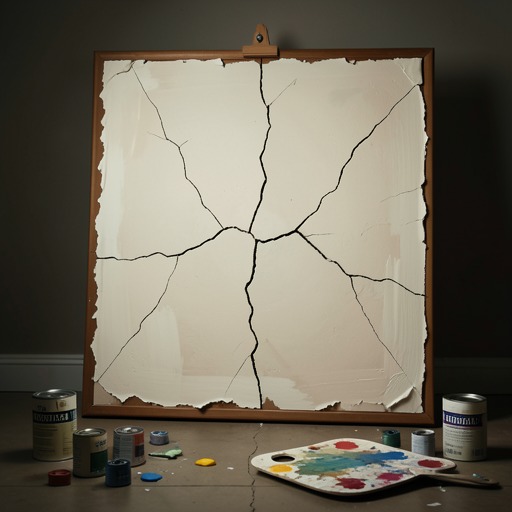
After the paint failed, the panels disappeared from public view. Three months before Edith Taft died, they were found in a locked chamber on the lowest of the Matsumoto Building’s three basement floors. Shreds of Sateen Dura-Luxe still clung to the canvases, identifying them as the remnants of Rabo’s once-famous and then infamous work.
The discovery occurred during a search for fire hazards deep underground. An insurance-company inspector found a locked steel door, obtained permission to break it open, and saw the canvases inside. No one had known what lay behind the door. The building’s basement thus preserved the physical supports of a painting whose defining surface had largely come away, separating the surviving structure from the failed material that had once made it an artwork.
Return of the Canvases
The inspector offered to return the panels rather than let them go to waste. She told Rabo that she was her company’s first female safety inspector and its first Black inspector, calling herself “two birds with one stone.” Her offer was matter-of-fact: she cared whether the canvases were discarded, but Rabo would have to arrange to collect them himself. He asked that they not be thrown away and said he would call Home Sweet Home Moving and Storage to pick them up.
Once returned, the eight primed and stretched canvases stood side by side in Rabo’s potato barn studio, each eight feet by eight feet and together forming a continuous surface sixty-four feet long. They were the same panels that had held Windsor Blue Number Seventeen before the paint and tape shed away. Their recovery did not restore the original painting; it made the surviving, stripped panels available for a new life in Rabo’s studio.
From Corporate Lobby to Public Attraction
In Rabo’s later museum tour, visitors first pass the swinging-girl pictures in the foyer, then early Abstract Expressionist works, and finally the enormous display in the potato barn. The returned canvases form the route’s culminating attraction. Rabo unspiked the barn’s sliding doors at one end so the increased flow of visitors could enter at one end and leave at the other, without bottlenecks; some visitors went through more than once.
The building’s history therefore marks a reversal in the work’s public status. At GEFFCo, the painting was promoted as a corporate showcase and a possible size record; in the basement, its remains were hidden behind a locked steel door; in Rabo’s barn, the recovered panels became part of a popular spectacle. Rabo rejects the expectation that the display be classified as conventional painting, calling it a tourist attraction, a World’s Fair, and Disneyland—and specifying that it is a gruesome Disneyland. The movement from lobby to basement to visitor route shifts the work from corporate prestige, through material failure and concealment, into an experience whose significance lies partly in how people move through and respond to it.