Grand Central Station
BluebeardGrand Central Station is where Rabo Karabekian arrives in New York in 1933, carrying his best drawings and expecting the beginning of his apprenticeship with Dan Gregory. The journey’s birth imagery gives the station a double force: it is a real point of arrival and the threshold of a new identity, but the welcome Rabo receives is an empty one. Alone among people greeting one another, he must carry himself from the station to the door of the master whose art he has admired from afar.
Arrival and First Impressions
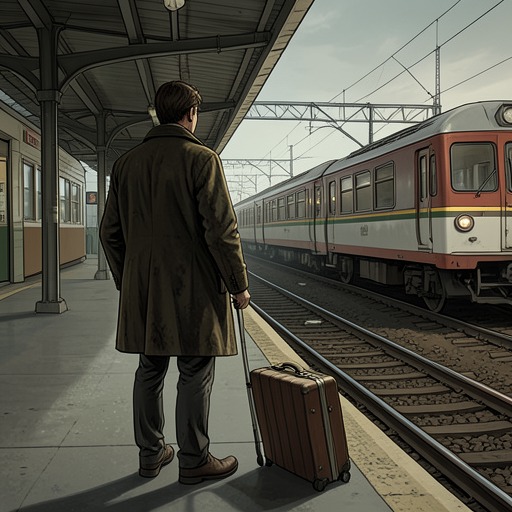
Rabo reaches Grand Central Station after crossing the continent in Pullman cars. In his retrospective account, the trip has left his mind blank, and he imagines California and San Ignacio as though they had never existed. The train’s passage from Chicago into the tunnel beneath New York City becomes a passage through a birth canal; ten minutes later, he says, he is born in the station. The metaphor makes a geographic transition feel like the beginning of a life, while the concrete details keep the scene grounded: he is wearing the first suit he has ever owned and carrying a cardboard valise and a portfolio of his best drawings.
The station offers no welcoming party. Rabo asks who is there to greet the “beguiling Armenian infant,” then answers that not a soul is there. The contrast between the language of birth and the absence of anyone to receive him gives this arrival its defining loneliness. He has crossed an immense distance for a promised future, but at the moment of entry into the city he has only his luggage, his work, and the hope that his new master will be there.
The Unreceived Newcomer
The isolation becomes sharper when Rabo sees other people in the station embracing and kissing while he stands alone. He has doubted that Dan Gregory would come to meet him, but he also wonders where Marilee is. She already knows what he looks like: he has sent her self-portraits and photographs taken by his mother. The station therefore gathers several expectations into one unanswered moment—not just the arrival of a young artist but the hoped-for recognition of someone who has made himself visible to people at a distance.
Rabo’s appearance makes the scene a portrait of economic circumstance as well as emotion. His suit came through the mail from Sears, Roebuck; his shoes are old and cracked, though he has shined them and fitted them with new rubber heels. One shoelace has broken around Kansas City, and he has joined its ends with a clumsy splice. He imagines that Dan Gregory could have used him as the subject of an illustration about a country boy lost in a city. The repaired lace is a small, telling detail: Rabo has prepared himself as carefully as he can, but the marks of limited means remain visible.
That self-portrait is also shaped by his knowledge of Gregory’s work. Rabo admires how the illustrator could make cheap clothes, worn shoes, and other material details convey a character’s economic and spiritual condition. He arrives hoping to learn from the artist whose images have taught him to read such signs, while already seeing himself through the visual language of his future mentor. His first view of New York is consequently both lived experience and an imagined illustration of a lonely newcomer.
Depression-Era Setting
In the account marked “BACK IN 1933,” Rabo asks a policeman at Grand Central Station for Dan Gregory’s address. The policeman says it is only eight blocks away and that Rabo cannot get lost because this part of the city is laid out like a checkerboard. The directions turn the station from a place of suspended expectation into a point of departure: Rabo can leave the crowds behind and proceed on foot toward the apprenticeship that has brought him east.
The walk begins amid the Great Depression. Rabo recalls homeless people filling the station and the streets, alongside newspaper reports of worker layoffs, farm foreclosures, and bank failures. He connects these visible signs of hardship to the present from which he is narrating, arguing that television can make a depression easier to hide and speculating that it may even conceal a third world war. The remembered station is thus not a private stage set apart from history. Its crowd and the news surrounding it place Rabo’s personal uncertainty inside a public crisis.
From the Station to Gregory’s Door
After leaving the station, Rabo finds himself at the entrance to Dan Gregory’s house. The door is not an incidental destination: it is the same noble oak door Gregory had used on the cover of the Christmas issue of Liberty magazine. Its massive iron hinges are rusty, and its knocker is shaped like a Gorgon’s head, with intertwined asps forming the figure’s hair and necklace. The remembered journey therefore moves from an empty public arrival to a threshold already familiar through Gregory’s art.
The resemblance between illustration and place makes Rabo’s arrival a meeting with the exacting visual skill he hopes to master. He points out that Gregory could render rust on the hinges and verdigris in the Gorgon’s face and writhing serpents, as well as the brown-edged or spotted leaves of the holly wreath shown on the magazine cover. The wreath has been removed by the time Rabo reaches the house, but the door remains recognizable. Grand Central Station begins this passage into Gregory’s world with solitude; the walk ends with Rabo confronting a real scene whose details have already been mediated by the illustrator’s image.