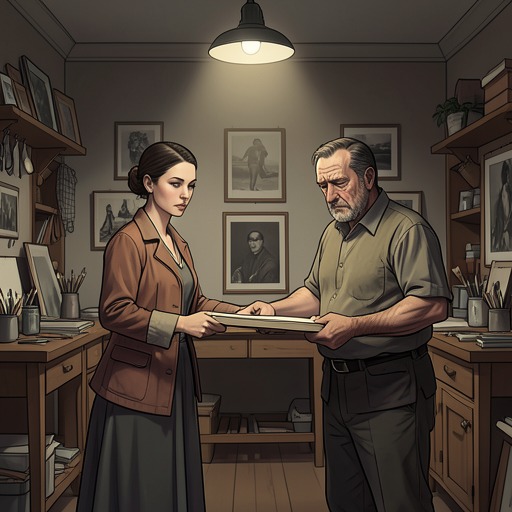
Union Square studio
BluebeardThe Union Square studio was a photographer-owned loft above Union Square that Rabo Karabekian and Terry Kitchen rented together when studio space in Manhattan was inexpensive. It became both Kitchen’s home and workplace and a place where Rabo spent several nights a week as his closeness to his wife and children diminished. The studio thus joined artistic collaboration to domestic estrangement, and its cot and damaged canvases make that double role especially visible.
Setting and Establishment
Rabo recalls that the two artists rented the loft after a conversation about how long he could stand before large fields of color. The space was at the top of a building on Union Square, and Manhattan studio rents were then low enough for an artist to afford both work space and life in New York City. The loft offered a practical base for their work; it was not an isolated retreat from the city but an affordable working address within it.
Shared Work and Domestic Distance
The studio gradually became more than a place to paint. Kitchen made it his home as well as his workplace, while Rabo began spending two or three nights a week there, on cots he had bought for the space. His family remained in a basement apartment three blocks away. Rabo’s account connects this change in routine to his increasing sense that he was less beloved at home, as he left behind his insurance-sales job and devoted himself to painting large fields of Sateen Dura-Luxe color.
That arrangement brings the studio into the story of Rabo’s troubled marriage without making it merely a symbol. The loft’s concrete use—as a shared workplace with sleeping cots—made it possible for Rabo to divide his time between the artists’ life there and the family life nearby. The division became more consequential as his artistic absorption and absences grew.
Kitchen and the Studio’s Later Scene
Years later, after Rabo returned from an absence, he carried his suitcase to the studio and found Kitchen asleep on his cot. Before waking him, Rabo saw that Kitchen had slashed all his paintings with an ivory-handled straight razor inherited from his paternal grandfather. Rabo’s immediate thought was that Kitchen might have harmed himself as well, but the account describes the slashed paintings, not such an act.
The scene sets Kitchen’s destruction of his own work against Rabo’s continuing investment in painting. Rabo describes his color fields as beginnings, meant to become more complicated as he approached what he calls soul. He wakes Kitchen and offers to take him for an early supper at the Cedar Tavern, but does not tell him about the deal he has just completed in Florence because Kitchen could not take part. The studio remains their shared base, yet their work and opportunities are no longer fully shared.
Narrative Significance
The loft connects artistic possibility to economic circumstance: its low rent allowed the two painters to occupy a Manhattan workspace at a time when an artist could afford to live in the city. At the same time, its use as Kitchen’s home and as Rabo’s occasional refuge records a cost borne elsewhere, in Rabo’s growing distance from his wife and children.
In the later studio scene, the cots and slashed canvases turn the shared workspace into a record of diverging artistic lives. The room sustains their companionship, but it cannot guarantee that they will make the same work, share the same prospects, or remain equally close. Its significance lies in that tension between the modest practical space that enables their art and the personal separations unfolding around it.