Solomon R. Guggenheim Museum
BluebeardThe Solomon R. Guggenheim Museum is the institution that bought Rabo Karabekian’s Hungarian Rhapsody Number Six and later found it disintegrating in storage. Its encounter with the painting makes the museum both a custodian of his work and a witness to its material failure, while Rabo’s proposed remedy is rejected along with his chance to control how that failure is remembered.
The Museum and the Private Collection
Rabo describes his East Hampton home as sheltering what he considers the most important collection of Abstract Expressionist paintings still in private hands. Visitors repeatedly ask what the pictures are supposed to mean, and he answers as a self-appointed museum guard would. The comparison is pointed: the paintings are his property, but the house also functions as a place of display in which the owner is expected to interpret what visitors see.
The domestic collection had once been presented in a setting deliberately adapted to modern art. A 1981 issue of Architect & Decorator showed the foyer from the front door and praised the entrance hall as containing the core of a small museum’s permanent collection. That account described a private house whose rooms and art could be read through the language of public exhibition. The Guggenheim episode shifts the collection’s story from this celebrated domestic display to the risks of institutional storage and conservation.
Acquisition and Material Failure
Hungarian Rhapsody Number Six began as an image Rabo covered with a couple of coats of Hungarian Rhapsody. He laid tape over it in a pattern he called pure abstraction, although he privately saw six deer near the left edge and, at the right, a red vertical band that suggested to him a hunter taking aim. The Guggenheim bought the resulting painting. Its abstract appearance thus concealed a particular image for its maker, even as the museum acquired it as a work of art.
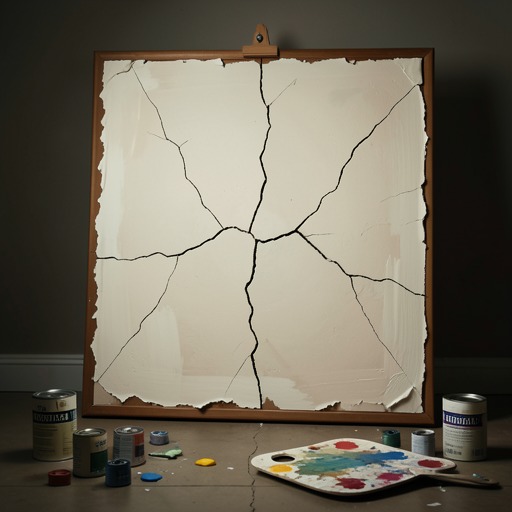
The painting was in storage when it began to fall apart, as Rabo’s other works had been doing. A woman curator noticed tape and flakes of Sateen Dura-Luxe on the floor and called to ask whether the painting could be restored and whether the museum might somehow be responsible. Her question about the museum’s humidity controls reflects the immediate problem of conservation: the work was deteriorating under institutional care, but the cause was not established as the museum’s fault.
A further discovery complicated the conservation problem. The curator reported that a large face had emerged from the canvas. Rabo recognized it as a caricature he had drawn with his filthy thumbs before covering it. The resurfacing image turned a technical failure into the return of an earlier mark, making the painting’s breakdown reveal something the finished abstraction had hidden.
Rabo’s Offer and the Museum’s Refusal
Rabo offered to duplicate the painting exactly, using more durable paints and tapes that, he claimed, would outlast the smile of the Mona Lisa. The offer was consistent with his willingness to remake the damaged works, but it could not restore the original object or undo the public story already attached to their collapse. The Guggenheim, like the other institutions and owners he approached, turned him down.
Rabo interprets that refusal as a preference for the comic footnote he had become in art history over a repaired or repeated work. In his bitter imagined dictionary entry, his surname becomes a term for a fiasco in which someone destroys his own work and reputation through stupidity, carelessness, or both. The museum’s decision therefore contributes to the finality of the failure as Rabo experiences it: his proposal to replace the painting does not change the story told about the original.
Display, Interpretation, and Public Attention
The Guggenheim episode contrasts with the later public display of Rabo’s concealed warehouse mural. By then, his museum tour runs from small girls on swings in the foyer, past early Abstract Expressionist works, to the enormous painting in the potato barn. He has unspiked the barn’s sliding doors so visitors can flow in one end and out the other; some walk through more than once. The carefully managed movement of this crowd is unlike the storage setting in which the Guggenheim’s curator found flakes on the floor.
Rabo says no solemn critic has appeared to classify the huge work, while lay visitors ask what kind of painting it is. He calls it not a painting but a tourist attraction, a World’s Fair, and Disneyland, then qualifies the comparison as gruesome, with nobody cute. Set beside the Guggenheim’s purchase of a damaged, individually owned canvas, this later attraction complicates the boundary between art object and public spectacle. The institutional museum and Rabo’s own improvised museum alike depend on display and interpretation, but the audiences and terms of attention differ: one work is encountered through conservation and art-historical reputation, the other through the bodily passage of visitors through a barn.