Luxembourg
BluebeardLuxembourg is the setting of the decisive wartime ordeal that leaves Rabo Karabekian without his left eye and leads to his capture near the end of World War II. It is also where his identity as an artist-soldier takes concrete form: he commands a platoon of artists whose camouflage creates false impressions for the Germans, while he chooses to remain with their close-knit unit rather than advance in rank.
Setting and Military Role
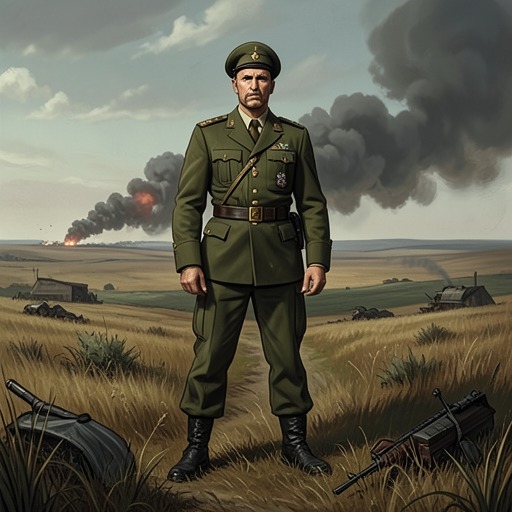
Rabo serves in Luxembourg as a lieutenant commanding a platoon of Army Engineers. The unit’s members are artists in civilian life, assigned to camouflage because the Army expects their artistic abilities to make them effective at concealing military positions and misleading the enemy. At the point of Rabo’s injury, however, they are fighting as ordinary infantry for their lives.
The platoon operates unusually: it is not attached to a division or corps, but receives orders directly from the Supreme Headquarters of the Allied Expeditionary Force and is temporarily assigned to generals who have heard of its deceptions. Rabo recalls that the unit could live with an artist’s informality about dress and military courtesy, and that its commanders were first fascinated by its visual tricks and ultimately grateful for them. This specialized work makes Luxembourg both a battlefield and the setting in which painting’s capacity to shape what people see becomes a matter of survival.
Wounding and Capture
Rabo loses his left eye during the fighting near the end of the war. He does not remember being struck. His remembered image is of a white German tank and German soldiers dressed in white approaching across a snow-covered meadow in Luxembourg. He is unconscious when taken prisoner; morphine keeps him unconscious until he wakes in a German military hospital housed in a church across the border, in Germany.
The wound heals quickly, and Rabo is soon sent to a prisoner-of-war camp as an unremarkable captive. In a later conversation, he argues that he is entitled to survivor’s syndrome, while Circe Berman points out that he had described the wound as nearly painless and quick to heal. The recollection distinguishes the physical course of this injury from the longer meaning Rabo assigns to surviving the war: Luxembourg marks the loss of his eye and his capture, even though he remembers little of the moment itself.
The Platoon as a Chosen Family
Rabo says that he had joined the regular Army and become a lieutenant two years before the United States entered the war. He might, he estimates, have become at least a lieutenant colonel by the war’s end, but refused promotions beyond captain so that he could remain with his thirty-six men. Luxembourg is thus bound to a form of belonging he later describes as a happy family. It is his first experience of a family that large, and a sharp contrast with the loneliness he recalls from civilian life.
That attachment also shapes the way he tells the story of his military service. His account does not present the platoon merely as a technical unit: it emphasizes its distinctive artists, its freedom from ordinary military attachments, and its repeated departures to serve different generals. The chosen companionship makes his later separation from the group at capture more than a change of location; it ends the shared wartime life he had declined promotion to preserve.
Aftermath and Significance
After the war, the United States pays for cosmetic surgery at Fort Benjamin Harrison to address the place where Rabo’s eye had been. He describes himself as blank rather than bitter at the end of the war, and says that neither he nor his friend Fred Jones had anything to return to. His injury is therefore both a specific consequence of the fighting in Luxembourg and part of a broader postwar rupture between military survival and civilian belonging.
Luxembourg also anchors Rabo’s account of camouflage, a skill that later stands out as an achievement he can claim without qualification. He recalls that his platoon received a Presidential Unit Citation for its work. The place gathers the two sides of that achievement: the artists’ ability to manipulate an enemy’s view, and the vulnerability of the men who had to fight when concealment gave way to direct combat.