Adolf Eichmann
FatherlandAdolf Eichmann’s role in the novel is traced chiefly through documents: as a Reich Main Security Office officer, he compiled the draft minutes of the January 20, 1942, Wannsee Conference, whose explicit account of killing methods was edited by Reinhard Heydrich into a bland archival euphemism. The contradiction between Eichmann’s fuller draft and the final record makes him a central link between the administrative language of genocide and the evidence that later exposes what that language concealed.
Identity and documentary role
The novel identifies Eichmann as an SS-Standartenführer of the Reich Main Security Office. His place in the story emerges not through a direct scene with him, but through records that Xavier March examines while investigating the deaths of officials associated with the Wannsee Conference. The documents present Eichmann as a compiler and participant in the machinery of policy, and also as a name whose public account of death proves unreliable.
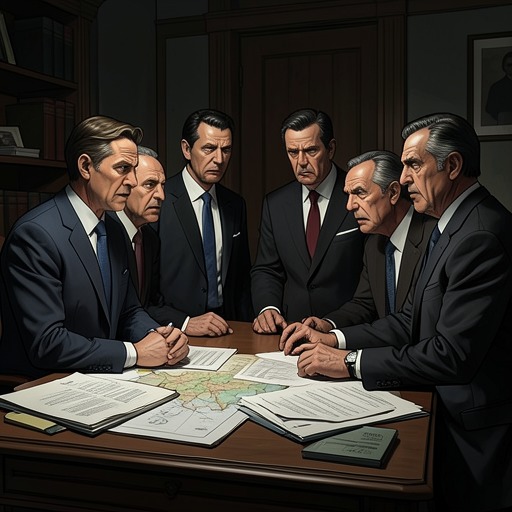
The conference itself was convened at Wannsee on January 20, 1942, to discuss the “final solution of the Jewish question.” Its surviving formal minutes describe a plan involving around eleven million Jews from across Europe and use administrative terms such as “labor utilization” and “natural reduction.” The breadth of the listed population makes clear that the policy was not limited to German Jews: the document enumerates people from more than thirty European nationalities.
The draft and the edited record
March finds rough photostats that appear to reproduce Eichmann’s original draft minutes. The typed document bears amendments and angry corrections in Heydrich’s recognizable handwriting. In Eichmann’s version, Heydrich discusses why shooting is inadequate as a method: it is slow, creates security risks, and affects the personnel carrying it out. Heydrich then calls on Rudolf Lange to give an eyewitness account of methods used in the East.
Lange’s account compares three operations: the shooting of Berlin Jews near Riga, the use of gas trucks at Kulmhof, and experiments with Zyklon B at Auschwitz. The draft records the latter method as especially promising in terms of capacity and security. These details place Eichmann’s minutes within an administrative process that compares methods of mass murder, rather than treating the conference as an abstract discussion of resettlement.
Heydrich’s handwritten “No!” marks the point at which that account is curtailed. In the final minutes, the entire section is reduced to the sentence that the participants discussed “various types of solution possibilities.” The difference between draft and final version is consequential: the original preserves evidence of the methods considered, while the edited text makes the meeting suitable for official storage by removing its specificity. Eichmann’s draft therefore survives in the narrative as a record of what the official minutes were made to hide.
The archive and the concealment
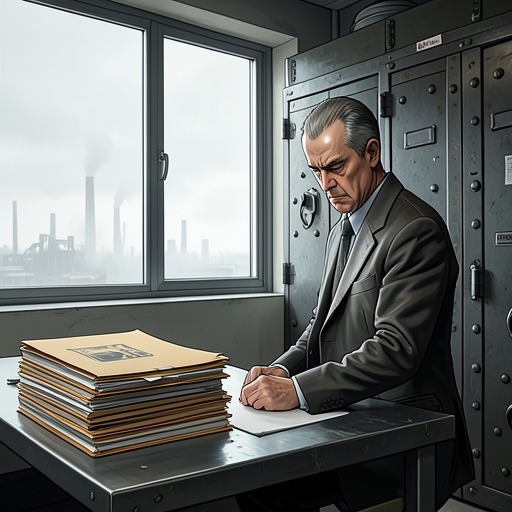
The documents March uncovers belong to a larger struggle over access to the past. A letter bearing Heydrich’s signature confirms the meeting’s date and venue; a later notice states that the minutes were removed from the archive at the request of the Reichsführer-SS. The removal notice is dated April 6, 1964, and March realizes that Heydrich had extracted the minutes only eleven days earlier. The archive does not simply preserve history: its gaps and interventions reveal who can control the evidence.
March obtains poor photocopies with the help of Rudi Halder, who is frightened by the danger of copying the papers and urges March not to see him again for a long time. Their haste and Halder’s fear emphasize the risk of preserving even a copy of material the authorities have removed. Against the sanitized official minutes, Eichmann’s draft becomes an unstable but crucial piece of evidence: its amendments record not only the subject discussed but the act of suppressing it.
Reported death and later fate
In a 1964 account of former conference participants, the Völkischer Beobachter is said to have reported that Eichmann died of a heart attack in 1961. The novel later states that he was executed by the Israelis in 1962. These accounts do not agree. Their contradiction places Eichmann among the officials whose deaths and postwar fates are obscured, misreported, or left uncertain within the fictional history.
Eichmann’s narrative significance rests on this double trace. The draft minutes expose how bureaucratic prose could convert mass murder into a matter of procedure, while the conflicting reports of his death show how the perpetrators’ public record remains subject to concealment and revision. The paper trail does not make the crime abstract; in the novel, its omissions and corrections become evidence of the deliberate effort to disguise it.