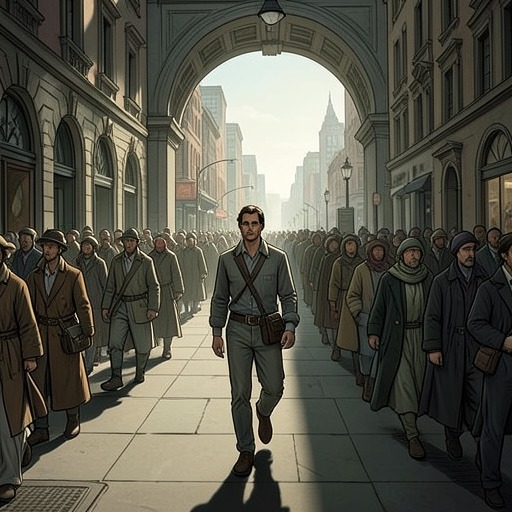
Joseph Goebbels
FatherlandJoseph Goebbels is presented through the propaganda apparatus associated with his office and the images attributed to him, rather than through sustained direct action. His influence ranges from a children’s cartoon warning against suspicious parcels to the distorted picture of America in Xavier March’s mind; set against records of the mass murder of European Jews, these materials expose propaganda’s role in shaping what the public sees and what officials are encouraged not to ask.
Propaganda and Public Awareness
The Propaganda Ministry produced a series of children’s cartoons as part of a campaign to raise public awareness about terrorism. One cartoon, pinned to a second-floor notice board, showed a girl opening a parcel layer by layer until she discovered an alarm clock attached to sticks of dynamite. Its final caption warned, “Warning! Do not open a parcel unless you know its contents!” The cartoon turns an elementary safety message into a maxim that March recognizes as applicable to police work: caution about what an object contains becomes caution about asking questions whose answers may be dangerous.
That public instruction carries an irony the scene makes explicit. A state that warns children to inspect the contents of parcels also relies on officers who have learned not to probe matters when they cannot control the answer. The cartoon is a small, ordinary piece of official communication, but its placement in the story connects the government’s management of public awareness with the larger suppression of knowledge.
The American Image
March’s first thoughts of America arrive through images he associates with Doctor Goebbels’s influence: racial stereotypes, wealthy capitalists, factories, poverty, crime, and popular entertainment. These impressions form a disjointed propaganda collage rather than a coherent understanding of the country. Against that inherited picture, March’s thoughts turn to Kennedy and Charlie, making America both a political image and a personal possibility.
The contrast matters because the novel shows propaganda working not only through public slogans but through the mental pictures available to an individual. March has previously treated America as a collection of hostile or degrading images; contemplating it now, he begins to imagine a destination beyond the world those images have helped define.
Broadcast Spectacle
As March and Charlie prepare to leave the apartment, the possible presence of a microphone shapes their movements: they keep quiet while getting ready. March turns up the radio, using a scheduled rebroadcast of Hitler’s 1937 speech attacking modern painters as cover. The program is part of an annual practice of replaying the speech, so official propaganda functions here both as political ritual and as a practical sound screen.
The broadcast’s argument condemns modern artists by treating their perceptions either as hereditary defects or as deliberate criminal deception. Its language shows how propaganda can convert cultural disagreement into questions of biological fitness and state punishment. March uses the broadcast to conceal private preparations, but the speech itself reveals the coercive logic that the regime circulates in public.
Propaganda Against the Documentary Record
The novel places Goebbels’s propaganda world beside records that contradict its claims and euphemisms. The Wannsee minutes identify a conference held on January 20, 1942, to address the “final solution of the Jewish question,” and enumerate about eleven million Jews across Europe. A draft record, with amendments associated with Reinhard Heydrich, preserves discussion of mass shootings, gas trucks, and experiments with Zyklon B; the corresponding passage was reduced in the final minutes. The gap between the detailed draft and the sanitized official version makes concealment part of the documentary record itself.
Martin Luther’s account of Auschwitz supplies a further counter-image to administrative language. It describes the camp’s rail siding, the arrival and separation of deportees, and the route leading to an underground chamber presented as a bathing and disinfecting facility. The account then records the removal and processing of bodies and the recovery of prisoners’ belongings. A separate order directs that human hair be collected, processed, and reported monthly, specifying uses for hair from female and male prisoners. Taken together, the documents show how bureaucratic classifications and logistical instructions made persecution operational while obscuring its human reality.
Power, Image, and Irony
Goebbels’s influence also appears in Odilo Globocnik’s remarks about a proposed SS baseball team that could play the U.S. Army. Globocnik says Goebbels is keen on the idea because he expects American audiences to respond to the pictures. The exchange presents propaganda as the deliberate staging of an image for foreign consumption, even as the novel’s evidence exposes the crimes that such images leave out.
Across these scenes, propaganda is more than a set of false descriptions. It is a system for shaping attention: it warns the public about parcels, supplies March with stereotypes of America, turns an annual speech into political ritual, and imagines sport as an instrument of persuasion abroad. The documentary evidence of mass murder presses against that managed surface, showing the distance between the images circulated by the regime and the realities its records reveal.