Paul March
FatherlandPaul March, known as Pili, is Xavier March and Klara Eckart’s son. At ten years old, he moves between a divided family life and the public rituals of the Reich: a visit with his father places him in a city tour, where his excitement about seeing the Führer gives way to fear that his father will be arrested. Through Pili, the novel shows both the strain in the March family and how political authority reaches into a child’s understanding of home and loyalty.
Identity and Family Background
Pili was born ten years and one month before the Berlin outing described in the novel. His parents had married after Xavier March met Klara, a nurse, while he was convalescing from suspected tuberculosis. By the time Xavier was promoted to Berlin in 1954, Klara was pregnant and their marriage was already failing; they later divorced.
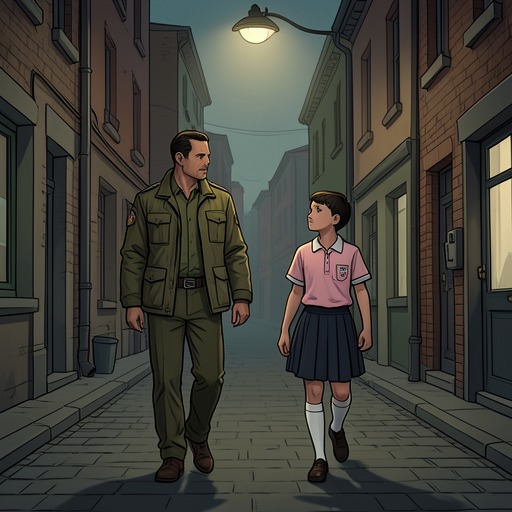
The separation has become a routine with rules rather than a shared family arrangement. Xavier collects Pili from Klara’s bungalow in Lichtenrade, in a southern suburb, by parking outside and sounding the horn twice. Klara’s appearance at the parlor curtain signals that Pili is ready. The unspoken procedure avoids an awkward meeting between the former spouses, but it also makes the child’s transfer between households a carefully managed ritual. Visits take place one Sunday in four, subject to Xavier’s work and the Reich Marriages Act.
Life and Visit with His Father
The visit in the city takes place during a school holiday. Since 1959, children have received a week off for the Führer’s birthday rather than for Easter, and this unusual Tuesday visit lets Xavier spend time with Pili. At Klara’s door, Pili appears as if reluctant to enter a performance, wearing his new Pimpf uniform: a crisp black shirt and dark blue shorts. He climbs into the car without speaking, and Xavier gives him an awkward hug.
Their conversation begins with ordinary attempts at connection. Xavier tells him that he looks smart and asks about school; Pili answers only that it is all right. Later, as the coach approaches the Great Hall, Pili returns to his seat bouncing with excitement and asks whether they are going to see the Führer. The question places a child’s enthusiasm beside the monumental public spectacle around him. Xavier’s attention, however, has drifted to a body he has seen outside, and Pili’s excitement interrupts that private preoccupation.
Political Fear and His Relationship with Xavier
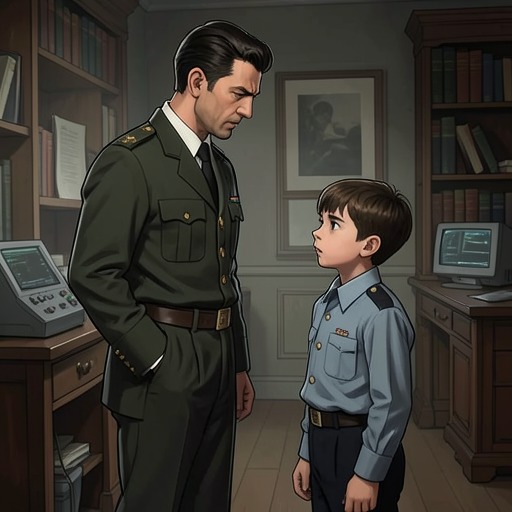
Pili brings his father a troubling report about how Xavier is regarded at school. He says that someone has told him Xavier does not give the Führer salute and makes jokes about the Party. When Xavier asks how the boy knows this, Pili explains that the same person claims there is a file on his father at Party headquarters and that it is only a matter of time before he is picked up. Pili is almost in tears with shame and says he thinks the warning is right.
The exchange makes Pili more than a witness to his father’s political unease: he has absorbed its threat through another person’s judgment and carries it into their visit. His distress mixes fear with embarrassment, while Xavier’s sharp call of his name shows the force of the revelation in the moment. The novel does not identify the person who gave Pili this account in the supplied scene, nor does it establish that the alleged file will lead to an arrest.
Narrative Role
Pili’s sparse speech gives the encounter its emotional measure. His reserved answer about school, his eager question about seeing the Führer, and his later near-tearful report trace a movement from the ordinary hopes of a child’s outing to the fear that his father is marked as disloyal. His new uniform belongs to the world of public conformity, while his concern for Xavier exposes the personal cost of that world inside a family.
The contrast is especially sharp because Xavier’s absence from the moment has already become a complaint in his marriage: even when physically present, he can seem elsewhere. During the outing, his thoughts turn away from Pili until the boy’s question brings him back. Pili’s role is therefore defined not by a long independent plot but by the pressure the scene places on the father-son bond: a child seeks shared attention and reassurance, yet brings home the state’s suspicion as part of what he has learned about his father.