Rudolf Halder
FatherlandRudolf Halder is Xavier March’s old friend, a former U-boat wireless operator who becomes a historian at the Reichsarchiv. His importance lies in the double position he occupies: a timid survivor of the war and a custodian of the official record, able to help March trace documents that the regime is actively removing. His courage is real but bounded; once the danger becomes unmistakable, he withdraws to protect his family, leaving March with the evidence and the risk.
Identity and Background
Halder re-enters the investigation through a midnight call. After hearing that an old comrade of Hitler’s has been recovered from a lake, March makes three calls, the last to a Berlin number. The sleepy man who answers is Halder, who recognizes March by his old nickname and protests the hour. Their familiarity is immediate, but the call also marks the start of a dangerous collaboration: March needs a friend who can reach the archives, and Halder is already inside the institutions whose records may explain the case.
More than twenty years earlier, Halder had joined the U-boat service as a university recruit and served as wireless operator aboard U-174. He was rushed through training in early 1942, when losses were high and Dönitz was searching widely for replacements. The work did not suit him. Clumsy and barely competent at changing a fuse, he spent voyages sweating with fear and seasickness; while the rest of the crew grew beards, his red facial hair came in sparse orange tufts. His shipmates nevertheless treated him as a mascot, believing that he brought good luck and covering his errors. The episode establishes a pattern that persists in his later life: Halder is not a natural man of action, but others take care of him, and he survives.
After the war, Halder returned to his studies in history at Berlin University. In 1958 he joined the Reichsarchiv team preparing the official history of the war. His days in a subterranean chamber, reconstructing the military strategy of which he had once been a frightened and insignificant part, bring his academic career into an uneasy circle. He had already published The U-boat Service: Operations and Tactics, 1939–46 in 1963 and was helping prepare a third volume on the German Army on the eastern front. His work is scholarly, but it is also part of the state’s organized account of its own past.
Friendship with March
The contrast between Halder’s past and present emerges in a hotel dining room where the two men meet. The shabby Prinz Friedrich Karl Hotel, between Kripo headquarters and Halder’s office in the Reichsarchiv, offers a discreet place to talk; trains shake the walls as they arrive at Friedrich-Strasse station. March’s SS uniform makes other patrons give him a wide berth. Halder, by contrast, sets out a generous breakfast—cheese, ham, salami, three hard-boiled eggs, black bread, milk, and coffee—and remarks on March’s reliance on coffee, cigarettes, and whisky. He has not seen his friend eat properly since March separated from Klara.
March thinks Halder has changed less than any of their old companions. Beneath the weight of middle age he still sees the gangling recruit, with wire-framed glasses and thin red hair, who had been frightened at sea. That recollection gives their friendship a history beyond the immediate case: March remembers Halder not as an authoritative archivist but as the vulnerable young sailor his crew once protected. At the same time, Halder has built a settled life that March no longer shares. He describes modest ambitions—a university post in the south, a country house with Ilse and the children, and a few books reviewed respectfully—and says archival work gives him a sense of his own mortality.
Halder’s help begins with a photocopy from an old Party directory, the 1951 Guide to the Personalities of the NSDAP. It contains four passport-sized portraits and short biographies, including one of Buhler. The directory is a small, routine artifact, but it gives March a documentary foothold for examining the official identity and wartime role of a man whose death has drawn him into a larger inquiry. Halder then explains Buhler’s authority as state secretary in the General Government: he and Frank had broad power, and resettlement would have been a central priority. To make the territorial rearrangement comprehensible, Halder turns the plates on the breakfast table into a rough map. The western Polish provinces had been incorporated into Germany as Reichsgau Danzig-West Prussia and Reichsgau Wartheland; the remaining territory became the General Government. His explanation connects the individual in the directory to the machinery of occupation and Germanization.
The Archive and the Missing Minutes
The investigation grows more dangerous when March and Halder search the Reichsarchiv’s correspondence and minutes. Among letters about gas-mask distribution and alleged misuse of gasoline by senior officials, they find a letter bearing Reinhard Heydrich’s signature and the letterhead of the Reich Main Security Office. Dated January 6, 1942, it confirms that an interagency discussion and luncheon, originally set for December 9, 1941, had been postponed to January 20 at the office of the International Criminal Police Commission in the Wannsee villa. The wording presents the meeting as administrative business. Its date and sender, however, make the document a key trace of the gathering later known as the Wannsee Conference.
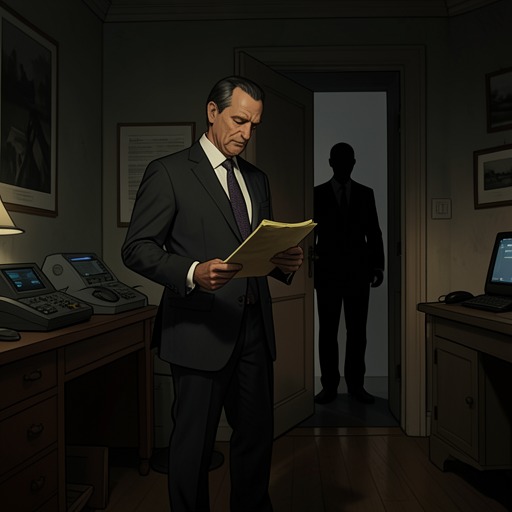
When March asks whether they can learn what was discussed, Halder searches the minutes and memoranda series. In another box he finds a single sheet stating that, in the interest of state security, the minutes of the January 20, 1942 meeting have been removed at the request of the Reichsführer-SS. The notice is dated April 6, 1964. Halder points out the date: Heydrich has had the record extracted only eleven days earlier. The document’s absence is therefore not a gap left by time or careless filing; it is a present act of state control. Halder explains that the Gestapo can remove papers on security grounds and usually transfers them to the vaults at Prinz-Albrecht-Strasse.
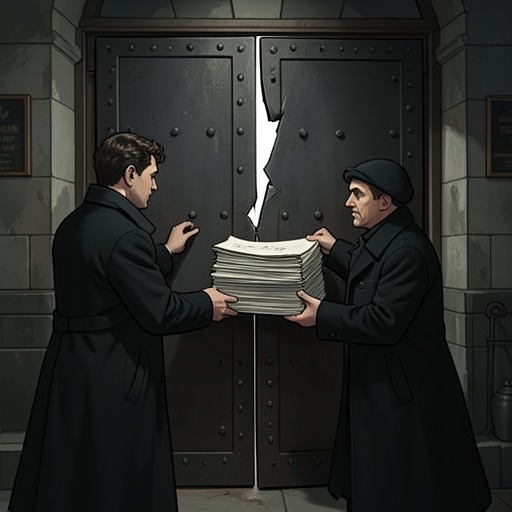
The missing minutes make Halder’s access and his fear inseparable. He has helped March find the institutional trace, but now the archive itself records that a powerful agency has intervened. In the registry, March examines three poor photocopies, made faintly and at an angle. Halder had not wanted to copy the material; after March pressed him, he rushed through the task, returned the papers to their boxes and shelves, and insisted that they leave by a rear entrance. The physical defects of the copies preserve the circumstances of their production: this is not a clean scholarly reproduction but a hurried survival of records taken under pressure.
Evidence, Fear, and Withdrawal
The papers March carries include Heydrich’s original invitation of November 19, 1941. It cites the authorization issued by Göring on July 31, 1941, charging Heydrich to coordinate the organizational, technical, and material preparations for a complete solution of the Jewish question in Europe. It also describes the meeting as necessary to coordinate further tasks, noting that Jews had been transported east from Reich territory, including the Protectorate, since October 10. The invitation turns the archive search into more than a question about Buhler’s career: it connects senior officials, a scheduled interagency meeting, and the ongoing deportations in the language of administrative coordination.
Halder’s response is not a sudden denunciation of his friend or of the danger. He stands miserable and helpless while fireworks burst overhead, then tells March they should not see each other for a long time. March accepts that Halder’s family comes first and embraces him before walking away. The separation gives his assistance its measure: Halder has helped identify the directory entry, explain the occupation’s administrative structure, find the correspondence and expose the removal of the minutes, but he will not continue alongside March once the risk becomes immediate. His retreat is neither the disappearance of his earlier courage nor an uncomplicated act of loyalty; it is the limit imposed by the ordinary attachments March himself acknowledges.
Narrative Role
Halder’s role is defined by the difference between preserving history and controlling it. As a historian, he reconstructs the war through official archives; as a former sailor, he knows that survival can depend on others quietly covering one’s weakness. When the same state that funds the historical record removes a central set of minutes, his expertise allows March to recognize the significance of the removal, while his fear shows the cost of pursuing it. The documents he helps uncover do not resolve the danger by themselves: the invitation survives as a copy, the minutes are gone, and the friend who helped retrieve the evidence returns to the safety of family life.
That contrast makes Halder a consequential ally without turning him into March’s equal in resolve. March carries the papers onward; Halder withdraws after ensuring that the record has been copied. His scholarly habits supply the route into the archive, and his caution exposes the pressure surrounding it. In a world where official paperwork can make violence appear procedural and then erase its own record, Halder’s brief, frightened assistance helps transform missing documents into evidence.