Xavier March
FatherlandXavier March is a homicide investigator in the Berlin Kriminalpolizei whose investigation of a body found in the Havel brings him face to face with the state’s buried crimes. A former U-boat officer known as “the Fox,” he follows small inconsistencies through police files, personal testimony, and official records until he understands that the deaths around him are tied to a deliberate campaign to erase the evidence of the murder of Europe’s Jews. His defining conflict is between the disciplined investigator he has been trained to be and the truth his investigation obliges him to expose.
Identity and Background
At forty-two, March is a slim man with gray hair and gray eyes. He served in the U-boat arm during the war, and the northern rain at the Havel briefly returns him to the memory of leaving Wilhelmshaven in a submarine with its lights extinguished. His colleagues call him “the Fox”: unlike the “gray wolves” of wartime propaganda, he does not run with the pack, and his strengths lie in determination and thought rather than physical force.
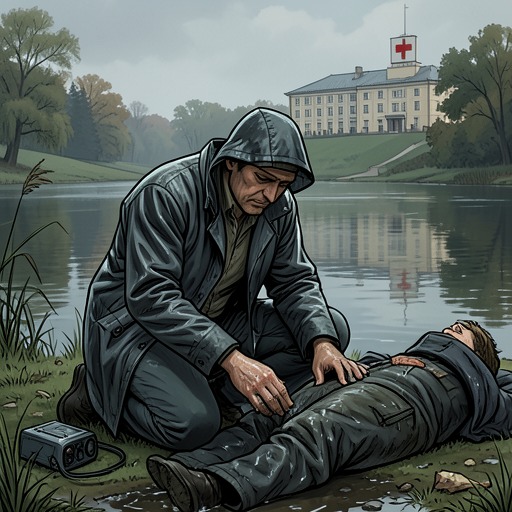
March’s work begins with the habits of a professional detective. At the lakeside, he notices the circumstances around the body and turns to the people and details that might explain them. The case’s promise of adventure is initially compatible with routine police procedure; what changes is the scale of what the evidence points toward. His methods remain those of an investigator even as the institutions around him increasingly treat investigation itself as a threat.
The Investigation and Its Turning Points
The death of Josef Buhler first presents March with competing explanations. He records the possibilities in his notebook: an accidental death, a killing carried out by the Gestapo, or a murder by Odilo Globocnik concealed under a state-security designation. He rejects each account as insufficient, noting that the Night and Fog order could have allowed the Gestapo to disappear Buhler without leaving his body in a public place. The body’s location and the official handling of the case therefore become clues, not incidental details.
A sparse diary adds a more specific trail. Among its few entries is a note of a meeting between Stuckart and Luther at ten in the morning on April 11, with small crosses marking other dates, including April 13, the day before Buhler died. March copies the dates and tries to distinguish what the diary establishes from what remains unexplained. His case grows not through a single revelation but through the pressure created by a few carefully recorded appointments and absences.
The investigation is repeatedly taken out of March’s hands. An official statement says that the Gestapo had been investigating Buhler and that the case was transferred to it as a matter of state security; the statement also accuses March of entering Buhler’s home illegally after the transfer had not been communicated to him. When Stuckart’s death is announced, the cases are declared linked and again placed under Gestapo control, despite March’s inquiries. The language of procedure thus becomes a means of discrediting the investigator and restricting what he can discover.
March’s superior, Artur Nebe, recognizes that March has not told him everything. Rather than treating that silence as a simple confession of guilt, Nebe privately gives him a file compiled about him and speaks with him away from Odilo Globocnik. The exchange shows the danger of March’s position: the authorities are monitoring him, but Nebe is not simply aligned with the force closing in. March’s investigation must proceed amid divided loyalties as well as direct obstruction.
Evidence of the Mass Murder
A document concerning a conference scheduled for January 20, 1942, at Wannsee becomes the hinge between the individual cases and a much larger crime. March and Rudi Halder recognize that the meeting’s organization is unusual and look for related minutes and memoranda. Later, March identifies Martin Luther as one of fourteen men summoned to the conference by Reinhard Heydrich to discuss the final solution of the Jewish question in Europe. He tells Henry Nightingale that, of the fourteen, six have been murdered, four have died by suicide, one in an accident, and two supposedly of natural causes; Luther is the only one still alive.
March’s recognition of the word “Endlösung” marks the moment when the scattered paperwork acquires its meaning. The children’s warning about not opening a parcel without knowing its contents has just presented caution as a public maxim; March’s sudden repetition of the term carries him into Max Jaeger’s desk to search for further records. The contrast is sharp: in a police state, the danger lies not only in opening a parcel but in learning what official language has been made to conceal.
When March finally explains the case to Charlotte Maguire, he recounts Buhler’s death, Luther’s disappearance, Hermann Jost’s testimony, Nebe and Globus’s involvement, the art treasures, the file compiled on him, and his son’s statement. The confession gathers together strands that had been held apart by secrecy. It also demonstrates that March’s pursuit has become a personal and moral risk: he is no longer merely testing a case theory but making the evidence intelligible to someone who may help him act on it.
Relationships and Pressure
March’s relationship with Max Jaeger is bound up with the investigation and its institutional dangers. When he learns that Buhler was described as the subject of a Gestapo investigation, he struggles to keep his expression impassive while Jaeger is present. Later, he searches Jaeger’s desk for records, relying on his colleague’s known laxity with administrative paperwork. Their working relationship places March close to the evidence, but the police hierarchy and Gestapo scrutiny make that closeness precarious.
Nebe’s relationship with March is similarly divided between authority and aid. Nebe confronts him with the existence of a file about him, yet also recognizes the incompleteness of March’s account and arranges a private conversation. At the end, he helps give March an opportunity to leave with the papers. The assistance does not erase the risks or make their positions identical; it makes Nebe’s choice consequential precisely because March is being pursued by the system in which both men hold rank.
March’s ties to his family remain part of the person endangered by the investigation. In a memory of a 1953 holiday with Klara, he recalls the trip south from Freiburg toward the Rhine and the afternoon when they began the family that would include Pili. The image of a steel bridge spanning the river between Germany and Switzerland joins that earlier life to the possibility of departure. Later, March tells Maguire that he has also heard his son’s statement, incorporating the family’s testimony into a case that has ceased to be safely separate from his private life.
Escape and Narrative Significance
March’s report to Nebe from Zürich is composed as an official memorandum, identifying the recipient by rank and office and recording that he attended the premises of Zaugg & Cie. The formal document briefly preserves the bureaucratic voice of his profession even as the investigation has taken him beyond its ordinary protections. Its matter-of-fact form contrasts with the extraordinary danger surrounding the evidence he is trying to carry forward.
In the final escape, Nebe urges March to get the papers out and have them published, while Krebs counts. March is told that men have risked everything to give him a chance; he must act before that chance closes. The ending leaves the publication of the documents as an urgent objective rather than a completed result. March’s final significance lies in that unresolved handover: the detective who followed official traces must try to move the evidence beyond the authorities that can suppress it.
The novel makes March’s investigative habits both his professional identity and the basis of his resistance. A diary’s sparse marks, an unexplained interval in a witness’s account, and a conference notice become links in a chain that official power would prefer to break. His route from the Havel to the Wannsee records is therefore not simply a solution to a murder mystery. It exposes how state paperwork can disguise violence, and how examining that paperwork can turn an investigator into a witness.