Adolf Hitler
FatherlandAdolf Hitler is the absent center of the novel’s alternate-history Germany. He appears through speeches, portraits, ceremonies, and official announcements, but the most consequential fact about his rule emerges through a sworn record: in the summer of 1941, he privately told Reinhard Heydrich that he had decided to resolve the Jewish Question once and for all. His authority is thus presented in two registers—spectacularly visible in public life and deliberately obscured where the regime’s crimes are concerned.
Identity and Public Presence
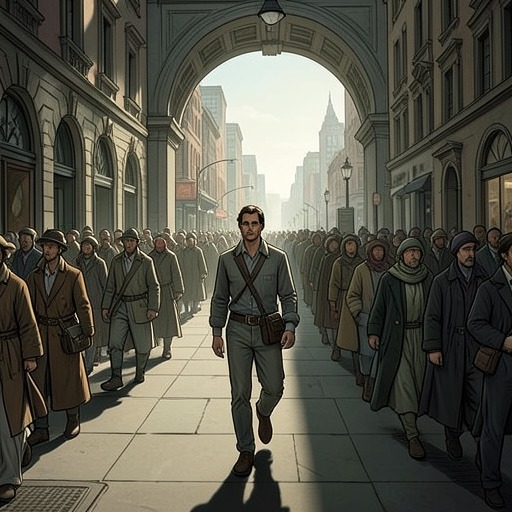
Hitler is identified by the titles Führer and Chancellor of the German Reich, and the novel makes those titles part of the country’s daily visual and ceremonial order. In the opening oath, loyalty to him is joined to loyalty and bravery. His presence is not confined to government buildings: in Third Reich capital Berlin, shop windows display gilt-framed portraits of him, decorated with twigs and flowers ahead of his birthday. As the celebration approaches, swastika banners multiply until the city is imagined as a forest of red, white, and black.
The architecture of power gives the cult a monumental address. A tour guide describes the Reich Chancellery and Führer residence as having a seven-hundred-meter façade, one hundred meters longer than the palace at Versailles. Its balcony is where Hitler appears before crowds of a million; even when the shutters are closed, sightseers look up in expectation. The building makes his public image seem both physically remote and capable of drawing a mass audience.
His birthday is also a destination for private gestures of devotion. A Swiss package posted in Zürich bears three stamps with tiny yellow flowers and is wrapped with conspicuous care. Inside is a heavy box of chocolates whose lid depicts girls dancing around a maypole beneath the Alps, with a greeting addressed to the Führer for 1964. The polished, affectionate surface belongs to a national culture in which even a birthday parcel is framed around the ruler.
Speeches and the Uses of History
Hitler’s recorded voice helps sustain that public presence. A 1964 government announcement says that he has invited the president of the United States to Berlin for discussions intended to promote understanding between the two peoples. The invitation has been accepted, and the American administration has indicated that John F. Kennedy intends to meet him in September. The broadcast closes with a salute and a declaration of German vitality; the national anthem follows, and people in a canteen sing along. March imagines the same acclamation rising from workplaces and schools across the country. The scene ties diplomacy to spectacle: the state presents the summit as another occasion for collective affirmation of the Führer.
The regime also preserves and recirculates Hitler’s earlier speeches. In March’s apartment, the radio rebroadcasts his 1937 attack on modern painters, delivered at the inauguration of the House of German Art. The passage condemns artists who represent the world differently and invokes hereditary defect and criminal prosecution. Its return over the airwaves shows how political doctrine is made habitual: an old speech is not simply an historical record, but a recurring part of the present’s controlled soundscape.
A statement attributed to Hitler in 1941 imagines a future in which people can no longer conceive of a way of life different from National Socialism. The novel places that projection beside the visible routines of obedience—portraits, broadcasts, official language, and public ceremony. The point is not merely that the regime commands assent, but that it seeks to make alternatives difficult to imagine.
War, Conquest, and the Hidden Order
Hitler’s public language about war presents permanent struggle as a source of national strength. March recalls a statement that a continuing state of war on the eastern front would form a sound race of men and guard against the softness of a Europe turned inward. Yet the comforts enjoyed by the population—Polish laborers tending gardens, Ukrainians sweeping streets, French cooks, and English maids—suggest that conquest has also produced the ease the regime’s rhetoric condemns. The gap between martial doctrine and settled privilege sharpens the novel’s portrayal of a society shaped by domination but increasingly accustomed to its benefits.
The most important account of Hitler’s policy comes not in a public speech but in Wilhelm Stuckart’s sworn record of conversations in December 1941. After Stuckart learned of reports that one thousand Jews evacuated from Berlin had been massacred in Rumbuli Forest, he sought clarification from Reinhard Heydrich. Heydrich confirmed the information and described a private conversation in which Hitler had explained his decision, made in the summer, to destroy the Jewish Question permanently. Hitler’s stated reasoning joined military opportunity to a vision of historical impunity: he believed that victory would prevent later scrutiny, while defeat would at least leave his enemies unable to benefit from the destruction of National Socialism. He framed the policy as removing the biological basis of Judaism so that the supposed problem would not recur for future generations.
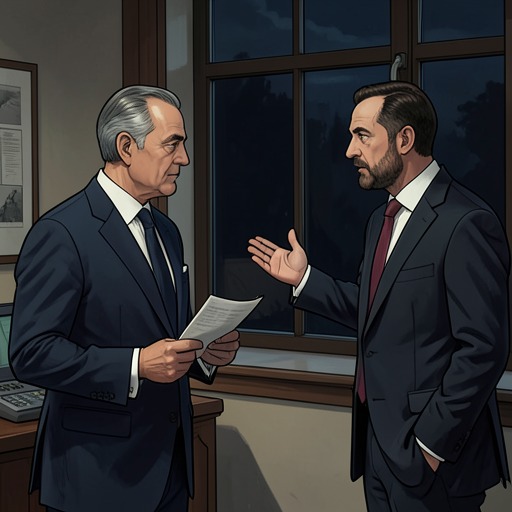
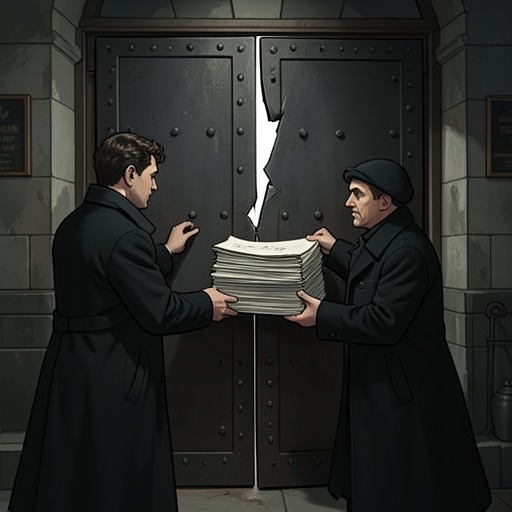
Stuckart’s account also makes the legal and documentary concealment explicit. Heydrich said that the powers to implement Hitler’s order had been granted by Hermann Göring on July 31, 1941, and that the matter would be discussed at an interdepartmental conference. When Stuckart suggested that so grave an order should be put in writing, Heydrich said political considerations made that impossible. He told Stuckart to raise any reservations directly with Hitler and joked that a chief legal draftsman and a chief policeman need not worry about legalistic grounds. The exchange captures a system in which immense state power proceeds alongside the deliberate absence of a signed order.
Narrative Function and Historical Record
Hitler’s role is constructed through mediated evidence rather than through a sustained personal portrait. Public broadcasts and monumental settings show how the regime manufactures presence; the sworn affidavit reveals what public ceremony conceals. This contrast also shapes March’s investigation. As he considers the suspicious deaths of two retired officials in the week an American president announces a visit, the cult’s carefully staged normality begins to appear inseparable from the suppression of inconvenient knowledge.
The novel’s closing historical note distinguishes authentic documents from invented ones and states that Hitler notoriously avoided attaching his name to a direct order for the Final Solution, while almost certainly issuing a verbal instruction in the summer of 1941. That qualification places the fictional evidence within a documented pattern without claiming that every scene is a historical transcript. Hitler’s defining significance in the story lies in that junction of personal command and bureaucratic deniability: his image fills the country, while the order at the heart of the regime’s crime is kept out of writing.