Rudolf Lange
FatherlandRudolf Lange is an SS-Sturmbannführer responsible for the security service in Latvia whose testimony at the Wannsee Conference linked administrative discussion of the so-called Final Solution to methods already being used to kill Jews. The novel places his account beside an official version that suppresses its specifics, making Lange’s role central to the contrast between documented mass murder and the bureaucratic language designed to obscure it.
Identity and Record
The public record March consults says that Lange, identified as SS-Sturmbannführer Dr. Rudolf Lange of KdS Latvia, died of a brain tumor in 1955. He is one of the fourteen men who attended the conference convened at Reinhard Heydrich’s invitation. By the time March reconstructs the group’s fate, thirteen are dead and Martin Luther is missing; Lange’s reported natural death sits among the conference participants’ wider pattern of disappearance and death.
Testimony at Wannsee
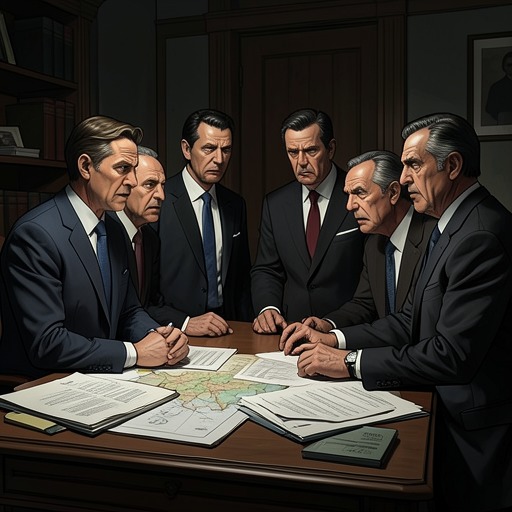
The conference minutes name Lange as the officer Heydrich called upon to report as an eyewitness after the participants discussed the practical difficulties of killing large numbers of people. In the draft minutes, Lange compares three methods: a mass shooting near Riga, the use of gas trucks at Kulmhof, and experiments with Zyklon B at Auschwitz. The draft presents the Auschwitz method as especially promising in capacity and security. His report therefore gives the conference record a concrete operational dimension: it describes methods already tested, rather than merely proposing a future policy.
The surviving draft also records Heydrich’s handwritten objection, “No!” The final version removes the detailed passage and reduces the discussion to the vague formulation that the conference considered “various types of solution possibilities.” Lange’s testimony is thus preserved in the altered papers as both evidence and an instance of its own suppression. The contrast makes the editing consequential: the record’s polished abstraction conceals the specific killing methods the draft had named.
The Wider Machinery
The evidence surrounding Lange’s report extends beyond the conference room. Martin Luther’s notes describe a camp installation with a railway siding, guarded enclosures, and a large deportee column directed away from those assigned to labor. The account records the organization of the site and its processing of people transported there, while a separate administrative circular orders that prisoners’ hair be collected, sorted, disinfected, and reported monthly for industrial use. These materials do not establish further actions by Lange himself; together, however, they show the wider system of transport, killing, and exploitation against which his conference testimony must be read.
Narrative Significance
Lange’s importance in the novel lies less in an individually developed life story than in the documentary traces attached to his office and testimony. His reported death in 1955 makes him unavailable to question, while the Wannsee draft preserves what the final minutes erase. Against the maxim that one should not ask a question without knowing the answer, March’s investigation turns on reading beyond the safe, official wording. Lange’s account helps expose how the regime’s language of administrative procedure and “solution possibilities” could conceal actions that the records, when compared, make legible.