Friedrich Kritzinger
FatherlandFriedrich Kritzinger is a former Ministerialdirektor of the Reich Chancellery whose importance to the investigation lies in the documentary trail connecting him to the Wannsee Conference and the extermination camps. A name March recognizes from news reports becomes a key to the case: Kritzinger had received information about the camps, and his death helps explain why the conference’s participants are disappearing. The records do not make him the investigation’s narrator or a fully developed onstage character; instead, they make him legible through documents, dates, and the pattern of deaths around him.
Identity and place in the record
Kritzinger is identified as a former Ministerialdirektor from the Reich Chancellery. When March encounters his name among fresh case files, he recalls the news coverage of the wrecked car outside Kritzinger’s home in Munich and the widow supported by her sons. The bombing had taken place on March 7, just over a month before March examines the file; no terrorist group had claimed responsibility. The public report supplies a conspicuous death, but not its explanation.
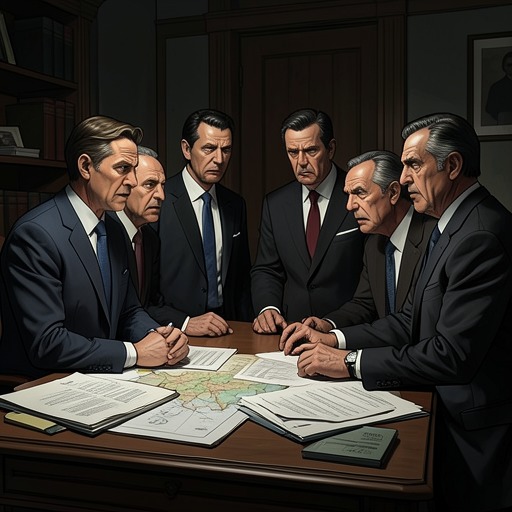
The novel’s reconstruction ties Kritzinger to the January 20, 1942, conference at the Wannsee villa, where officials discussed the “final solution of the Jewish question.” March’s review of the minutes exposes the murderous program behind their bureaucratic language: the document names more than thirty European nationalities and estimates that around eleven million Jews were included. Kritzinger’s significance therefore extends beyond his office or his death. His name belongs to the administrative circle whose conference records reveal the scale and intended operation of the genocide.
The documentary trail
A handwritten note dated July 18, 1943, is addressed to Kritzinger and introduces a list of camp locations. March later connects this correspondence to a specific sequence in the records: Martin Luther visited Auschwitz on July 15; two days later, Josef Buhler forwarded the map locations of six camps to Kritzinger; and on August 9, the last deposit was made in Switzerland. The dates also match Buhler’s pocket diary. March concludes that Kritzinger is the fourth man in the group whose name keeps recurring in the evidence, and that this part of the mystery has been solved.
The documents surrounding Kritzinger make the distance between administrative knowledge and physical implementation difficult to preserve. The conference minutes, in their surviving form, conceal the practical methods of killing behind phrases such as bringing Jews “to the East” for labor. In rough photostats of the draft minutes, March finds a deleted account of methods discussed at the conference: shootings near Riga, gas trucks at Kulmhof, and experiments using Zyklon B at Auschwitz. Reinhard Heydrich crossed out the passage and the final minutes reduced the discussion to a brief euphemism. The surviving drafts and Kritzinger’s place in the correspondence let March reconstruct what the polished record had suppressed.
A further document shows the same system operating in detail. Martin Luther’s notes describe a transport arriving at Auschwitz, the separation of deportees, the route to a room presented as a bathing facility, and the killing and disposal process that followed. In the camp’s property store, a memorandum records the collection and intended industrial use of prisoners’ hair, with separate monthly reporting required for female and male hair. These records are not presented as Kritzinger’s own testimony, but they illuminate the machinery of extermination that the camp-location list helped place on the map and that the conference documents obscured.
Deaths and the witness pattern
When March tallies the conference participants, the scale of the pattern becomes unmistakable: of fourteen men invited by Heydrich, thirteen are dead and Luther is missing. Some deaths had been publicly reported as natural causes; others had been recorded as accidents, suicides, or killings. Kritzinger’s death is especially conspicuous because he was blown up outside his Munich home, and no terrorist organization claimed the bombing.
March later explains the pattern to Krebs by arranging the deaths in sequence. The first participant died in 1954, followed by others in 1955 and then at intervals in 1957, 1959, 1960, 1961, and 1962. An apparent attempt to kill Luther in 1963 may have prompted him to hire guards. The pace then quickened: Gerhard Klopfer died in May, Otto Hoffmann was found dead in December, and Kritzinger was killed by a car bomb in March 1964. March treats Kritzinger as the trigger in the latest acceleration—a death that frightened Buhler and made the threat to the remaining men harder to dismiss as coincidence.
The pocket diary supplies a telling mark in this sequence. Buhler placed a cross beside the date of Kritzinger’s death. After a stretch in which nothing happened, he marked another cross for April 9, when Karl Schöngarth died beneath a subway train at Zoo Station. March reads those marks as evidence of Buhler’s growing alarm: Kritzinger’s killing had altered how the survivors understood the danger, and Schöngarth’s death confirmed that the danger had reached them.
Complicity, evidence, and historical memory
The novel’s central question is not only what happened at the camps, but whether surviving proof can be made visible and believed. A quotation from The Drowned and the Saved describes an SS officer’s prediction that witnesses would be killed, evidence destroyed, and survivors dismissed as unbelievable. The account resonates with the pattern March traces around the Wannsee participants: the men who knew what the conference authorized are dying, while official records and public explanations obscure the crime.
Against that effort at erasure, the evidence is stubbornly material and administrative: a handwritten note to Kritzinger, a dated camp-location list, amended conference minutes, diary marks, and the surviving records of camp operations. The contrast is central to Kritzinger’s narrative function. His death may have been made to look like one more unexplained act of terrorism, but the dates and documents place it within a larger sequence that March can test and explain. Even at the end of his investigation, when March finds scorched brick fragments at the Globus site, the significance rests on material existence: the fragments are small, but they are physical traces where official denial would prefer an absence.
The novel’s closing historical note distinguishes its fictional pattern of deaths from the participants’ recorded historical fates. It states that Kritzinger died at liberty after a severe illness, rather than in the 1964 car bombing described in the novel. That distinction frames his fictional death as part of the thriller’s invented witness-elimination plot, while preserving the larger historical point that the Wannsee Conference and key documents quoted in the narrative were real. The character’s importance lies in this intersection of record and invention: Kritzinger’s name helps March connect the conference, the camp locations, and the deaths, while the final note makes clear where the novel’s alternate history diverges from the historical record.