Hermann Jost
FatherlandHermann Jost is an eighteen-year-old SS cadet whose report of a body in the lake brings him into Xavier March’s investigation. His account begins as a seemingly straightforward witness statement: a solitary training run, a corpse near the shore, a call to the police. But a discrepancy in his timing makes him a suspect in March’s eyes, while his later identification of Odilo Globocnik gives his anxious, isolated presence a sharper significance. Jost is a minor figure, yet the investigation repeatedly turns on what he has seen, withheld, and finally said.
Identity and Background
Jost is introduced as a young man in a tracksuit, his light-brown hair cropped close enough for his scalp to show through the dust. He appears no older than eighteen and avoids looking at the body he has found. He gives his rank as SS-Schütze and identifies himself as a cadet of the Sepp Dietrich Academy, the training institution at Schlachtensee. His Saxon accent and nervous, eager-to-please manner register alongside his youth; the uniform places him inside the regime’s military order, but his awkwardness distinguishes him from the authority that order projects.
His written statement supplies a fuller name and biography: Hermann Friedrich Jost, born in Dresden on February 23, 1945, and now a cadet at the Berlin academy. It also presents him as a creature of routine. He says that he prefers to run alone and describes his usual route west through the Grunewald Forest to the Havel, then north along the lakeshore to the Lindwerder Restaurant before turning south toward the barracks at Schlachtensee. The exactness of this route makes the later uncertainty in his account measurable.
The Body and the Missing Time
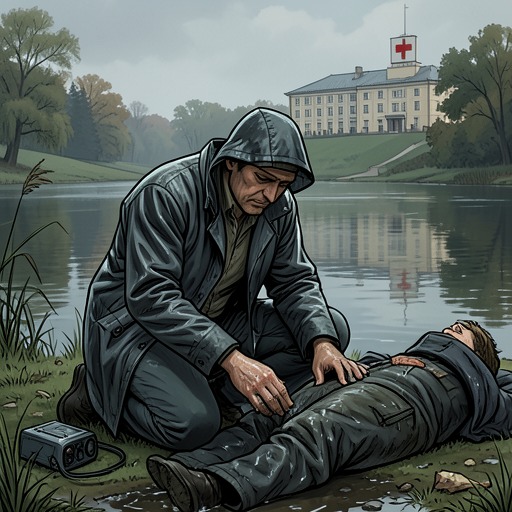
On the morning of the discovery, Jost says, he left the barracks at 5:30 for his regular run. Three hundred meters north of the Schwanenwerder causeway, he saw what at first he mistook for an object in the water at the lake’s edge; it was a man’s body. He ran half a kilometer along the path to a telephone, notified the police, returned to the body, and waited for the authorities. His statement emphasizes that it was raining hard and that he saw nobody. In March’s first encounter with him, Jost adds that it was still dark and that he initially thought the body was a swan.
March does not accept the account as complete. Jost says he called the police at five past six, but the lake was three kilometers from the barracks. Given the distance, the hard rain, and Jost’s daily running, March calculates that he must have reached the lake well before six. Roughly twenty minutes out of the thirty-five between Jost’s departure and his call remain unaccounted for. When Jost asks whether he is free to leave, March first says yes, then stops him at the door and directly confronts him about the discrepancy. The interrogation changes the meaning of the statement: a precise route and a precise call time do not establish what Jost did during the missing interval.
The evidence provided does not disclose what happened in those minutes or establish why Jost’s statement omits them. March identifies the gap and demands an explanation, but the scene ends with the question still open. Jost’s role therefore rests on an unresolved distinction between the information he gives and the information he withholds; neither a motive nor a fuller account is supplied here.
Isolation at the Academy
Jost reappears in a classroom of SS cadets during an exchange about obedience. Asked why they obey, the class answers in terms of inner conviction, belief in Germany, the Führer, the Movement and the SS, and loyalty. After the instructor approves the response and dismisses the others, he orders Jost to stay behind. Jost remains standing at attention alone in the middle of the room as his classmates file out beneath a portrait of the late Heinrich Himmler.
The other cadets’ looks mark him as an outsider: they seem to regard him as the queer, the loner, the one who is always out of step. The narration notes that he might be due another beating in the barracks that night. This detail makes his solitude more than a momentary posture. Within an institution that teaches collective loyalty, Jost is presented as socially exposed, watched by peers and singled out by an instructor. The scene does not explain the source of his estrangement, but it establishes the vulnerability against which his later response should be read.
Identification of Globus
In a subsequent confrontation, Jost resists identifying the face put to him. Pressed to say whose face he sees and told that he knows, he finally shouts, “Globus!” The outburst supplies a concrete identification that matters to March’s investigation: Jost recognizes Odilo Globocnik. His response is emphatic, but the available scene does not specify the circumstances in which he saw Globocnik or explain how that recognition bears on the body’s discovery.
The name also links Jost’s small, uneasy role to a wider structure of power. Earlier, he is a witness whose chronology fails to satisfy March; later, he is a cadet isolated by his own institution and a man who can identify a powerful figure. These facts do not resolve his earlier silence, but they prevent his statement from being treated as the whole of what he knows.
Narrative Role
Jost’s importance lies in the tension between official procedure and incomplete testimony. His written account is formally composed, signed in the presence of Kripo investigator Xavier March, and anchored in exact places and times. March’s arithmetic nevertheless exposes what the document leaves out. The contrast gives the witness statement a double function: it records what Jost is willing to put on paper while providing the details needed to test its omissions.
The character is drawn through a small number of strongly defined circumstances rather than an extended personal history: a cropped head bent away from a corpse, a solitary run in the rain, an unexplained interval, a lone cadet left after class, and the shouted name Globus. Together, these details make Jost neither a settled explanation of the crime nor a mere background witness. He is an uncertain point of access to the investigation, whose vulnerability and fragments of knowledge matter precisely because March cannot take his first account at face value.