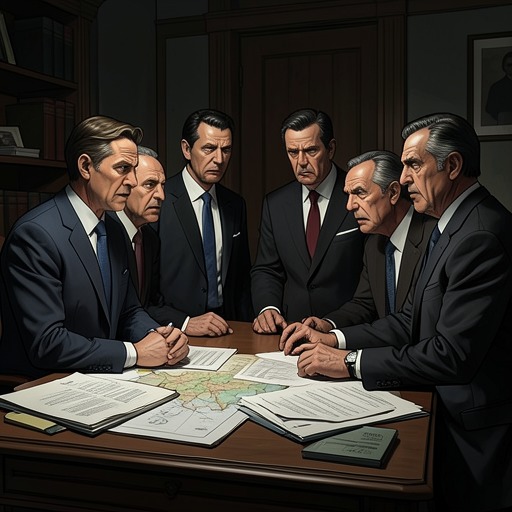
Roland Freisler
FatherlandRoland Freisler is named among the participants in the Wannsee Conference and later among those killed before the war’s end. Though the evidence gives him no individual dialogue or developed personal arc, his appearance connects the conference’s administrative machinery of genocide to the later fates of its participants.
Identity and Conference Role
The conference minutes identify Roland Freisler as one of those who attended the meeting on January 20, 1942, at Am Großen Wannsee 56–58 in Berlin. The minutes describe a policy affecting approximately eleven million Jews across Europe, presenting deportation and forced labor in bureaucratic language. Freisler’s inclusion places him among the officials associated with that coordinated undertaking, although the cited record does not specify his individual contribution or words at the meeting.
The documents examined in the novel expose a gap between official phrasing and operational reality. A fuller draft records discussion of mass shooting and killing methods, including testimony about gas vans at Kulmhof and Zyklon B experiments at Auschwitz; the final minutes reduce that discussion to a single phrase. The evidence does not attribute the editing or any particular decision to Freisler, but his attendance locates him within the conference whose surviving paperwork both records policy and obscures its means.
The Conference’s Documentary Record
The conference minutes name the participants as a group, while the narrative places that record alongside evidence of the system’s implementation. At Auschwitz, the account describes a transport arriving at a railway siding, nearly two thousand deportees being divided, and a camp installation where people were killed and their belongings and hair collected. A later circular ordered the use of hair cut from concentration-camp prisoners for industrial felt and thread, with monthly reports required. These records show the administrative reach of the machinery associated with the conference; they do not establish that Freisler personally directed any of the actions described.
Death and Historical Aftermath
The novel’s concluding account states that Freisler was killed in an air raid in 1945. It offers no further circumstances of his death. His fate is listed alongside those of other conference participants: some died, some were tried or imprisoned, and others survived the war. The brief entry therefore fixes Freisler’s endpoint without supplying a personal reckoning or a fuller biography.
Narrative Significance
Freisler’s role in the novel is documentary rather than dramatic. He appears first as a name in the record of a meeting concerned with Europe’s Jews, then as one of the participants whose later fate is reported. That framing makes the list itself consequential: it links an official gathering to a historical aftermath while keeping the limits of the evidence visible. Freisler is confirmed as an attendee and as a victim of the 1945 air raid; the text does not support further claims about his motives, conduct, or personal response to the crimes documented elsewhere.