August Eisler
FatherlandAugust Eisler, an SS surgeon and Kripo pathologist, embodies the danger of expertise detached from responsibility. In the investigation of a body recovered from a lake, he offers a competent medical assessment; in an earlier case, his judgment helps destroy an innocent man’s alibi, and March later learns that Eisler’s own record includes participation in lethal experiments on prisoners. The contrast makes Eisler more than a brusque forensic specialist: his professional authority is inseparable from the criminal system that produced it.
Identity and Professional Role
Eisler serves in Kriminalpolizei Department VD2, the pathology division, and is identified as both a Kripo pathologist and an SS surgeon. His manner is marked by affronted dignity and irritation. When Xavier March approaches his car at a lakeside investigation, Eisler objects to March’s barrack-room humor; at the scene, he keeps apart from the others beneath an old black umbrella rather than share it. These details establish a colleague who maintains distance even while participating in the work of the investigation.
That distance does not make him a marginal figure. Eisler is called upon to interpret physical evidence and estimate time of death, judgments that can shape a criminal case. His status gives his conclusions institutional weight: in March’s recollection of another inquiry, Eisler’s estimate prevails over the detective’s, with consequences for the accused.
Forensic Work and March’s Cases
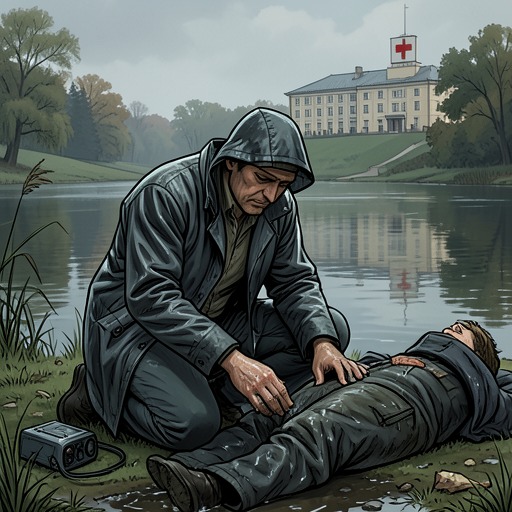
At the lakeside, Eisler examines the corpse’s lower leg, which ends below the calf. March asks whether a propeller caused the damage, but Eisler identifies it as an old amputation, and remarks that it was well done. He then presses the chest to assess the body and estimates that death occurred about twelve hours earlier, perhaps less. The exchange shows him working through a concrete forensic question rather than endorsing March’s initial possibility.
Later that night, March goes to the Berlin city morgue, where Eisler has already gone home. When March returns in the investigation of Josef Bühler’s death, however, Eisler is at work in the basement. He has opened Bühler’s chest and is examining the stomach; his assistant produces a small amount of lettuce in a transparent bag. Eisler explains that lettuce digests slowly and can remain in the intestinal tract for hours. The detail belongs to his ordinary evidentiary practice: he treats what a victim ate as a possible aid to determining the sequence of events.
His work is not presented as a guarantee of justice. March recalls an earlier winter case involving a bargemaster named Kempf, who died after being pulled from the Spree. The question was whether Kempf’s death was accidental or murder, and the time he could have survived in the cold water mattered to the second mate’s alibi. March estimated that the ice made fifteen minutes the maximum; Eisler gave an estimate of forty-five minutes. The prosecutor accepted Eisler’s view, which destroyed the second mate’s alibi and led to his execution. The episode shows the power of Eisler’s expertise—and the irreversible consequence of a disputed conclusion.
Dachau and the Limits of Official Expertise
After the Kempf case, the prosecutor privately showed March documents marked Geheime Reichssache—Top Secret State Document and dated Dachau, 1942. They described freezing experiments on condemned prisoners, conducted within the SS surgeon general’s department. Prisoners were handcuffed and placed in icy water, then removed at intervals for temperature measurements until they died; photographs and charts recorded the experiments. The records named a young Untersturmführer, August Eisler, among those who conducted them over a two-year period.
The discovery recasts the earlier dispute. Eisler’s assessment was not merely one expert opinion among others: the documents connected his medical knowledge to experiments that inflicted lethal harm on prisoners. March and the prosecutor responded by getting drunk together, but neither spoke of the matter the following day, and they never spoke to each other again. Their silence leaves the evidence intact while showing how little room the police institution afforded for confronting what it revealed.
The episode also sharpens the irony of Eisler’s authority. In the morgue he reads bodily traces for clues; at Dachau, according to the documents, medical observation served an experimental program whose subjects were condemned prisoners. The same professional capacity can appear as investigative method in one setting and an instrument of state violence in another. The novel does not suggest that this history cancels the practical value of every examination; it shows instead why technical competence cannot, by itself, establish moral credibility.
Connections to the Investigation and the Novel’s Larger Stakes
Eisler’s direct connection to March is professional, but the knowledge March acquires about him becomes part of the detective’s larger reckoning with state violence. Their relationship is shaped less by open confrontation than by what March knows and what the system leaves unsaid. Eisler is absent when March first visits the morgue, yet present again in the examination of Bühler’s body; the recurring setting links routine police procedure to the history of crimes that the same regime has concealed.
The novel’s wider investigation reveals that the fourteen men who attended the conference convened by Reinhard Heydrich are dead or missing: thirteen are dead, and Martin Luther is missing. In that atmosphere, a notice warning police not to open a parcel without knowing its contents becomes a maxim against asking questions without knowing the answer. Eisler’s history supplies a human counterpart to that atmosphere of managed knowledge. The danger is not only that evidence may be destroyed, but that official expertise and procedure can help determine which accounts are accepted and which consequences follow.
Eisler’s role remains bounded by the scenes and documents that identify him; the evidence does not describe a confession, punishment, or final fate for him. His significance lies in the contrast the novel establishes between forensic authority and ethical responsibility. The body may yield evidence, but the standing of the person interpreting it cannot be separated from the uses to which his knowledge has already been put.