Odilo Globocnik
FatherlandOdilo Globocnik, known within the SS as Globus, is the senior SS figure who makes the investigation into Josef Bühler’s and Wilhelm Stuckart’s deaths a contest over who controls the evidence. A former Gauleiter of Vienna and an SS general with personal access to the investigation, he is both an instrument of the regime’s secrecy and the embodiment of its threat: he directs the search for Martin Luther, obstructs public disclosure, and tells Xavier March that the witness he needs is gone. His repeated assertion that the sites of mass killing have left no trace expresses the novel’s central conflict between historical truth and state-enforced forgetting.
Identity and Authority
Globocnik first appears not in person but as a recognizable passenger in a speeding convoy: March glimpses an old man beside a young woman in the black limousine, and a sentry explains that Reich Minister Goebbels has been screen-testing while his wife is away. The appearance links Globocnik to the privileged, public-facing world of the Party leadership before the investigation reveals the coercive power behind it.
The novel identifies him as a former Gauleiter of Vienna, familiarly known throughout the SS as Globus. He holds the rank of Obergruppenführer, and his presence at Bühler’s estate alongside two Sturmbannführer signals that the matter has attracted unusually high-level attention. Later, at the same scene, he is standing with his back to the room while Artur Nebe sits at the piano. The contrast places Globocnik among the officials who have arrived to contain the case, rather than among the detectives trying to establish what happened.
Taking Control of the Investigation
The transfer of authority begins when two Gestapo colleagues tell March that, because Bühler held a prominent Party position, the case has been redesignated a security matter. They require the files and status reports, and order the Kripo investigation closed immediately. The order is not presented as routine cooperation: it strips March’s team of jurisdiction at the very moment its inquiry might expose powerful people.
At Bühler’s estate, Globocnik’s methods make the threat concrete. Three SS men enter the grounds; one shoots the wounded dog and another removes its body. March recognizes Globocnik among the officers and understands that the men have been there before. When Hermann Jost, under questioning, finally identifies Globocnik as the face he saw, his recognition connects the SS general to the events under investigation and makes Jost’s testimony dangerous.
In a later meeting, Globocnik says the authorities had known about Bühler’s activities in the General Government and his associates, but that Bühler discovered they were investigating him the previous week. He also describes Stuckart as implicated in the same affair. These remarks establish that the deaths are not being treated as isolated mysteries: Globocnik frames them as a problem the leadership already knew about and is now managing.
Martin Luther and the Suppression of Publicity
Globocnik calls Martin Luther the key to the mystery and argues that finding him will explain the case. When Nebe proposes using the press and television to circulate Luther’s picture, Globocnik refuses. He says Heinrich Himmler has expressly forbidden publicity and warns that a scandal involving Party leaders would be especially damaging with John F. Kennedy expected. Instead, he proposes a confidential alert to Ordnungspolizei patrols and surveillance of railway stations, ports, airports, and border crossings, assigning the work to Krebs.
The distinction is revealing: Globocnik wants the search to be extensive but invisible. The aim is not to invite witnesses or public scrutiny, but to find Luther without alerting the media or foreign observers. His handling of the case therefore extends beyond obstruction of March’s investigation; it is an effort to control what the public can know about the leadership’s involvement.
March, the Missing Witness, and the Erased Record
The confrontation with March distills Globocnik’s power into a brief, calculated gesture. He hands March his pistol and tells him, “You have no witness. Not anymore.” The message follows the killing of the dog and the disappearance of the witness March hoped to rely on. Globocnik does not need to explain the machinery behind the threat: the loss of testimony is itself the argument. March runs from the estate.
Later, Globocnik turns up in Krakau, where he had arrived two weeks earlier on a Gestapo jet with special authorization from Reinhard Heydrich, personally signed. He had caused an uproar, knew exactly which file he wanted, and left by lunchtime. The episode gives the search for the missing record a specific route and chain of authority: Globocnik’s intervention in Krakau was sanctioned from the top and directed at a file, not merely at a person.
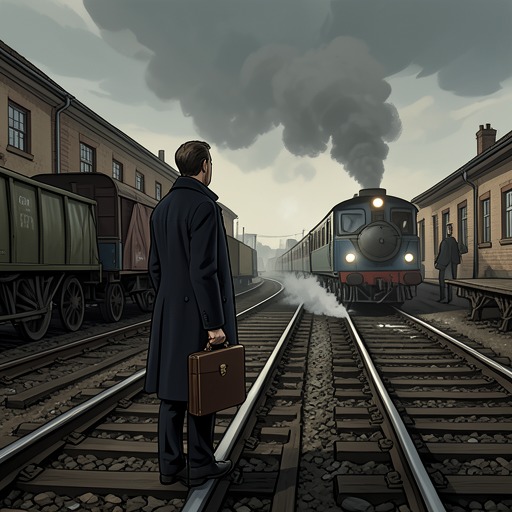
At a railway yard, Globocnik meets March’s arrival with mocking applause, welcoming the Kriminalpolizei’s theories as a train and the remains of a body stand at the center of the scene. Later, when March names Majdanek, Sobibor, and Auschwitz-Birkenau, Globocnik replies that they are only names, that nothing remains, not even a brick, and that nobody will believe what March has found. He dismisses the sites as empty names and tries to turn the absence of surviving physical evidence into a denial of the crimes. March later remembers the taunt as his worst moment because part of him, too, could not believe it.
Complicity and Ending
Globocnik’s role is not that of an independent operator. A participant in the investigation acknowledges knowing that Globocnik killed Bühler and Stuckart, but says Globocnik acted on Heydrich’s orders and that no one could object once Heydrich had decided to let him act to spare the Party a public scandal. The explanation makes the hierarchy plain without absolving those who serve it: orders provide the cover, while silence preserves the institution.
The novel’s closing historical account says that Globocnik was captured by a British patrol at Weissensee, Carinthia, on May 31, 1945, and committed suicide by swallowing a cyanide capsule. That ending stands in sharp contrast to the confident denial he directs at March. In the investigation, he tries to make the destruction of evidence mean that the past cannot be known; in the historical coda, his own fate is recorded, fixing the man who sought to erase testimony within a record that outlasts his threats.