Josef Buhler
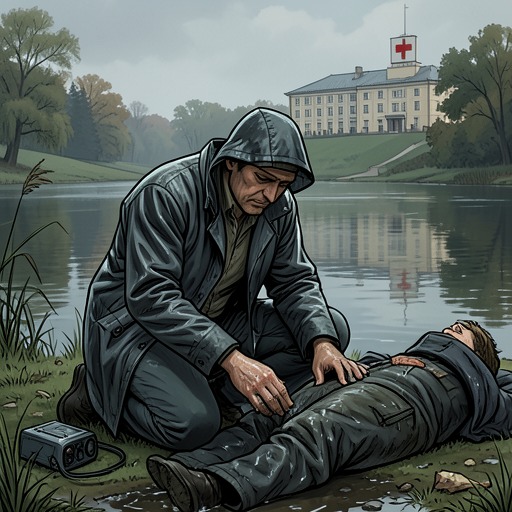
FatherlandJosef Buhler is a senior Nazi official whose body, recovered from the Havel, opens Xavier March’s investigation into a death made to look like suicide. The respectable lawyer and state secretary was also part of a lucrative wartime scheme with Wilhelm Stuckart and Martin Luther, trafficking looted art from occupied Poland. His sparse diary, a storm-darkened jetty, and injuries overlooked in the initial account turn the apparent drowning into evidence of a larger effort to conceal the past.
Identity and Public Standing
Buhler’s bureaucratic record gives him every mark of establishment respectability. He joined the Party in 1922, worked as a lawyer with Hans Frank, and became deputy president of the Academy of German Law. A file identifies him as a Party member with the honorary rank of SS-Brigadeführer and records his service as state secretary in the General Government from 1939 to 1951. March sees in the recovered body a face both prim and forgettable: the lawyer’s face of a “machine man,” indistinct in memory despite its sharp features.
The identification itself is forensic and administrative. After the body was recovered from the Havel, no missing man matched its description, so fingerprints were checked against records. They established that the dead man was Doctor Josef Buhler. The preliminary assessment placed his death on the night of April 13 and attributed it to drowning. Buhler had lived on Schwanenwerder, close to where the body was found.
His past also reaches back to the early Nazi movement. A records search matched him to a single arrest, made by police in Munich on November 9, 1923—the date of the Beer Hall Putsch. The match, drawn from an arrest forty years earlier, gives the investigation an unexpectedly long historical perspective: Buhler’s career was rooted not merely in the later machinery of government, but in the movement’s founding violence.
Diary and the Investigation
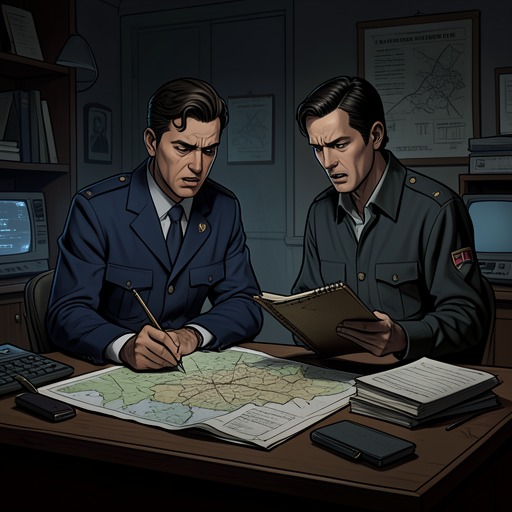
Buhler’s diary is so sparse that March initially thinks it may be blank. Its entries rarely fill more than a week or two pages, yet a handful of marks become a compact timetable. A small cross appears on March 7; April 1 is marked as his sister’s birthday; another cross appears on April 9. For April 11, Buhler records “Stuckart/Luther, 10 a.m.” On April 13, the day before his death, he draws one more cross. The diary does not explain the marks, but its meeting notation links Buhler to Stuckart and Luther shortly before the killings under investigation.
The circumstances of the death become clearer when March presents his preliminary observations. Buhler probably died between six on Monday evening and six the next morning. His lungs contained fluid, indicating that he was alive when he entered the water, and the cause was almost certainly drowning. A sentry reported no visitors arriving by land during those hours. That fact could suggest suicide, but it does not account for signs of access from the lake: March notices recently scraped woodwork on the jetty, consistent with a boat having moored there.
March reconstructs a night-time assault during a storm. The rough water, he argues, explains the damage to the jetty. The attackers would have landed in darkness, then subdued Buhler’s dog: it was later shot after being described as deranged, and March believes the animal had been alerted, clubbed senseless, and muzzled. The absence of visitors by land thus becomes part of the method rather than proof that Buhler was alone.
The murderers, in March’s account, exploited Buhler’s own strength against him. His sister said he was a strong swimmer despite his disability, and his shoulders appeared well developed. After inspecting the cleaned body in the morgue, March notes bruising on the cheeks and gums near the front of the mouth. At the house, a bottle of vodka was nearly empty. He expects the autopsy to show alcohol in Buhler’s bloodstream and proposes that the attackers forced him to drink, stripped him, took him out by boat, and threw him overboard. Drowning while alive explains the fluid in his lungs; the injuries and emptied bottle suggest coercion rather than a voluntary entry into the water.
The choice of method matters. When challenged over why the killers did not simply shoot Buhler, March concludes that they wanted the death to pass as suicide and bungled the staging. The disguise resembles the apparent suicide of Wilhelm Stuckart. March suspects Stuckart was murdered in a planned operation: two attackers inside the apartment and a third in the foyer, posing as an elevator repairman. The electric drill was intended to cover the gunshot and give the killers time to escape before the body was found. Buhler’s death therefore helps March recognize a pattern rather than an isolated crime.
Wartime Partnership and Motive
The diary’s reference to Stuckart and Luther becomes more consequential when March reconstructs their wartime business. In July 1942, Germany’s successes on the Eastern Front and the occupation of Polish territory created opportunities for officials to enrich themselves. Buhler requisitioned art treasures in the General Government and sent them, concealed in official mail, to Stuckart at the Interior Ministry. Luther, head of the German Division of the Foreign Ministry, smuggled the objects abroad for sale. Each man’s position protected the next step: few would dare interfere with mail addressed to a powerful Reich official or order Luther to open his bags.
The proceeds and status of the arrangement endured long after the wartime looting. Buhler, Stuckart, and Luther retired in the 1950s as wealthy and honored men. In March’s reconstruction, their scheme is a racket disguised by offices, procedures, and respectability: a chain that moved plunder from the General Government to foreign buyers while authority itself served as cover. The April 11 diary entry supplies a specific meeting point in that history, connecting Buhler to the other two men shortly before the events of 1964 expose the danger surrounding them.
Death and Narrative Significance
Buhler’s death is the case’s first major revelation about how the past is being protected. The official account begins with a senior Party figure found drowned near his home; March’s close attention to the body, the jetty, the dog, and the vodka turns that surface explanation into a murder reconstruction. Each detail revises the meaning of another: no land visitors does not exclude a boat, a strong swimmer could still be forced into the lake, and drowning does not establish suicide when bruising and staging point to violence.
The investigation also makes Buhler’s anonymity part of his significance. He is remembered by March as a face of bureaucratic machinery, yet the machine man’s career connects early Party history, the occupation administration, the theft of Polish art, and the present-day elimination of witnesses. His thin diary is the counter-image to his public record: a few crosses and one meeting notation, enough to suggest that the apparently orderly life of a respected official concealed both a criminal enterprise and a dangerous set of associations. After the clues are assembled, the apparent suicide can no longer be read as an isolated death; it is one piece of a coordinated effort to bury evidence.