Wilhelm Stuckart
FatherlandWilhelm Stuckart is a senior Nazi legal and administrative official whose career links racial legislation, state power, and the concealed machinery of mass murder. In the investigation led by Xavier March, Stuckart’s death initially appears to be a suicide, but the official account unravels alongside documents bearing his signature: an affidavit describing Reinhard Heydrich’s disclosure of Hitler’s intent, and evidence connecting senior officials to the January 1942 Wannsee Conference. Stuckart emerges both as a participant in the regime’s institutions and as a witness whose papers preserve what those institutions sought to hide.
Identity and Career
Stuckart was born in Wiesbaden on November 16, 1902. He studied law and economics at the universities of Munich and Frankfurt-am-Main, graduating magna cum laude in June 1928. He had joined the Nazi Party in Munich in 1922 and later held positions in both the SA and the SS. His advancement was rapid: he became mayor of Stettin in 1933 and state secretary in the Ministry of the Interior in 1935, a post he held until 1953. In 1944 he was promoted to honorary SS-Obergruppenführer; after leaving government service, he returned to private legal practice in 1953.
The portrait that March finds in a professional directory combines intellectual credentials with an image of carefully managed authority. Stuckart’s listed publication, A Commentary on the German Racial Laws, dates from 1936, and a Kripo file records his 1936 membership on the Ministry of the Interior’s Committee for the Protection of German Blood, which considered applications for marriages between Aryans and non-Aryans. The book is described as foundational to the profession by Walter Fiebes. That standing makes Stuckart more than a prominent official: his work helped give legal form to the racial categories enforced by the state.
Corruption and Public Reputation
The archival account also complicates the polished portrait of the legal authority. Shortly after Stuckart joined the committee on marriage applications, police began receiving anonymous allegations that he issued licenses in return for bribes and had sought sexual favors from women whose cases came before him. The file presents these as allegations, not as adjudicated findings, but their presence places the administrator of racial law within a record of suspected personal abuse of office.
After his death, the Berliner Tageblatt obituary described him as a dedicated servant of the National Socialist cause. March recognizes the notice from the previous night and is shaken by the discovery: the man whose death he is investigating has been publicly declared dead of heart failure on Sunday, April 13. The obituary’s calm language is an early piece of the discrepancy between official presentation and the circumstances March later uncovers.
Death and the Investigation
According to the autopsy account in the Kripo file, Stuckart’s mistress, Maria Dymarski, was found fully clothed and facedown on the bed in his apartment at Fritz-Todt-Platz. The report says Stuckart shot her first and then apparently shot himself. A note left on the dining-room table presented his action as an attempt to spare embarrassment to his family, the Reich, and Hitler. The apparent suicide was thus supplied with a politically deferential explanation, while the obituary represented his death as heart failure.
March does not accept the scene as a straightforward suicide. When Artur Nebe observes that a fabricated suicide by Josef Buhler would make a fabricated suicide in Stuckart’s case plausible, March explains his theory: three people were involved, with two inside the apartment and a third in the foyer pretending to repair the elevator. The electric drill was meant to cover the sound of the shot and give the killers time to escape before the bodies were discovered. March also considers whether the note was forged or written under duress. These remain investigative possibilities rather than established answers, but they turn Stuckart’s death into part of a wider effort to suppress the truth.
The case draws March and Max Jaeger into Stuckart’s apartment on April 16. A report by Karl Krebs states that the Gestapo had taken over the investigation into Stuckart and Buhler because it regarded the cases as linked. Krebs says he apprehended the two investigators at the apartment at 00:12 and that they agreed to go to Gestapo headquarters pending clarification. The official account therefore records not only the transfer of the case but also the moment when March’s independent inquiry becomes a matter of direct conflict with the secret police.
The Affidavit and the Wannsee Evidence
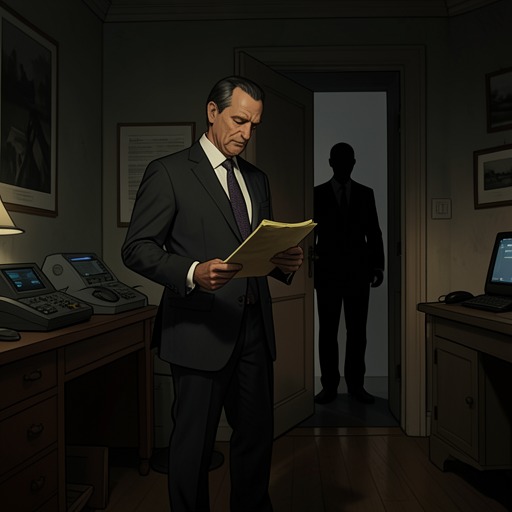
The most consequential evidence associated with Stuckart is a four-page, typewritten affidavit bearing his signature. In it, he recounts that on December 21, 1941, Interior Ministry adviser Dr. Bernhard Losener came to him in agitation after hearing that Berlin Jews recently deported east had been massacred in the Rumbuli Forest. Losener sought a transfer out of his post; Stuckart says he promised to seek clarification. The affidavit thus begins with a report moving through ministry personnel before it reaches the state secretary.
Stuckart states that the following day he went to Heydrich’s office on Prinz-Albrecht-Strasse. According to his account, Heydrich confirmed that the report was true and demanded that Stuckart identify the source of the information. Heydrich then described a conversation with Hitler at headquarters in East Prussia the previous July: Hitler had decided to resolve the so-called Jewish Question, accepted that the decision carried consequences, and believed that victory would prevent later scrutiny of how Germany had achieved it. When Stuckart proposed putting the order in writing for legal reasons, Heydrich said that political considerations made this impossible and told him to raise reservations with Hitler personally. Stuckart’s affidavit records that the regime’s chief policeman invoked the authority of the regime’s chief legal draftsman while dismissing the need for a written order.
The document is dated June 4, 1942, in Berlin, signed by Stuckart as an attorney, and witnessed by Josef Buhler, also an attorney. Its evidentiary force lies partly in that formal construction: it presents itself as a sworn record based on notes Stuckart says he made on the evening of the conversation, while also preserving an account of a decision deliberately kept off the written record. The novel sets this testimony beside the bureaucratic correspondence March later finds, revealing how the absence of a formal order can itself be part of the method by which responsibility is concealed.
One key document is Heydrich’s invitation, dated November 19, 1941, to an interagency discussion originally planned for December 9 and later postponed to January 20, 1942, at Wannsee. The letter cites Hermann Göring’s July 31, 1941 authorization to prepare organizational, technical, and material measures for a complete solution of the Jewish question in Europe. It also states that Jews had been transported east from Reich territory, including the Protectorate, since October 10. When March and Rudi Halder locate a notice that the January 20 minutes were removed at Heydrich’s request, the date on the notice is April 6, 1964—eleven days before the discovery. The file trail links the old meeting to a current effort to remove its record.
The surviving conference minutes identify Stuckart and Buhler among the participants. They describe a plan affecting about eleven million Jews across more than thirty European nationalities, using language of direction, labor, and “natural reduction” to obscure the intended outcome. Draft minutes preserve details that the final version suppresses: discussions of shooting, gas trucks at Kulmhof, and experiments with Zyklon B at Auschwitz. In the draft, Heydrich rejects a passage about those methods; in the final minutes, that material is reduced to a brief phrase. The contrast makes the record’s revisions as significant as its surviving text. Stuckart’s documented place among the participants connects his legal and administrative career to the meeting at which mass murder was organized in bureaucratic language.
Narrative Role and Significance
Stuckart is reconstructed primarily through documents, institutional records, and the competing accounts of his death. His career history, professional publication, obituary, police file, affidavit, and place in the Wannsee minutes do not form a neutral archive: each has a purpose, an author, and a degree of omission. March’s investigation reads across them, comparing a public notice of natural death with autopsy evidence, a claimed suicide with signs of a staged killing, and official meeting records with drafts marked by Heydrich’s corrections.
That documentary structure gives Stuckart a double significance. He is an architect and administrator of racial law, a senior official whose signature and office connect state policy to human consequences; he is also a source of evidence about the regime’s unrecorded decisions. The novel does not resolve every uncertainty around his death or establish that his affidavit exhausts what he knew. Instead, his papers expose the central contradiction of the case: a government that depends on meticulous procedure can also remove minutes, suppress an order, and make the record’s gaps serve power. Stuckart’s surviving testimony matters because it gives March a route from a suspicious death to the concealed history the state is trying to erase.