Charlotte Maguire
FatherlandCharlotte Maguire, known as Charlie, is a 25-year-old American journalist and Berlin representative of World European Features. Initially identified in the investigation of Wilhelm Stuckart’s murder as the American woman who found the bodies, she proves to be more than a witness: her own reporting methods, concealed recording equipment, and willingness to work with Xavier March make her an important ally in an investigation whose evidence is vulnerable to interception and suppression.
Identity and Introduction
The police file identifies Maguire as a 25-year-old representative of the American news agency World European Features. She is the only witness to the discovery of the bodies other than the porter at Stuckart’s apartment building. She tells the authorities she saw two men on the stairs just before the bodies were discovered, while the porter denies that anyone was there. The conflicting accounts make her both a potentially valuable witness and a person whose testimony can be challenged.
When March seeks her out, he finds her in a bar among a group of English-speaking journalists. She is the only woman at the table, laughing with the other reporters and ruffling the hair of an older man. The group’s ease breaks when they notice March approach in uniform. The scene introduces a public and professionally connected Charlotte, whose position is not reducible to the dismissive description of her in police gossip.
The Witness and the Investigation
Maguire’s account places her at Stuckart’s building at noon. She says the porter directed her to the fourth floor, but she could not take the elevator because it was being repaired, so she went up the stairs. That circumstance matters to the investigation: she had access to the route on which she says she saw the two men, while the porter’s contrary statement leaves March with an unresolved discrepancy rather than corroboration.
At the bar, Henry Nightingale, the second secretary at the United States Embassy, steps in when March asks to speak privately with her. He says she has already told the police all she intends to tell them. Maguire nonetheless invites March to join the journalists, introducing Howard Thompson of The New York Times, Bruce Fallon of United Press, Peter Kent of CBS, Arthur Haines of Reuters, and Nightingale. Her ironic toast to the idea that the Americans and the SS are now friends frames the encounter as a collision between March’s police authority and a group of American reporters conscious of the new political circumstances.
The investigation also exposes the risks she faces. March realizes that his own inquiries have left a trail to Stuckart’s apartment and worries that the Gestapo may detain Maguire for questioning. He imagines how officials could press her about an envelope and the man who opened a safe. This is March’s fear, not a confirmed account of what happens to her, but it establishes her vulnerability within the machinery of the investigation and helps explain why their cooperation carries danger.
From Witness to Collaborator
Maguire’s connection to Stuckart is more complicated than her initial account suggests. She eventually tells March that her parents knew Stuckart before the war and that she visited him before Christmas, but clarifies that she did not initiate the later contact: Stuckart called her on Saturday night. The disclosure revises the apparent direction of the relationship. She is not simply a journalist who happened upon the case; the murdered man had sought her out.
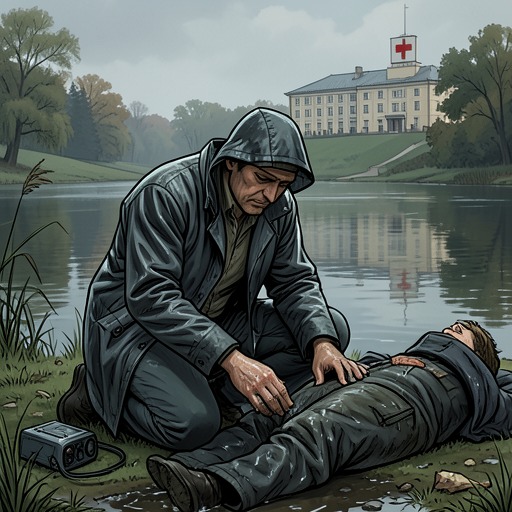
Her practical courage is made explicit after March is attacked. He finds himself in the kitchen while she cleans a cut on the back of his head. Asked where she learned to fight, she answers that growing up as the only girl in a family with three brothers taught her to do so. The scene reverses the conventional rescue pattern March invokes: she is the person caring for him, and her competence is grounded in her own account of her upbringing rather than in a rescue by a male companion.
Maguire also acts independently as a reporter. She demonstrates a portable American tape recorder concealed beneath her coat, with a cable running down her sleeve to a small suction cup attached to a telephone receiver. She explains that she carried the apparatus across the street and used it to record a call because she needed proof. Nightingale advises March to listen rather than dwell on how she made the recording. Her choice is an act of evidence-gathering, but it also exposes her to the risks of obtaining and retaining material that powerful people may want suppressed.
Evidence, Trust, and Consequences
The book repeatedly connects Maguire’s work with vulnerable physical records. At Stuckart’s apartment, March notices mail collected over several days and neatly opened, then spots chocolates wrapped like those connected with Josef Buhler and postmarked from Zürich. Maguire is holding a paper knife when March sees the opened correspondence. This detail places her near material that may connect separate deaths and clues, while also showing how easily evidence can be disturbed or compromised during an investigation.
The wider inquiry makes the danger of documentary evidence plain. In 1934, a Gestapo agent sent to Switzerland by Reinhard Heydrich sought German account holders through deception and contacts among bank employees. The resulting pressure led Swiss authorities to adopt a banking code that made disclosure of clients’ holdings punishable by imprisonment; the German numbered-account business later collapsed. In the present investigation, the same broader struggle over secrecy and proof recurs through Maguire’s recording, the papers March retrieves from the Reichsarchiv, and a sheet relayed from wiretappers in Charlottenburg. She is not the author of every piece of evidence, but her recording makes her part of a story in which information must be captured, preserved, and carried across barriers of power.
At the Zürich stock exchange, March and Maguire walk close together without holding hands, followed by two men in fawn raincoats. The market display registers the effect of détente on German shares, with most listed prices rising while Krupp falls; the crowd attributes the halted slide to Joe Kennedy. The scene places their personal movement within a public climate of financial anxiety and political change, while the men following them suggest that their investigation has not become safe merely because they have crossed a border.
Narrative Role and Significance
Maguire’s trajectory is a movement from being described by others to acting as a maker of evidence. The file identifies her, the porter disputes her account, and Nightingale initially speaks for her in the bar; but she later supplies information on her own terms, discloses that Stuckart contacted her, helps March after his attack, and presents a recording she devised and operated herself. The contrast matters: she is not only a witness to events but a journalist who decides how to obtain and use proof.
Her story also links personal risk to the material forms through which truth survives. A repaired elevator shapes her route up the apartment stairs; opened mail and a paper knife mark the handling of clues; a hidden recorder turns a telephone call into a portable record; photocopies from the archive preserve documents despite the fear of the historian who made them; and a wiretapping report arrives on flimsy paper. Maguire’s own contribution belongs to this fragile chain. The evidence establishes her collaboration and resourcefulness, while leaving the full outcome of her involvement unstated in these scenes.